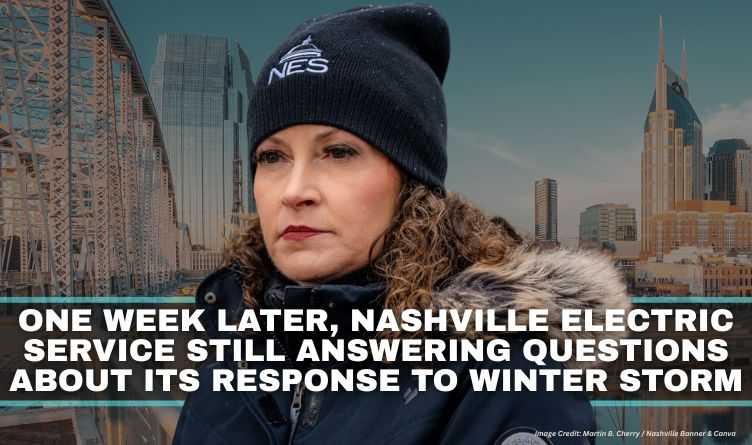
Image: Teresa Broyles-Aplin, Nashville Electric Service CEO, speaks during a press conference last Friday. Image Credit: Martin B. Cherry / Nashville Banner & Canva
***Note from The Tennessee Conservative – this article posted here for informational purposes only.
This story was originally published by the Nashville Banner. Sign up for their newsletter.
by Steven Hale, [The Nashville Banner, Creative Commons] –
As the remnants of a historic winter storm slowly melted on Monday, tens of thousands of Nashville residents remained without power. Many more have only just gotten light and heat back after going days without it — evacuating to hotels, sheltering with friends and family or else huddling in their homes and watching the temperature drop. Five weather-related deaths have been announced, with Metro officials bracing for more to be discovered.
As the dire facts, figures and anecdotes have accumulated, the same question has dominated exasperated conversations around the city: how did the Nashville Electric Service mess this up so badly?

Mayor Freddie O’Connell’s frustration with the utility has become increasingly clear in recent days, as he called NES’ estimated timeline for power restoration “unacceptable” and later said he’d learned that “NES is unequipped to communicate about a crisis.”
On Monday, the mayor issued an executive order creating “a Commission to Review Preparation and Response” to the storm, which will “have the ability to hold hearings and request the assistance of the Metropolitan Auditor.” O’Connell said he has asked for initial findings within six months.
Asked Monday whether he believed anyone at NES should resign over their response to the storm, O’Connell said that would ultimately be a question for the NES board and management, reiterating that Metro will be doing various “after-action” reviews of its own.
“I think in the middle of the crisis we’re focused on getting power restored and when we get there we’ll start to ask a lot more questions,” he said.
Metro Council members who spoke to the Banner agreed with the mayor’s initial verdict that NES utterly failed to communicate clearly and effectively with both city officials and residents during the largest crisis it had ever faced. But officials also raised — and will be looking into — questions about how the utility prepared for a storm everyone knew was coming.
“I’m not gonna go as far as saying that we caused deaths here,” Councilmember Jordan Huffman said. “But I would say there’s a damn good chance that it happened that way.”

An unprecedented storm
There is no denying that Metro officials, and NES specifically, faced a largely unprecedented crisis in the wake of last week’s winter storm. Power outages peaked at 230,937, the most rec
orded in the history of NES. At a media briefing on Monday, the mayor said that a complete assessment of the damage revealed more than 700 utility poles down across Davidson County, along with scores of fallen trees blocking roads and complicating access to outage sites. On top of that, average temperatures remained below freezing throughout the past week, further complicating the conditions faced by NES crews.
“In a perfect world power would have been back in a matter of hours, but with the blow this storm delivered to Nashville, that just was not feasible,” NES president and CEO Teresa Broyles-Aplin said at a press conference on Thursday. “Have restoration efforts gone perfectly? No. Not under these unprecedented circumstances.”
A significant number of outages was all but certain in a city where three-quarters of powerlines are above ground and exposed. But what had gone unsaid until the weekend, according to the mayor, was the truth about the utility’s internal understanding of that damage and how it would affect its efforts to restore power.
“We heard a lot more clearly from NES than at any point I had heard, things like the need to get the backbone of the system online as quickly as possible,” O’Connell said at Monday’s briefing. “The need to do the assessment of damage, which you know now has resulted in more than 700 utility poles down, and that process alone could take more than several days during the week.”
If the mayor and other Metro officials had been given a “clear sense” of what NES knew about the damage and how much it didn’t know yet, he said, they would have advised residents to leave their homes and look for somewhere else to stay sooner.
“If people are going to be out two weeks, say ‘hey you’re going to be out two weeks,’” Huffman told the Banner. “Just giving people the actual facts and letting them make decisions or giving us the facts and letting us disseminate it.”
Huffman, who chairs the Metro Council’s Public Health and Safety Committee, said he believed most of NES’ failures during the crisis were related to communication. But the delay in getting a full assessment of the damage — which in turn delayed the process providing estimated timelines for power restoration — made him wonder about the number of crews NES had on hand ahead of the storm.
“At the beginning of the storm when [Mt. Juliet’s] Middle Tennessee Electric has more boots on the ground than NES, that’s a problem,” he said. “They knew what we knew. There’s no reason we shouldn’t have been staffed up, at least a little bit.”
Huffman said he didn’t expect NES to know it would need upwards of 1,000 linemen, but having more than it did could have sped up the response.
“I think they didn’t prepare for that and they panicked, and we’re all paying the price,” he said.
NES officials have said they had 200 line crews ready when the storm first hit, noting that every other utility in the region was also working to reserve workers. Heading into this past weekend, it reported having more than 1,200 working around the county, and O’Connell said on Sunday that 500 more would be added.

Communications problems
In a video posted to its Instagram account on Monday, NES said that the scale of the damage “takes a great deal of man-power, skill and time to address” but that the utility’s crews “won’t rest until every light is back on.” At Monday’s briefing, the mayor expressed “special thanks” to the line crews that have been “out there busting it, working long shifts, for more than a week.” Huffman, too, emphasized the severity of the disaster NES was responding to, but also reiterated frustrations with the organization’s communication.
“I’ve seen the damage myself,” he said. “It’s bad out there — hurricane-level damage. But when you do things such as text people and tell them that they have power when they don’t or you don’t allow people to report outages because your site crashed due to a known issue that you knew about weeks before this took place … you start to see that you’ve got a utility that has no idea how to handle their communications.”
Even more upsetting than those missteps, he said, was NES’s apparent inability to give Metro officials information that could assist them in their own efforts to help constituents.
“Even still today, over a week after this, over a week of asking, NES cannot give me a list of affected addresses in my council district,” he said. “That is unacceptable.”
At-Large Metro Councilmember Quin Evans Segall, who has been posting about Metro’s response and her own family’s ordeal on Bluesky, told the Banner that the city is “still very much in acute crisis mode” but that she has been taking notes for the inquiries to come.
“Not being an engineer, for me it’s too soon to opine on the scale of the damage and how it could or couldn’t have been managed better, but I think we have to dig in and figure that out,” she said. “On the communications front, as somebody who has lived through this here before, I think we all — NES included — could have been much more open and up front about the likely timeline so that people could prepare their families for whatever that might be.”
Days ago, in a series of posts stressing the underrated severity of the crisis, Evans Segall raised the ominous-but-likely possibility that the death toll would continue to rise as “people are almost certainly frozen to death in their homes.”
Speaking to the Banner, she reiterated that, in fact, a full assessment of the storm damage is yet to come.
“I don’t think we know the full toll of this yet in terms of cost and lives,” she said. “There are still a lot of people without power.”
As of 5 p.m. Monday, that number sat stubbornly above 23,000 NES customers as the temperature dropped toward freezing again.