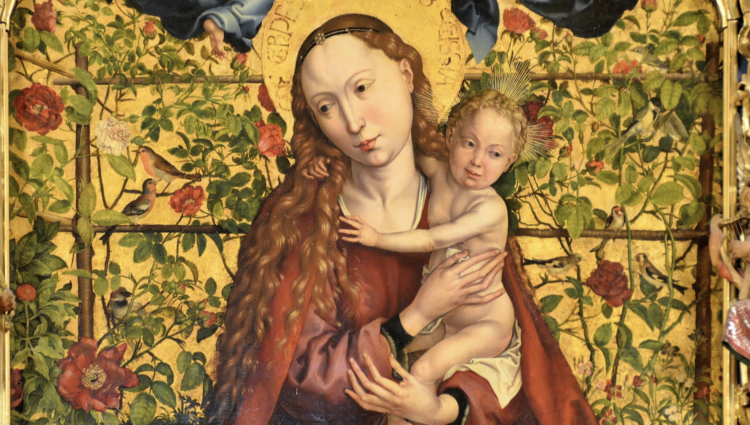
God searches for every soul like the Lover searches for his Beloved in the Garden. The soul of the believer is the beautiful daughter, lovely like Jerusalem. As God walked in paradise with Adam, so he now dwells in the believer through grace. Through the Church and her sacraments the believer so greatly desired by the Lord becomes the garden restored, with its walls rebuilt: paradise. “Arise, my love, my beautiful one, and come away.”

Before I entered the Order, I had the privilege of spending an afternoon in the gardens of Versailles, the palace of Louis XIV—the splendor of France in all her earthly glory. There, white sand paths trailed past impeccably kept hedge rows, concealing hidden fountains. These bottomed-out in a man-made lake, where even the shore on the far side still belonged to the Sun King. If there was any place on earth that could offer a glimpse at paradise it was Versailles, a garden for the Lord to walk in during the cool of the day (cf. Gen 3:8).
We nonetheless know by faith that all the kingdoms of the world and their glory are ashes and dust before the Lord, and before the paradise he has prepared for those who love him. The word “paradise”—paradeisos in Greek—is taken from an Old Persian word referring to a walled garden or orchard; in Farsi even today this word’s distant, though etymologically similar, children—ferdows, pardēs—signify a garden, or the garden of paradise as well. So the Lord reveals his purpose by his own words (cf. Luke 23:43): communion with God, enclosed and reserved only for him (cf. Song 6:2–3). Thus one does not wander away from paradise by chance; one must choose to leave. Only by man’s free choice, then, was the garden poisoned (cf. Deut 32:32). Thus the garden was taken from its wicked tenants, its walls guarded from our wickedness by a cherub with a flaming sword (cf. Gen 3:24, Matt 21:33–46). Our expulsion haunts us to this day, carrying forward into future generations our collective evil, pain, and suffering. Mankind remembers this original separation: every true reform movement is premised on the backwards gaze that energizes a bold step forward, both in the Church and in human society. That yearning for the golden “way things used to be” before the “corruption” of the present is the yearning for paradise.
God in his mercy, however, did not leave paradise lost, pined and thirsted for, forever (cf. Ps 63). God’s plan of salvation rested in paradise. Thus in the fullness of time God came once more to dwell with men in earthly paradise, the paradise of the Blessed, the walled garden (Song 4:12): the Blessed Virgin Mary. By the Incarnation of the Son of God in the womb of the Blessed Virgin Mary, God had come once more to walk in the cool of the day, to fulfill that which was foretold for the redemption of Mankind (Luke 24:44–48).
Saint Louis de Montfort, that apostle of the Rosary, merely summarizes Saint Ephrem, Saint Ambrose, and numerous other Eastern and Western Fathers when he declares that the Blessed Virgin is “the true earthly paradise of the new Adam,” of whom “that ancient paradise” was only a symbol (True Devotion, 261). As Saint Isaac of Stella noted, what is said of the Church is said of our Lady in particular, and what is said of Our Lady in particular is said of the Church in general “almost without qualification” (Sermo 51: De Assumptione Beatae Mariae; PL 194, 1862A–B). As the perfect image of the Church, then, what the Blessed Virgin Mary received as a singular grace in a bodily manner, all Christians may receive in spirit. God’s dwelling in the Christian is supremely fitting: he dwells in the holy place, in our inner soul, as he dwelt in the Blessed Virgin Mary. “Holy things are for the holy,” as we hear in the Byzantine liturgy. The Blessed Virgin Mary’s soul is an image for the paradise that our soul becomes when restored by grace.
The Gospels show us this restoration of the soul to its original paradisic purity. Our Lord promised Saint Dismas the Good Thief, “today I will be with you in paradise” (Luke 23:43). And now in Eastertide, we hear how Saint Mary Magdalene, apostle of the apostles, confused Our Lord for the gardener (John 20:15). Is it not the gardener who nurtures new life so it might bloom? Saint Mary Magdalene made a providential error, then: she encounters the gardener who will nurture the bud of eternal life, the life of grace (cf. Luke 17:21). In Saint Mary Magdalene and Saint Dismas, we see that God searches for every soul like the Lover searches for his Beloved in the Garden. The soul of the believer is the beautiful daughter, lovely like Jerusalem (Song 6:4), whom the king desired so greatly (Ps 45:11). As God walked in paradise with Adam, so he now dwells in the believer through grace. Through the Church and her sacraments the believer so greatly desired by the Lord becomes the garden restored, with its walls rebuilt: paradise. “Arise, my love, my beautiful one, and come away” (Song 2:13).
✠
Republished with gracious permission from Dominicana (April 2026).
The Imaginative Conservative applies the principle of appreciation to the discussion of culture and politics—we approach dialogue with magnanimity rather than with mere civility. Will you help us remain a refreshing oasis in the increasingly contentious arena of modern discourse? Please consider donating now.
Image: Martin Schongauer, Madonna in Rose Garden