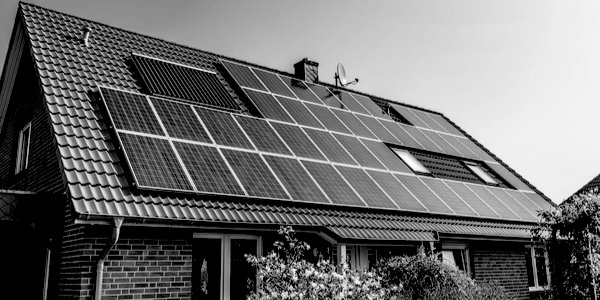
HOUSEHOLDS will be eligible for thousands of pounds of solar panels and other green tech to lower their energy bills, the Government has announced. According to the BBC, the Warm Homes Plan promises to provide £15billion to households across the UK over the next five years in a ‘rooftop revolution’ that will triple the number of homes with solar technology, and lift a million people out of fuel poverty.
What’s new? We have been here before with Chris Huhne’s ‘Green Deal’ of the 2010-2015 coalition government. The big problem, then as now, is the potential for massive fraud if the only requirement is to fill in a form for the money and submit fabricated documents, while there will be no proper on-the-ground auditing. A total of £240million was wasted before Huhne’s disastrous scheme was cancelled. Hundreds of millions more could be wasted again, and the national debt will be increased for nothing. Here, we reproduce Paul T Horgan’s still highly relevant article from 2016.
When it was first launched this century, the TV series The Thick Of It was touted as the Yes Minister for our time. Well, up to a point. The central theme of Yes Minister was the struggle of elected representatives of the people to surmount civil service inertia. It justified its authenticity by having members of Harold Wilson’s kitchen cabinet as advisers to the programme. Events in recent British history were repackaged as comedy. The episode ‘Party Games’, where Jim Hacker is elevated to the top spot, is based on Harold Wilson’s resignation at a time when Denis Healey was politically unpopular for being obliged to embrace monetarism; Jim Callaghan leapfrogged over him. The episode ‘A Victory for Democracy’ is clearly based in the US invasion of Grenada.
By contrast in The Thick Of It, the Sir Humphreys and Bernards are invisible. The struggle is between government ministers and their spin doctors. The only programme consultant is for swearing.
Another way that The Thick Of It differs from its supposed predecessor is that, instead of dramatising historic events for comedic effect, the show anticipated or created them. The word ‘omnishambles’ entered the political vocabulary when it was used by Ed Miliband to characterise the George Osborne’s 2012 budget, where the Chancellor had imposed VAT on hot Cornish pasties. It was coined in the third series of the show. (At this point Bernard would be pointing out the incorrect mix of language and suggesting that ‘omniruina’ would be correct.)
The road trip undertaken by Harriet Harman in a pink battlebus as part of her ‘Woman to Woman’ campaign seems virtually identical to the similar fictional effort ‘Here to Hear’ performed by Nicola Murray. This effort was explained by Malcolm Tucker as the closest he could get to locking Murray in a metal box. In real life, Harman had succeeded in alienating 50 per cent of the voting population, otherwise known as men, and at the time was having to defend her efforts in the 1970s to water down legislation against the child pornography as well as explain why she was working for as a legal officer for a pressure group that had the Paedophile Information Exchange as an affiliated organisation. Locking Harman in a metal box for a few weeks was clearly seen as a sound idea by Labour.
The final series of The Thick Of It had story about a tented protester in the mould of the late Brian Haw, who kills himself over being evicted from key-worker housing. At the time the never-named junior partners in the fictitious coalition government, which we are allowed to assume are Liberal Democrats, were entertaining a community economist. In their panic, the politicians set up a £2billion bank designed to make microloans to keep the economist from squealing to the media.
Surely the Lib-Dems would not do something like that in real life?
I am afraid, dear taxpayer, they did.
The Green Deal was designed to improve the energy efficiency of more than 14million homes by 2020. The idea was for property owners to install energy efficiency improvements at no upfront cost, with the costs being recouped through the property owner’s energy bill over a number of years.
It does not sound like a bank, but it was. There was a Green Deal Finance Company. The scheme lent money to householders, it had a depositor and lender of last resort in the taxpayer. There was a loan book. The Green Deal Providers had to be certified by the Financial Conduct Authority. It was, for all intents and purposes, a bank.
During the coalition, the Department for Energy and Climate Change (DECC) was one of the departments whose cabinet-level position was parcelled out to the Liberal Democrats. The Secretary of State was Chris Huhne. To be fair, the Conservative Greg Barker who was Minister of State was on his feet in the Commons as frequently as his boss was in talking up the Green Deal. It was touted as a flagship policy for the coalition.
Neither of these men now sit in the House of Commons. Barker has a life peerage. Huhne quit the Commons when he was convicted of perverting the course of justice over a speeding ticket. He was sentenced to eight months imprisonment, of which he served two.
There is a genuine problem to be dealt with here. According to the National Audit Office, ‘The UK’s 27 million homes are responsible for more than a quarter of the country’s total energy demand and greenhouse gas emissions. Due to the age and design of many buildings, the UK’s housing stock is among the least energy-efficient in Europe. Occupants of inefficient homes have to use more energy to keep their home warm, leading to higher bills and harm to the environment. They may alternatively suffer colder conditions, which can have a significant impact on their health.’
The idea behind the Green Deal was that householders would borrow money to pay for improvements to improve energy efficiency. However, they would not pay off the loan directly; instead the payments would be taken from their energy bills. The golden rule was that the amount paid by the household in paying off the loan should not exceed the energy savings provided by the improvements. The work was to be performed by approved suppliers and contractors.
The official launch of this scheme took place in January 2013 as one of the provisions of the Energy Act 2011.
And then? Well, very little. By late summer 2013, the uptake of the scheme was precisely 133 homes out of a national housing stock of 27million.
This was a disaster. The scheme made loans at rates of between 7-10 per cent and as such was meant to be self-financing. After initial set-up costs paid for by the state, the private sector was meant to step in. After all, selling loans for 7 per cent after borrowing money on the market for, say, 4 per cent sounds like money for old rope. But it depends on householders being willing to borrow the money at 7 per cent. There was an up-front cost to consumers of about £150 for a household energy assessment. This bit was a success, with over 50,000 houses being tested. But the conversion rate from assessment to loan was pitiful. With 133 loans, the scheme was not self-financing. The Green Deal had been set up expecting an uptake of millions.
Why was the uptake so low? That is the question that no one seems to be able to answer. The consumer had a choice and voted with their wallets, which they kept closed.
One clue may be that the underlying objective was to reduce carbon emissions. Energy production is a complex business and has been further complicated by the whole global warming debate. The release of carbon dioxide into the atmosphere has been monetised in this country. One consequence of this has been that energy-intensive businesses in this country, like steel production, are now saddled with another financial burden which overseas competitors do not have. Would the Port Talbot works have been loss-making had the State not added to the costs of production compared to its competitors in India and China?
Commerce in this country is being hobbled due to a belief that our climate is changing, with a scientific standard of proof that is vastly inferior to the one used to prove the existence of the Higgs Boson. But then climatology is a relatively new discipline compared with physics. Physics has such historic figures as Einstein, Newton and Maxwell. Climate science has er, well, see if you know without looking it up. I’m sure there is someone.
So the real objective is actually nothing to do with the capitalist drivers of profit and efficiency or, as has been seen, the selling of products and services that are attractive to buyers. Also it has to be asked why exactly the state was trying to act like a home-improvement finance house. State services are usually those that the private sector will not or cannot perform. In this case the UK has a financial services sector, a pretty large one by all accounts. If no enterprising financier could fashion a product to incentivise people to insulate their homes, the chances are that there is no money in it. Throwing money at the problem, which is what governments tend to do, is a feeble way of improving things. Tony Blair threw extra billions at the NHS, but patients were neglected and abused to death on Labour’s watch.
By the time the Green Deal was wound down shortly after the 2015 General Election, £240million had been spent. About 14,000 loans had been taken out, probably about 0.1 per cent of the target. The growth from 133 loans to 14,000 may be partly explained by the increasingly expensive incentives that the government offered like cashbacks (£16million), promotion through local government (a whopping £106million), and ‘other programme, administration and capital expenditure’ (whatever that means, an inexplicable £71.7million). In 2012, DECC forecast that the Green Deal Finance Company would provide loans worth more than £1.1billion by the end of 2015. The actual figure by that date was £50million. It had cost £14,000 per household to provide an average loan of £3,600. Only the State could do this and stay in business.
Two hundred and forty million pounds is a huge number. But we no longer think it is huge in terms of state spending because our news feeds regularly bandy around government figures denominated in billions. The national debt is £1.56trillion [2026 edit: now £2.9trillion]. The annual interest payment on this is £43billion [2026 edit: now £106billion]. That is £117million per day, which is £4.9million per hour. We mere human taxpayers are rendered into invisibility by such numbers. It is the financial equivalent of the oversized architecture planned and built by 20th century dictatorships that were designed to demonstrate in three dimensions the insignificance of the individual compared to the collective or the state. Our heads are battered every day by these figures to the point that the waste of £240million, or about two days interest payments on the national debt, is not front-page news, though it should be.
Our housing stock does need to be more energy-efficient, if the National Audit Office is to be believed. However pretending to be a bank was a failure. Selling home improvements is a difficult business. Cowboy builders abound. One in ten of the ‘approved’ contractors had their accreditation withdrawn. Energy companies told the government point blank they hated the scheme.
Once the the Conservatives were free of their coalition partners, they ditched the scheme. The National Audit Office investigated. They were not impressed. The Green Deal was effectively a state-sponsored home-improvement finance business. But it did not act like a business. Normal businesses sell products to markets and they research those markets to ensure that the offer aligns with the market demand. This was not done competently. But then people who work in the state sector are not exposed or perhaps even understand commercial pressures. That is indeed exactly why a significant proportion of them work in the heavily-unionised state sector. They are not necessarily entirely good friends of capitalism and do not understand competition unless they want to stifle it. It is a very safe, if not well-remunerated, berth. There is rarely a downturn in the business of the state.
Our elected representatives in Parliament did not really scrutinise the Green Deal. Hardly any MP asked any difficult questions or put the government on the spot, which is an important part of their job. But then questioning green policies is seen as a heresy. Much better to go with the flow. Even if it loses close to a quarter of a billion pounds. The Green Deal seems to have been above politics, a technocratic initiative. No one was blamed, no one was criticised. Everybody gets to keep their index-linked pension. There is no deterrence to a repeat of this waste of time, effort and money. The business of government goes on and on. The national debt increases. We, our children, grandchildren, and so on get to pay for it all in return for a vote every five years. It is usually better than dictatorship, although a poorly-scrutinised policy like the Green Deal slipping its way through an ostensibly democratic chamber does invite awkward questions.
I do believe that it is possible to write a dissertation on the history of this policy as an example of how ideas are formulated, scrutinised and implemented in a coalition government. It would be nice if someone gained a doctorate on the back of the Green Deal so some good could come out of it. It is certainly an object lesson on how not to do policy.
Two hundred and forty million pounds. And no one really seems to care.
The writers of The Thick Of It have ruled out any new series. With policies like the Green Deal, who needs satire?