If we truly want to overcome the curse of racism, we need to begin with restoring the humanities, the voice of the human race, to their rightful place at the heart of any good, true and beautiful education.

This year marks the fiftieth anniversary of the premiere of Destiny, a politically-charged play by the Marxist playwright, David Edgar. I remember seeing it at the Aldwych Theatre in London in May 1977, amidst the backdrop to the nationwide celebrations to mark the Queen’s Silver Jubilee. Although I was only sixteen-years-old, and although a chasm of almost half a century separates me from that evening, I still recall a heated dialogue between a young idealistic white supremacist and an equally idealistic Marxist. It was a quickfire exchange in which one ideological dogma was countered by the opposing ideological dogma. Essentially, the racist argued that political society and history were all about the struggle between the races whereas the Marxist countered that political society and history were all about class struggle. There was no common ground. Never the twain would meet in anything but physical violence.
That was then; this is now.
Today, the Marxists have become racists. They see political society and history as a struggle between the races. They are now as obsessed with seeing everything in terms of race as are the white supremacists. It’s all about race. Race and the struggle between the races is the root cause of everything.
This new manifestation of racism has affected and infected education. When mixed with “progressivism” and feminism it makes a Molotov cocktail which is thrown at anything written by “dead white men”. It has led to the figurative burning of books and to the literal banning of them.
This neo-racism in education justifies its iconoclasm on the grounds of “diversity”, “representation” and “empowerment”. The arguments are simple and simplistic. Modern society is diverse and “dead white men” do not represent that diversity. Instead, these “dead white men” impose their antiquated, racist and sexist views upon the culture, wielding power over those whom they do not and cannot represent.
At this point, we need to step back and look at “race” itself and at the connection between concepts of “race” and manifestations of racism.
The worst thing about racism is the judging of someone for something he can’t help being. A person can’t help being born with the skin colour that he inherited genetically from his parents. On the same basis, someone can’t help being dead. Should a dead person be dismissed as having nothing to contribute to the conversation on the grounds that he has died? Should we refuse to read any writer’s books following his death? Is prejudice against the dead any more justified than prejudice against those with a different skin colour?
And the same can be said, of course, with respect to prejudice against men. Should someone be dismissed on the grounds that he is male? Is prejudice against men any more justified than prejudice against the dead or those of a different race?
Those who are prejudiced against dead white men will respond that the past is full of dead ideas that have nothing to contribute to the “progressive” discourse. They will say that the white race has dominated other races and needs to be stripped of the privileges that such domination has given them. They will say that men have dominated history and culture and need to be stripped of the privileges that such domination has given them.
The first response is rooted in what C.S. Lewis called chronological snobbery. It presumes that the new ideas are the best ideas and that nothing can be learned from the Great Conversation in which the greatest of sages have discussed the wisdom of the ages.
The second response makes the racist assumption that Europeans dominated because they were white and not because they were serving their own desire for prideful self-empowerment. They had the technology at their disposal to impose their will on those who lacked such technology. European domination of other parts of the world is about sin, not skin. Pride and not pigmentation was and is the problem.
The third response is rooted in the reduction of humanity to the status of mere homo economicus in which we are merely cogs in the socio-economic machine. If the purpose of life is merely to be a good producer and consumer of economic products in order to achieve prideful self-empowerment, it makes sense that women would want to join the legion of wage slaves serving the machine. In a society that embraces this reductionist understanding of humanity, women have nothing to gain but their chains and nothing to lose but their families.
Having broached the subject of humanity, let’s look at race in relation to humanity.
The white supremacist paleo-racists and the pseudo-Marxist neo-racists see race in purely genetic and physiological terms. The colour of a person’s skin determines who they are and how they should be treated. Older understandings of race are healthier and should be reintroduced to the conversation. It was once common parlance to speak of the “English race” or the “German race” which indicated belonging to a common culture with a common heritage. When Aleksandr Solzhenitsyn was asked what he meant by “Russian”, he replied “anyone who feels Russian”. It is in this sense that I am an Englishman living in America but my children are Americans living in America. I am of the English race, in the older understanding of the word, and my children are of the American race. This has nothing to do with our genetic physiology.
A broader understanding of race is to speak of the human race. I remember the days when anti-racist Marxists would chant “one race, the human race” when demonstrating against white supremacists. That was before they became as racist as their enemies.
It is love of the human race which should animate our love of the humanities. It is love of the human race that should animate our desire to see the humanities restored to the core of the educational curriculum. The point is that the humanities teach us about our humanity, our shared experience of who we are. It is not because Homer is a dead white man that we should read him but because he is a fellow member of the human race who is still alive because he speaks to us about our shared humanity and shows us our human personhood in the light of that shared humanity.
The fact that Homer is dead or white or male is far less important than the fact that he is one of us. He is a member of the human race, with an exceptional gift of storytelling, who tells us stories that deepen our understanding of ourselves and our neighbours. He should not be the victim of discrimination on agist, racist or sexist grounds but should be welcomed to the conversation and to school curricula.
If we truly want to overcome the curse of racism, we need to begin with restoring the humanities, the voice of the human race, to their rightful place at the heart of any good, true and beautiful education.
__________
The Imaginative Conservative applies the principle of appreciation to the discussion of culture and politics—we approach dialogue with magnanimity rather than with mere civility. Will you help us remain a refreshing oasis in the increasingly contentious arena of modern discourse? Please consider donating now.
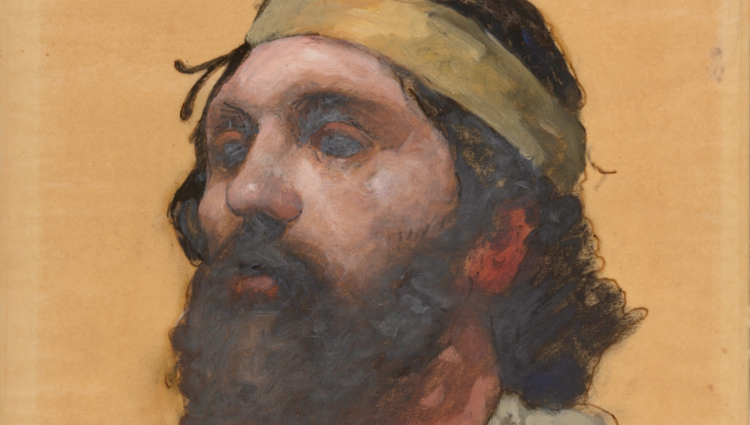
The featured image is “Bust-length Study of the Blind Homer” (late 19th century), by Paul Buffet. This file is made available under the Creative Commons CC0 1.0 Universal Public Domain Dedication, courtesy of Wikimedia Commons.