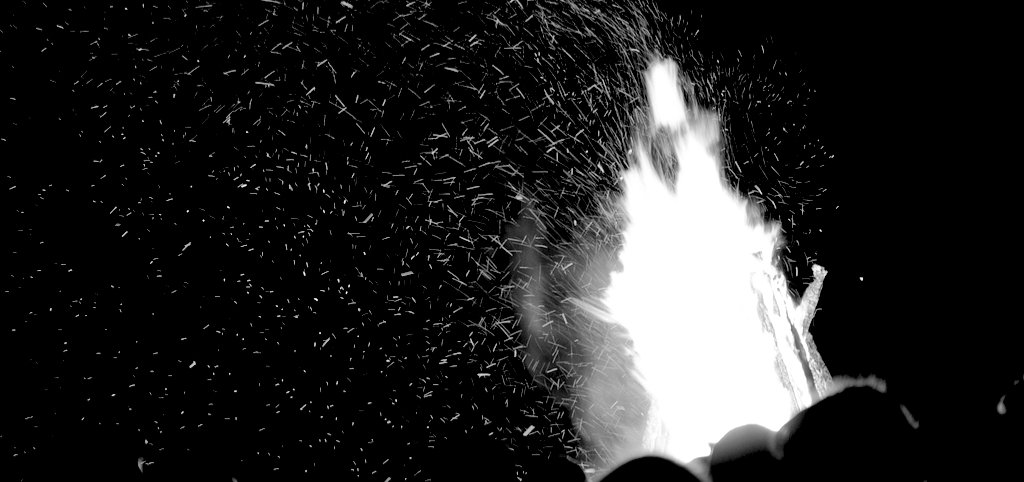
WE’RE rapidly approaching two of my least favourite times of the year: Halloween and Bonfire Night.
As a Catholic, am I supposed to feel uncomfortable about the celebration of the discovery of the Gunpowder Plot of 1605, in which the Catholic ex-soldier Guy Fawkes attempted to blow up Parliament because King James I refused to end the persecution of his co-religionists? I seldom have.
My mother was once a Protestant who marched with the Orange Order in her youth and my father was a very liberal Catholic. I grew up mixing naturally with our Protestant neighbours and I look back fondly on our own bonfires, the treacle toffee, baked potatoes and other trappings. I loved the fireworks then, and bonfires were great fun. As my son grew up, I took him to bonfires too, and I remember holding him as a three-year-old and watching his face awestruck by fireworks that turned into glorious golden palm trees many hundreds of feet in the sky. It was an occasion of pure joy.
The idea of banning Bonfire Night, which occasionally emerges in our cancel culture at this time of the year, is preposterous to just about every Catholic I know. Most tend to accept this night simply as part of our islands’ story.
From my reading of history I suspect that Bonfire Night has its earliest origins not in the Gunpowder Plot, however, but in the burnings of Protestants under Queen Mary I, the Tudor monarch known by posterity as ‘Bloody Mary’.
This moniker, while deserved, is also a little unfair given that her father executed 70,000 people and her half-sister, Elizabeth, also presided over a regime in which many thousands were sent to the gallows.
Like Mary, Henry also burned Protestants at Smithfield in London. His Protestant children, Edward VI and Elizabeth I (are you listening Mr Lammy?) burned Anabaptists for being the wrong kind of Protestant. There is plenty of evidence to suggest that to the 16th century mind burning for heresy was not as controversial as the question of who the heretics actually were. Nor was it a new punishment. Though repealed briefly under Edward, it had been on the statute books for centuries, and used against Sir John Oldcastle and the Lollards by Henry V in the early 15th century, for instance. Witches were burned too, right into the 18th century when Janet Horne was the last woman to be sent to the stake in Dornoch, in the Highlands, in 1727.
That said, Queen Mary from 1555 to 1558 presided over the most intense period of burnings since Boudica set fire to Colchester and London. They were the sharp end of her policy to reverse two decades of Catholic persecution and restore the old faith. Mary had generously included concessions to allow nobles who had benefited from the dissolution of the monasteries to keep lands and properties they had acquired and the majority of the English people conformed. The burnings were reserved for the supposedly small hard core who would not. Yet they turned into a witchhunt of unspeakable savagery. It almost succeeded, according to Eamon Duffy, Professor of the History of Christianity at the University of Cambridge. In his superb 2009 book, The Fires of Faith, he explains that the burnings were abating at the time of Mary’s death because most recalcitrant Protestants were either dead or in exile.
Bonfires were communal celebrations and in the reign of Elizabeth they were lit every November 17 to mark the day of her accession. They must have evoked the horrors of the previous regime, especially in towns such as Lewes, Sussex, a Protestant stronghold where in June 1556 a total of 13 people – 11 men and two women – had been burned together. It is hardly surprising that Bonfire Night is celebrated there with exceptional vigour to this day.
It would be a mistake to assume, however, that under Elizabeth, liberty returned to England and religious witch-hunting stopped. It continued mutatis mutandis and this time the victims were Catholics who dissented from her police state and her Stalinist-style personality cult. Similar numbers were executed by Elizabeth to Protestants killed by Mary, according to the Museum of London, and many others perished in prison. Catholics suffered horrible deaths too.
If forced to choose, would you pick death by fire or castration, partial hanging, evisceration, your beating heart pulled from your chest before you are beheaded and your body chopped into four pieces and put on public display? This medieval punishment for high treason of hanging, drawing and quartering was used with astonishing frequency to execute Catholic priests in Elizabethan England and to terrorise the local population into conformity. There was a deeply dark side to the so-called ‘golden age’.
The problem that Elizabeth faced was, of course, identical to that faced by Mary: the other side would simply not go away. To each queen the problem was a zero sum struggle for survival in which there could be only one winner.
The idea of tolerance, or religious pluralism, had no currency in those times. It was seen dangerous and unworkable, a madness that would grant your enemies the freedom they needed to move against you.
Liberal democracy was a long way off. Regime change was brought about only by the death of the monarch and not by parliamentary elections. Such a constitutional arrangement invited all manner of plots and rebellions. All monarchs faced them, Protestants and Catholics alike.
Henry was threatened by the Pilgrimage of Grace, for instance, Edward the Western Rebellion, Mary the Wyatt rebellion, Elizabeth the Babington Plot, the Northern Rebellion and the revolt by the Earl of Essex. James I put down not only the Gunpowder Plot, but the Main and Bye Plots of the Puritans.
In my experience, the more one reads about the English Reformation – from reliable historical sources and not in works of fiction – the more the safe assumptions on which much of our Whig history has been written begin to dissipate. The picture is surprisingly more complicated than it first appears, and there are heroes and villains on both sides.
Although I’m not in favour of blowing up Parliament (glad to get that on the record), I confess that I do have a certain sympathy with Fawkes and his fellow conspirators. They were provoked deliberately, I think, by Robert Cecil, Elizabeth’s former first minister and kingmaker to James. Their folly gave this master strategist the propaganda victory he needed to crush the still-popular Catholic cause, perhaps for good. I remember putting this to his direct descendant, Robert Cecil, the Earl of Salisbury, when I interviewed him about the Gunpowder Plot in 2005, around the 400th anniversary. If I remember rightly, he was adamant that there was a plot (some theorists have argued there wasn’t), but he agreed that the Crown knew about it and milked it for all it was worth.
In the aftermath of the plot, Bonfire Night celebrations were transferred from November 17 to November 5 to mark the nation’s ‘double deliverance’ from the Spanish Armada and from gunpowder. The propaganda coup would be enduring.
Four centuries on, Bonfire Night for me is a cause for neither shame nor celebration but a sad and harrowing reminder of an era in which so many of the people of England killed and died for what they believed, and of the plight of all those ordinary people caught in the upheavals and monstrously persecuted in so many ways. It is an occasion for thanks that such turbulent times are over and that Catholics and Protestants today live together in practical and respectful ecumenism.
Those who care enough about the Christian faith have, moreover, a strong sense of being in the same boat, of being confronted by new challenges, such as militant Islam, secular humanism, neo-Marxism, neo paganism, and the many other ascendant destructive ideologies that can be added to the list with every passing year.
Our enthusiasm is for none of these but for the child born in Bethlehem to be ‘the light of men . . . the light that shines in darkness, and darkness could not overpower it’.
Now that’s worth celebrating.