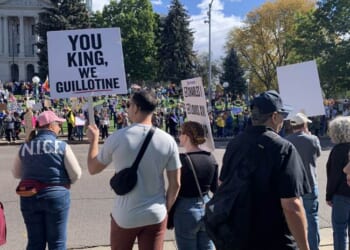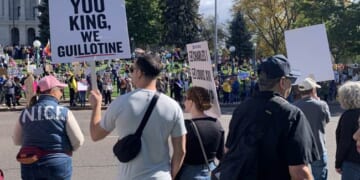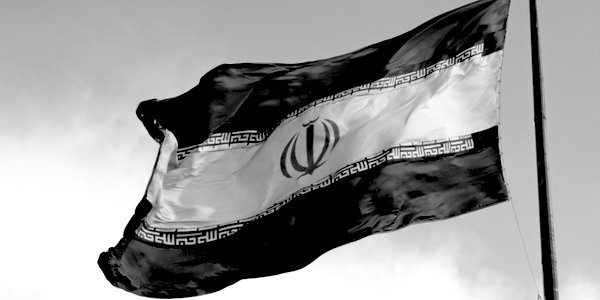
WHEN protest becomes fashionable, it stops being meaningful. The streets of Tehran offer the corrective: women tearing off compulsory hijabs at the risk of prison or worse, students chanting under the shadow of live ammunition, workers striking against a regime that tortures, jails, and executes its critics. This is dissent in its original form, unmediated and lethal. And yet the professional outrage class, normally incapable of restraint, has responded with a disciplined silence. Not a delay, not uncertainty, but a silence so precise it reads like doctrine. Figures who never miss a cue when Israel is involved – Roger Waters, Susan Sarandon, Mark Ruffalo, Brian Eno, Gary Lineker, Macklemore – have suddenly misplaced their megaphones, as if courage, like outrage, now requires prior ideological authorisation.
That silence is not ignorance; it is selection. In the contemporary protest economy, dissent acquires moral value only when it is directed westward. It must indict liberal democracy, free markets, Zionism, or the legitimacy of the Atlantic world. Only then does it become ‘systemic’, worthy of NGO campaigns, celebrity endorsements and rolling media coverage. When protest is aimed at a theocratic dictatorship, the machinery stalls. There is no white colonial villain, no capitalist infrastructure to blockade, no liberal order to denounce, no Zionist enterprise to condemn. The narrative refuses to co-operate.
The NGO-media complex runs on a single governing story. Power is always Western, always capitalistic, always suspect. Resistance, therefore, must be anti-Western to count as resistance at all. Best of all, if it is anti-Zionist.
This explains why Iranian women demanding bodily autonomy are treated as a local curiosity, while Western activists demanding the dismantling of their own societies are elevated to moral visionaries. The former seek liberal freedoms; the latter perform their rejection. Only one sustains the model.
Israel sits at the centre of this distortion. It provides the indispensable hinge that allows Middle Eastern brutality to be reframed as a morality tale about Europe and America. So long as Zionism can be blamed, everything else becomes ‘context’. Hamas is softened into grievance, Hezbollah into resistance, Iran into a misunderstood regional actor. Actual victims are inconvenient because they point in the wrong direction.
Here the silence curdles into something more revealing. The selectivity is animated by anti-Zionist/anti-Semitic derangement. Outrage is calibrated not by the scale of injustice but by proximity to Jews. Where Israel can be blamed, fury is limitless; where acknowledging oppression would vindicate Jewish sovereignty or expose its enemies, indignation collapses. Jews are permitted agency only as villains. Jewish self-defence is always excessive, Jewish success always suspect. When Jews are not the problem, the moral apparatus malfunctions.
Iranian protesters are intolerable to this worldview for three reasons. They rise against a regime that arms and finances the anti-Israel cause. They demand freedoms that Israel already embodies, however imperfectly. And they shatter the claim that the Middle East’s central affliction is Zionism rather than authoritarian theocracy. To take them seriously would be to concede that the region’s most durable pluralist society is not the disease but the counter-example. For a movement emotionally invested in Israel as original sin, that concession is impossible.
The inversion is grotesque. A regime that executes teenagers is handled with sociological tenderness, while a democracy fighting jihadist proxies is cast as metaphysical evil. Protesters chanting ‘death to the dictator’ in Tehran are met with a shrug, while Western students chanting for the destruction of the Jewish state are praised for ‘raising awareness’. One begins to suspect that awareness is precisely what is being avoided.
There is comedy in the contortions. Those who insist that silence is violence suddenly rediscover the therapeutic virtues of silence. Those who claim to ‘centre lived experience’ decide that Iranian lived experience requires careful editorial review. Principles prove infinitely flexible; the target remains fixed.
This is not mere hypocrisy but a closed moral system, sustained by NGOs, foundations, academic departments and media platforms that reward Israel-bashing as cost-free virtue and launder anti-Semitic tropes as anti-colonial critique. Within that system, Iranian protesters are not heroes but liabilities. They complicate funding narratives. They confuse audiences. They suggest, intolerably, that liberal democracy might be worth wanting.
That suggestion is the real heresy. The protest industry cannot admit that people outside the West are willing to die for Western ideas, because that would mean those ideas are not simply tools of domination. It cannot admit that Israel’s existence strengthens rather than weakens that case, because that would require abandoning its central fixation. So it looks away, hoping courage will exhaust itself quietly.
It will not. The Iranian protesters will persist without celebrity applause, sustained by conviction rather than narrative convenience. History has a habit of siding with such people. The silence of the anti-Zionist protest class will be remembered too, not as nuance or complexity, but as moral failure camouflaged as politics.