Solemnity of The Nativity of Our Lord
Christ the Lord is born today;
today, the Saviour has appeared.
Earth echoes songs of angel choirs,
archangels’ joyful praise.
Today on earth his friends exult.
Glory to God in the highest, alleluia.
 Poem: Scott Cairns – “The Nativity”
As you lean in, you’ll surely apprehend
the tiny God is wrapped
in something more than swaddle.
The God is tightly bound within
His blesséd mother’s gaze—her face declares
that she is rapt by what
she holds, beholds, reclines beholden to.
She cups His perfect head
and kisses Him, that even here the radiant
compass of affection
is announced, that even here our several
histories converge and slip,
just briefly, out of time.
Which is much of what an icon works as well,
and this one offers up a broad array
of separate narratives
whose temporal relations quite miss the point,
or meet there.
Regardless, one blithe shepherd offers music to the flock,
and—just behind him—there
he is again, and sore afraid, attended
by a trembling companion
and addressed by Gabriel.
Across the ridge, three wise men spur three horses
towards a star, and bowing at the icon’s
nearest edge, these same three
yet adore the seated One whose mother serves
as throne.
Meantime, stumped, the kindly Abba Joseph ruminates,
receiving consolation
from an attentive dog whose master may
yet prove to be a holy
messenger disguised as fool.
Overhead, the famous star is all
but out of sight by now; yet, even so,
it aims a single ray
directing our slow pilgrims to the core
where all the journeys meet,
appalling crux and hallowed cave and womb,
where crouched among these other
lowing cattle at their trough, our travellers
receive that creatured air, and pray.
“The 12 Days of Christmas” Carol:
The song, “The Twelve Days of Christmas” is an English Christmas carol. From 1558 until 1829, Roman Catholics in England were not permitted to practise their faith openly. Someone during that era wrote this carol as a catechism song for young Catholics. It has two levels of meaning: the surface meaning plus a hidden meaning known only to members of the Church. Each element in the carol has a code word for a religious reality which the children could remember. To fit the number scheme, when you reach number 9, representing the Fruits of the Holy Spirit, the originator combined 6 to make 3, taking the 6 fruits that were similar. There are actually Twelve Fruits of the Holy Spirit. Catholics in England during the period 1558 to 1829, when Parliament finally emancipated Catholics in England, were prohibited from any practice of their faith by law— private OR public.
“The Twelve Days of Christmas” was written, therefore, as one of the “catechism songs” to help young Catholics learn the faith—a memory aid, when to be caught with anything written indicating adherence to the Catholic faith could be punishable with either imprisonment or death.
The ‘True Love’ refers to God. ‘Me’ is every baptised person.
The First Day of Christmas, A partridge in a pear tree is Jesus, presented as a mother partridge willing to sacrifice herself to save her young.
Another Christmas tradition that was banned by Oliver Cromwell was the humble mince pie. Here is a verse that went about at the time:
The high-shoe lords of Cromwell’s making
Were not for dainties — roasting, baking;
The chiefest food they found most good in,
Was rusty bacon and bag-pudding;
Plum-broth was popish, and mince-pie —
O that was flat idolatry!
So enjoy your mince pies and plum pudding, if you’re having it, today!!
__________
The Imaginative Conservative applies the principle of appreciation to the discussion of culture and politics—we approach dialogue with magnanimity rather than with mere civility. Will you help us remain a refreshing oasis in the increasingly contentious arena of modern discourse? Please consider donating now.
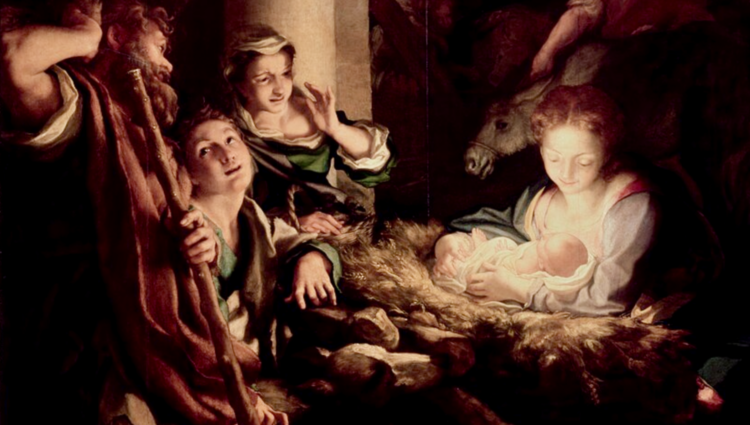
The featured image is “Nativity” (between circa 1528 and circa 1530), by Antonio da Correggio, and is in the public domain, courtesy of Wikimedia Commons.