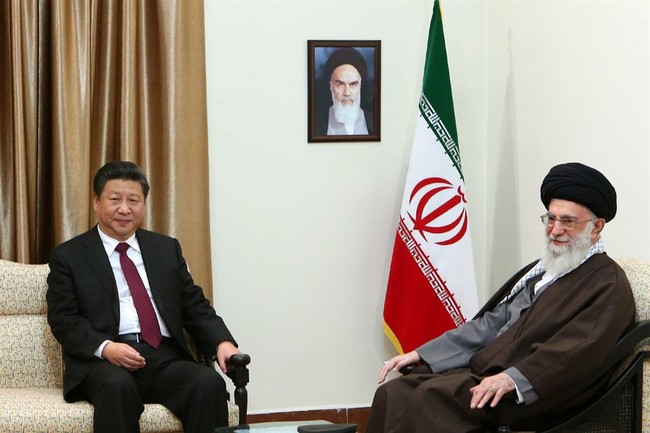
Forget yesterday’s parlor game of Where’s Mojtaba? A far more interesting question has emerged in the week after the start of Operations Epic Fury (US) and Roaring Lion (Israel): Where’s Xi?
The biggest loser so far this week, apart from the Iranian regime, has been China. First off, as David wrote earlier, they have badly miscalculated American power and will in defending its interests. All of their assumptions of a declining West and rising East have just collapsed, and in its wake, so have the assumptions about power balances.
More acutely, however, China also faces a serious energy crisis. Iran may not have completely stopped traffic through the Strait of Hormuz, but the regime’s attacks have stalled nearly all of it. And China had been the most reliant on those shipping lanes for its gray-market oil supply:
Tehran’s strike campaign threatens to disrupt shadow shipping networks and sanctions-evasion routes, raising energy costs for Moscow and Beijing and potentially squeezing Russia’s war funding and China’s industrial and military supply chains.
As of Monday, the Iranian regime declared the crucial Strait of Hormuz — between Hormuz Island, Iran, and the Omani enclave of Khasab — closed, under threat of vessels being “torched.”
Oil tanker traffic immediately fell sharply as merchant seamen now fear missile strikes, but the conflict has also affected the so-called “shadow fleet” of unflagged or surreptitiously flagged oil tankers connected to economically isolated countries like Cuba, Iran and Russia. …
European partners have also taken action against “shadow fleet” vessels, tightening the vise on China and particularly Russia amid the new unrest.
The US has already dispatched additional naval assets to provide escorts for shipping in the Strait of Hormuz. Donald Trump wants to reverse the sharp rise in oil futures by providing security for tankers, but likely will only provide escorts and reinsurance guarantees for non-sanctioned vessels and shipping:
The US energy secretary said Friday the US Navy was preparing to escort ships through the Strait of Hormuz “as soon as it’s reasonable to do it,” as traffic through the key trade route remains strangled due to the US-Israel war on Iran.
“As soon as it’s reasonable to do it, we’ll escort ships through the straits and get the energy moving again,” Chris Wright told US broadcaster Fox News’s “Fox and Friends” show.
US President Donald Trump had said on Tuesday that the US Navy would “begin escorting tankers through the Strait of Hormuz, as soon as possible” in a bid to avoid disruption of global oil supplies.
Twenty percent of the world’s oil supply flows through the Strait of Hormuz – and China gets roughly 45% of that, according to Reuters. Beijing has spent this week trying to convince the Iranian regime remnants to stop attacking tankers passing through, to no avail so far, apparently. China has already cut off exports of its refined oil products and may need to start some level of energy rationing. If they have to rely on US escorts for oil shipments, China’s leaders likely understand that their gray-market imports will likely be near the bottom of the American priority list.
With all of this at risk, one would expect Xi Jinping to take a dominant role in trying to save his allies in Tehran, especially with as much money and effort he invested in the ayatollahs as a counterweight to the US. Writing in Foreign Affairs today, however, Yun Sun concludes that Beijing has washed its hands of the ayatollahs and of the global strategy anchored by Ali Khamenei. The Stimson Center expert no longer expects China to intervene in the fight after the revelation of American power, will, and technology:
After Israel’s 12-day war against Iran in June 2025, China offered only boilerplate diplomatic rhetoric in support of the Islamic Republic. Similarly, in the Chinese Ministry of Foreign Affairs’ official press conference remarks this week, the harshest language that the ministry was willing to use was in its condemnation of the assassination of Iran’s supreme leader, Ayatollah Ali Khamenei, rather than of the overall campaign against Iran. The ministry’s call for “relevant parties to stop military operations”—a request that includes Iran as well as the United States and Israel—and its vocal support for respecting the “sovereignty, security, and territorial integrity” of Gulf states suggests that China is trying to stay on good terms with countries in the Gulf as much as with Iran.
This hands-off approach to Iran has been a long time coming. Since October 7, 2023, when Hamas attacked Israel, Beijing has grown increasingly disillusioned with Tehran’s capability and credibility as a regional power. Chinese strategists have also lost confidence because of what they see as Iran’s tendency to capitulate to Western demands, rather than fight back, as manifested in its persistent desire to negotiate with Washington. Ultimately, Beijing doesn’t see regime change in Iran as a worst-case scenario. China is willing to work with whatever leadership emerges after the strikes as long as it protects oil flows and prioritizes shared economic interests. Only if these interests are threatened, or if a protracted war of attrition disrupts oil shipments through the Strait of Hormuz, will Beijing have to reconsider its place on the sidelines and respond more forcefully.
The hesitation to get more vocal in support of Iran likely reflects this last point. The quickest way to restore traffic through the strait is to get the US to secure it. The actual security risk for this critical energy chokepoint turned out to be the mullahs, not the US or Israel, and now Xi has to rely on Donald Trump to protect their main energy import channel.
Plus, Sun writes, Beijing has belatedly realized how poorly Iran performs, both economically and in terms of real power projection. Only when the West appeases Iran does the regime appear strong. When the West confronts Iran, everything withers, including their will to fight. Sun writes that Trump isn’t the only one looking forward to a potential regime change:
Although Chinese state media have refrained from openly criticizing the regime, the Chinese policy community focused on the Middle East is clear-eyed about the bad decision-making, rampant corruption and poor governance in Tehran. Israel’s ability to infiltrate the Iranian security apparatus, which is what allowed it to effectively target Iranian military leaders and nuclear scientists during the 12-day war, suggests that many Iranian officials don’t trust their system and are willing to sell out their country. Chinese leaders are skeptical of the viability of an Iranian state that its own officials don’t have faith in.
China’s disillusionment with Iran’s leaders means that Beijing is not inherently opposed to regime change. Because its priority is to ensure that Iran remains a viable economic partner, it is regime agnostic. In fact, if the U.S. and Israeli attacks curtail Iran’s rogue military ambitions and the country repositions itself as an economic power in the Middle East, it could represent a future that China embraces.
China also has a meeting with Trump at the end of March. Xi wants to find a rapprochement with Trump on trade as well as global security concerns. Iran could have been leverage in those talks before the war broke out, but now it will be either a liability or potentially a deal-breaker.
In other words, Xi isn’t being passive; instead, he’s waiting to see what happens. If Iran collapses, he’ll try to work with the successor regime. In the unlikely event that Iran can stave off the US, Xi may become more confident in the mullahcracy, but not if they have to capitulate on security issues. Iran’s value to China is directly related to both energy and as a proxy to contain American power. If Iran fails on the latter, Xi will have to recalculate his approach to the US to account for it.
Xi can afford to stay on the sidelines and watch. The mullahs who banked on their alliance with Beijing have severely miscalculated and are already on their way to oblivion.
Editor’s Note: For decades, former presidents have been all talk and no action. Now, Donald Trump is eliminating the threat from Iran once and for all.
Help us report the truth about the Trump administration’s decisive actions to keep Americans safe and bring peace to the world. Join Hot Air VIP and use promo code FIGHT to get 60% off your membership!