Charles Murray may well have been both a well-educated agnostic and a happy one, but today he believes that the “inescapable conclusion” is that “a God created a universe that would enable life to exist.” And in his new book, he seeks to nudge secularists along the same route that he has taken to this conclusion.
Taking Religion Seriously, by Charles Murray (185 pages, Encounter Books, 2025)
 Professors Cass Sustein and Richard Thaler might or might not give a “thumbs up” to this book. Does anyone remember their 2008 book Nudge and its endorsement of what they termed, oxymoronically, “liberal paternalism?” Liberals with a libertarian bent, the pair sought to encourage, maybe even nudge, public and private forces to “nudge,” rather than compel, people to do the right and liberal thing for themselves and their country. Liberals with a secular bent, their project was entirely devoted to matters material. Saving and allocating money was much more important to them than saving and harvesting souls.
Well, along has come a conservative with a history of libertarian leanings and a very different notion of what nudging should do and where nudging might lead. In this case, however, Charles Murray is a former nudgee who has now become a nudger.
Nonetheless, “nudge” also happens to be his verb of choice. Beginning sometime in the mid-1990s (and his early fifties) and continuing a bit into the new century Murray experienced a “series of nudges” of a very different sort, nudges that gradually began to get him “unstuck” from “dead center.” Dead center? That would be the conventional wisdom which held–and holds–that all great religious traditions are nothing more than human inventions. Dead center? That would be Murray’s past presumption that “smart people (Murray included) don’t believe that stuff anymore.”
By Murray’s accounting, that same presumption would also be the conventional wisdom of millions of well-educated, successful people (Murray very much included) for whom religion had been at best irrelevant. These would be people who had grown up in thoroughly secular households or those who had been raised in a religious tradition, but who had drifted away and “never looked back.”
Briefly autobiographical, this book begins by looking back. Raised in a conventional Presbyterian household in Newton, Iowa, Murray went off to Harvard where students were as “thoroughly socialized to secularism as earlier generations had been socialized to be devout.” His next stop was a Peace Corps tour in Thailand where he tried Buddhist meditation, only to be “scared” by the surrender of autonomy.
Returning to the United States, Murray rejoined millions of Americans who were doing what he had been doing and would continue to do, namely “distracting myself with western modernity.” Nothing changed—and no nudging of any sort appeared—at least not until 1985 and the birth of a daughter to his second wife. That event, more than any other, apparently set in motion, or at least nudged into motion, what would turn out to be a “meandering pilgrimage to belief.”
By her accounting, his new wife loved her daughter “far more than evolution required.” For her new husband (and now father of three) that love seemed to point “vaguely toward God.” That alone must have been quite a step for Murray, a self-described “over-educated agnostic” and at least until then a quite “happy agnostic” to boot.
At that point neither husband nor wife was a church-goer, but new mother Catherine Murray soon decided to join a Quaker meeting house. And Charles? He would occasionally tag along “without much optimism that it would do me any good.” Whether it did or didn’t he doesn’t bother to explain.
No additional nudgings are recorded until the mid-1990s. The triggering question was put to him by Charles Krauthammer during one of Murray’s recurring lunches with Krauthammer and William Bennett: Why is there something rather than nothing? At the very least it was then time to start reading, and then finally to start wondering as well. His first stop was C.S. Lewis’s Mere Christianity and the Lewis position that Christ had to have been one of three beings: lord, lunatic, or liar—not to mention that there might well be an embedded moral law in all of us.
But Murray’s reading did not stop there. Far from it. At various points throughout the book he inserts annotated bibliographies on a great variety of topics and inquiries. Among them are the Big Bang theory, the Resurrection, the historicity of the Gospels, and the Shroud of Turin.
Charles Murray may well have been both a well-educated agnostic and a happy one, but he does not pretend or claim to have been a well-read agnostic. He was someone who simply assumed that agnosticism was the only sensible and/or respectable approach to the unknown. Whether he is now a happy believer or not, he doesn’t say, but a well-read believer he surely is.
Ironically, such pre-nudge Murray thinking—or, better yet, its unthoughtful presumption—is a product of the eighteenth century Enlightenment. Ironically? As Peter Kreeft has pointed out in his new memoir From Calvinism to Catholicism, the Enlightenment was actually a de-enlightenment that ushered in a new dark age, an age that the re-enlightened Murray correctly contends began to take serious hold in Western Europe and in the United States during the latter half of the nineteenth century.
In other words, it is the very age that Charles Murray and his readers, very much including yours truly, have been swimming in for the entirety of our lives. It is also the age that Murray has managed to read, and presumably continues to read, himself out of. Rational man of sorts that he thought he was, Murray was once a confirmed agnostic. A newly rational man that he continues to think that he is, Murray is now a believer.
As such, he has taken it upon himself in this book to nudge others toward belief. If this qualifies as evangelizing, and in a sense it does, it is evangelizing of the nudging sort. In one other (coined) word, this book amounts to Charles Murray, “nudgealizer,” saying, in effect, something like this: Here is what I have read and here is why I have been persuaded. Here is what I would encourage you to read. And, therefore, here’s hoping that you will begin your own meandering pilgrimage, an intellectual pilgrimage that will lead you where it has led me—or at least somewhere toward where it has been leading me.
Years ago, radio talk show host Dennis Prager asked one of his callers if he believed in God. The caller responded that he didn’t know. Prager‘s immediate retort was to remind his listener that he hadn’t asked him what he knew, rather he had asked him what he believed. After all, as Prager put it, “nobody knows.”
Well, Charles Murray doesn’t know either. Nor does he claim to know. But today he is willing to declare that he does have a much better handle on what he now believes to be true. Does that belief still contain mystery? Of course. Does that trouble Murray? Not at all. It is enough for him to state that he believes that the universe was created by an “unknowable creative force that itself has no explainable source.”
Not quite finished, here is the well-educated, well-read, highly erudite Charles Murray at his most profane and down-and-dirty nudging best: “Any God worthy of his name is at least as incomprehensible to a human being as I am to my dog.”
That God, of course, remains outside of history. This universe, of course, remains well within history. Is it the only one? Murray, of course, doesn’t claim to know. What he does want to insist upon is that his answer is limited to three options: 1) One universe exists; it happens to permit life; therefore we lucked into an inexpressibly small chance; 2) So many universes exist that it is not surprising that one of them, ours, permitted life to exist; 3) One universe exists, and it was designed to permit life.
Murray then proceeds to ask a question of his own: Which of the three options is the most plausible? For him, the third option has “none of the drawbacks of the first two,” since it requires him to assume that an initial miracle had created something rather than nothing. We’re back to the Krauthammer question: Why is there something rather than nothing?
Murray then concedes that the other two options seem to assume the same thing, namely that an initial miracle did create something rather than nothing. But for him the first two options just as readily seem prepared to ignore an initial miracle and then proceed to explain everything else. Therefore, the “inescapable conclusion” for Murray is that “a God created a universe that would enable life to exist.”
That conclusion opened up many possibilities for Murray, far from the least of which is the existence of a soul. As both a “child of the Enlightenment” and an “orthodox materialist,” Murray had presumed that the brain was the “only possible (italics in the original) source of consciousness.” But is that the case? After all, “people throughout the world and throughout history until the Enlightenment had assumed the opposite,” namely that “humans possess souls that exist independently of the brain.”
Evidence of a sort, Murray then turns to other evidence of another sort, namely paranormal phenomena, near-death experiences, and terminal lucidity, which he defines as a sudden return to self-awareness. All such evidence leads him to conclude that the scientific establishment” needs to take such evidence more seriously than it has been willing to do.
If there was a time, and there was, when Christian thinkers turned to science to confirm Christian belief, might there come a time when science will be called upon to restore Christian belief? A new Christian thinker by the name of Charles Murray certainly thinks so. For that matter, that’s precisely what he is attempting to do in this book.
With Taking Religion Seriously, Murray is simply doing what he has always done, while risking that he will make new enemies—which is also something that he has always done. Nonetheless, whether the subject is as broad as an expanding universe or as confined as an empty tomb, Murray is willing to explore and investigate, read and report, before judging… and nudging. Yes, this nudgee has become a nudger. Who knows, maybe some day even one-time thoroughly secular nudgers and their devotees will themselves join the nudgees of one Charles Murray.
__________
The Imaginative Conservative applies the principle of appreciation to the discussion of culture and politics—we approach dialogue with magnanimity rather than with mere civility. Will you help us remain a refreshing oasis in the increasingly contentious arena of modern discourse? Please consider donating now.
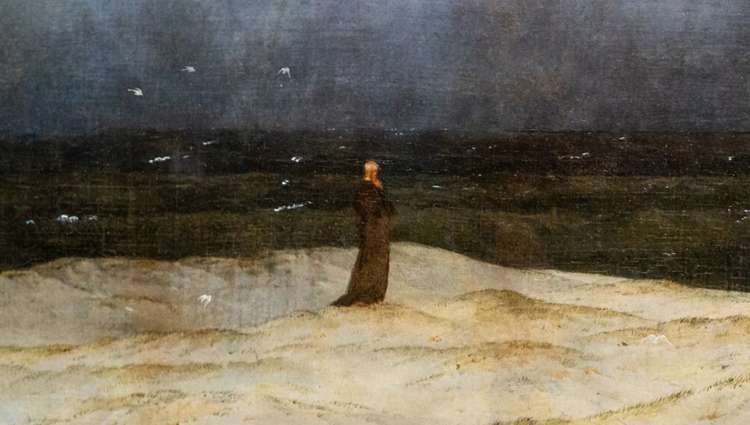
The featured image is “The Monk by the Sea,” by Caspar David Friedrich (1774–1840), and is in the public domain, courtesy of Wikimedia Commons.