State Funding Board sets growth rate at max of 2.35%, lower than inflation.
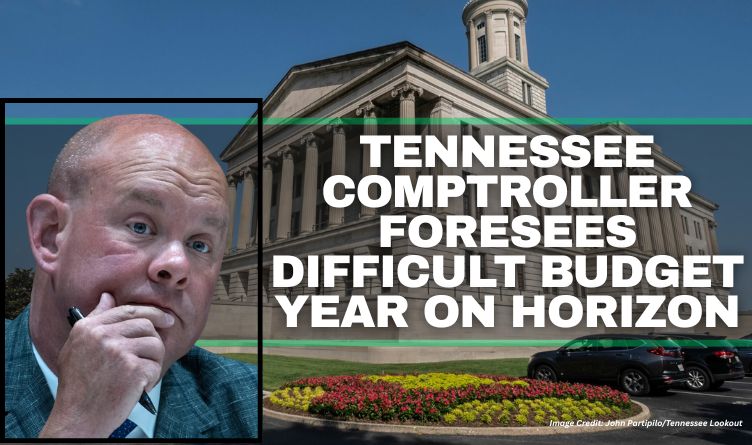
Image Credit: John Partipilo/Tennessee Lookout
*Note from The Tennessee Conservative: This article posted for informational purposes only.
By Sam Stockard [Tennessee Lookout -CC BY-NC-ND 4.0] –
In the wake of business tax cuts and dried-up federal stimulus funds, Tennessee Comptroller Jason Mumpower is predicting a tough budget for fiscal year 2026-27.
Mumpower, who chairs the funding board that sets the budget growth rate each year based on economic forecasts, told the Lookout he believes it will be “the tightest budget year the Lee administration has experienced” in nearly eight years.
“There’s so many demands for money and resources,” said Mumpower, a former Republican lawmaker. “Prioritization is going to be the word of the year.”

Yet Republican lawmakers are pushing for an increase in funding for the state’s new private-school voucher program, which cost $144 million this year.
Gov. Bill Lee also wants to add to the 20,000 students receiving $7,300 to attend private schools. The state has declined to say how many of recipients were enrolled in private school already, though 66% were expected to come from private schools.
With a difficult budget year looming, Finance and Administration Commissioner Jim Bryson urged department heads to trim their budget plans by 1% as they made presentations to the governor’s staff in November. Lee, though, told reporters he didn’t know anything about Bryson’s request.
Nearly every department requested funding increases.
The Department of Safety and Homeland Security is seeking an $84 million increase in its budget for next year, including more than $43 million to hire Tennessee Highway Patrol officers. The Department of Correction is seeking an $85 million increase, which includes $13 million more to pay CoreCivic, a private company that runs four state prisons.
Two years after dialing back the economy’s growth rate to reflect negative growth, the funding board recently set the figure for fiscal 2026-27 to fall between 2.25% and 2.35%, which would bring the state $450 million more in revenue.
Mumpower described the state’s economy as “very resilient” but noted the federal stimulus funds are gone and projected growth is below the 3% inflation rate.
“Obviously, our purchasing power is impaired by that inflation rate,” he said.
Rep. John Ray Clemmons of Nashville said Democrats have been warning of a coming financial crisis for years and accused Republicans of running the state “off the fiscal cliff.”
“Reckless spending programs, endless corporate handouts and rampant fiscal mismanagement, combined with irresponsible revenue cuts that made our state even more reliant on fluctuating sales tax revenues, have resulted in an impending budget crisis,” Clemmons said.
Republican lawmakers approved two straight years of business tax reductions and a three-year tax rebate in 2024 that initially cost the state $1.5 billion initially, $7.4 billion over the next few years.
Changes came after the Department of Revenue said the state could run into “significant legal risk” because of challenges to the property measure in the state’s franchise tax. State officials never identified any litigation, and some lawmakers said the move was simply good policy.

Tennessee has a AAA bond rating with Moody’s Analytics, a financial company in New York, Yet a Moody’s analyst described Tennessee’s economy as “treading water”, mainly because of tariff increases and federal job cuts. Sixteen states have economies that are expanding, according to the report, while 22 are in a recession or facing “high risk” for a recession.
House finance committee Chairman Gary Hicks said he met with Moody’s Analytics in October and its representatives never mentioned that the state was “treading water.”
Hicks said revenues are starting to “normalize” after two years of federal stimulus injections during the pandemic era.
“Which means we’re going to have to be more efficient in how we run government,” Hicks said. “I’m not real worried about that just yet. The economy’s always changing and it always will.”
Moody’s asked about the state’s business tax reductions, but Hicks said the state showed how it went about the business tax cuts “deliberately.” He said the state put itself in a good position by using “recurring” dollars, revenue projected to come in every year, for “non-recurring” expenditures, items that won’t have to be funded each year.