Challenging a number of schools of thought in economics and political philosophy, Andrew Willard Jones in his book, “The Church Against the State,” presents an unapologetically Catholic and specifically Thomist view of the world and, in particular, of America. Jones argues that America, in her own unique fashion, blends that which is venerable and ancient with that which is new and innovative.
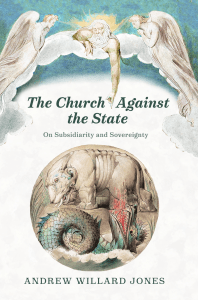
The Church Against the State: On Subsidiarity and Sovereignty, by Andrew Willard Jones (321 pages, New Polity Press, 2025).
 Ever since I arrived at Hillsdale, way back in late 1999, I’ve had the great privilege of teaching an off-semester class on the meaning, significance, and influence of Christian Humanism. Normally, I teach the American Founding, Jacksonian America, and Sectionalism and Civil War in sequence (all of which I love), but the fourth semester is mine to do what I will. Let me just note again, it is truly a great thing to teach Christian Humanism. As the name suggests, Christian Humanism is about the intersection of Judeo-Christian ethics with humane philosophy and education. What has Athens to do with Jerusalem, you ask? Everything, the Christian Humanist answers. When St. Paul goes to Mars Hill to debate the Epicureans and the Stoics, he does not dismiss them. Critically, he praises them for their “Unknown God” and praises their poets: “In Him we move and live and have our being.” The latter is from Cleanthes Hymn to Zeus from the year 300BC or so, and it originally stated, “In Zeus we move and live and have our being.” St. Paul wisely substitutes the invocation of Zeus with a pronoun, but he necessarily needn’t. After all, Deus, Latin for God, is simply a corruption of the Greek, Zeus.
As such, Christian humanists find a lineage in Socrates, Plato, Aristotle, Cicero, Virgil, St. Paul, St. Augustine, St. Jerome, St. Ambrose, St. Bonaventure, St. Thomas Aquinas, Dante, Petrarch, Sir Thomas More, and Edmund Burke. In the twentieth century, the focus of my Christian Humanist course, there’s G.K. Chesterton, Paul Elmer More, T.S. Eliot, C.S. Lewis, J.R.R. Tolkien, Willa Cather, Josef Pieper, Wilhelm Roepke, Thomas Merton, and Russell Kirk with allies in the form of Irving Babbitt, Eric Voegelin, Leo Strauss, Friedrich Hayek (who fully reverted back to his childhood Catholicism at the end of his life), Robert Nisbet, and Ray Bradbury.
Though I am a historian by training, I even devote a section on Christian Humanist economics, focusing on Roepke, E.F. Schumacher, and Sam Gregg. Now, though, I will never be able to teach the class without also incorporating Andrew Willard Jones, a Thomist economist extraordinaire, especially after reading his excellent 2025 work, The Church Against the State: On Subsidiarity and Sovereignty.
Challenging a number of schools of thought in economics and political philosophy, Jones presents an unapologetically Catholic and specifically Thomist view of the world and, in particular, of America. Jones notes, rightly, that many of the things we consider in the American tradition actually transcend a superficial liberalism, complicating Locke and other Enlightenment figures. America, in her own unique fashion, blends that which is venerable and ancient with that which is new and innovative.
Sounding very much like a Catholicized Robert Nisbet (echoing the very Catholic Alexis de Tocqueville), Jones calls for a deep understanding of subsidiarity, an essential part of a republican (res publica) common good:
Subsidiarity is a social form in which higher levels of association are ordered toward the fulfillment of lower levels of association, and ultimately to the fulfillment of the human person. This does not mean that the higher is somehow subservient to the lower. Rather, the lower levels are fulfilled through their elevation into the higher levels—which is the formation of those higher levels. The child is fulfilled by being elevated into the family even as the family is fulfilled by elevating children into its larger life. The family is fulfilled by being elevated into the villages even as the village is truly a village only by concorporating families into its larger life. Subsidiarity is not the assertion that the family is perfect on its own and everything bigger only exists to help it out. Rather, the family is made ever more perfect through the agency of high levels of order—and those higher orders themselves become more perfect in the process because it is only in the lives of such ‘more perfect’ families that they have a real existence.
One is immediately reminded of de Tocqueville’s claim in Democracy in America that the primary and most fundamental natural right is the right to associate, one with another, at the level of family, education, faith, and business. In de Tocqueville’s view, while the political sphere is important, it is, critically, limited to that which is political and should not interfere with the cultural or religious. Jones takes a similar tack.
One is also reminded of Edmund Burke’s famous plea toward the end of his Reflection on the Revolution in France: “We begin our public affections in our families. No cold relation is a zealous citizen. We pass on to our neighbourhoods, and our habitual provincial connections. These are inns and resting-places. Such divisions of our country as have been formed by habit, and not by a sudden jerk of authority, were so many little images of the great country in which the heart found something which it could fill. The love to the whole is not extinguished by this subordinate partiality.” For us to love our country, we must love our families first and our country must be lovely. In this way, patriotism is intimately related to patria.
Throughout The Church Against the State, Jones considers the role of subsidiarity in our political, constitutional, and economic relations. One chapter, in particular, that stood out to me was his penetrating analysis of the elusive and creepy (yes, creepy) Carl Schmitt, a Dawsonian Christian Humanist turned Nazi. While Jones maintained his objectivity in the chapter, I openly applauded and laughed as I happily made my way through it as the author expertly deconstructed the confused German philosopher.
Overall, I truly devoured The Church Against the State. It is an excellent book—well written, well argued, well researched. I have only one correction, and it is a minor one. Jones, in one minor point in the book, claims that Austrian economist Friedrich Hayek saw only collectivism and individualism. Hayek, though, was far more nuanced than this. Here he is in late 1945:
That true individualism affirms the value of the family land all the common efforts of the small community and group, that it believes in local autonomy and voluntary associations, and that indeed its case rests largely on the contention that much for which the coercive action of the state is usually involved can be done better by voluntary collaboration, need not, as I have already suggested, be stressed further. There can be no greater contrast to this than the false individualism which wants to dissolve all these smaller groups into atoms which have no cohesion other than the coercive rules imposed by the state, and which tries to make all social ties prescriptive, instead of using the state mainly as a protection of the individual against the arrogation of coercive power by smaller groups.
Again, though, this is a minor criticism, but I had to defend my beloved Hayek.
If I’ve not convinced you yet, let me throw down the gauntlet and write, no conservative or Christian Humanist should be without this book on his shelf. All honor to Jones!
__________
The Imaginative Conservative applies the principle of appreciation to the discussion of culture and politics—we approach dialogue with magnanimity rather than with mere civility. Will you help us remain a refreshing oasis in the increasingly contentious arena of modern discourse? Please consider donating now.
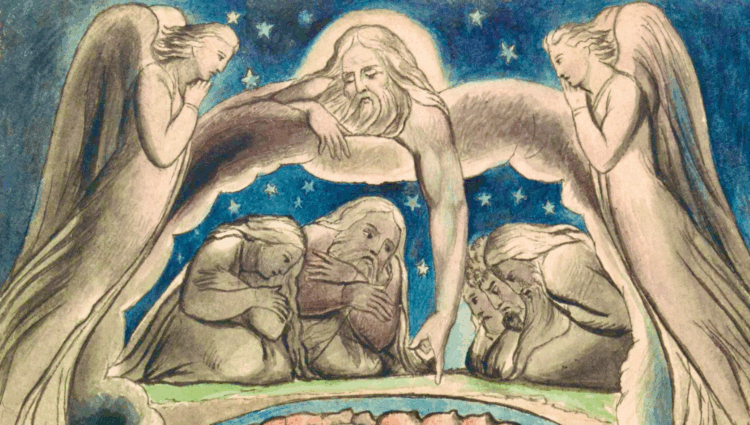
The featured image is “Behemoth and Leviathan” by John Linnell, and is in the public domain, courtesy of Wikimedia Commons.