THERE have been suggestions that Storm Goretti, which brought winds and snow a couple of weeks ago, was the worst storm to hit the South West since the Great Storm of 1703, generally recognised as the most powerful to hit Britain in recorded history.

The claim, which is patently absurd on every level, is based on the fact that wind gusts of 99mph on the Scillies were apparently the highest on record there:
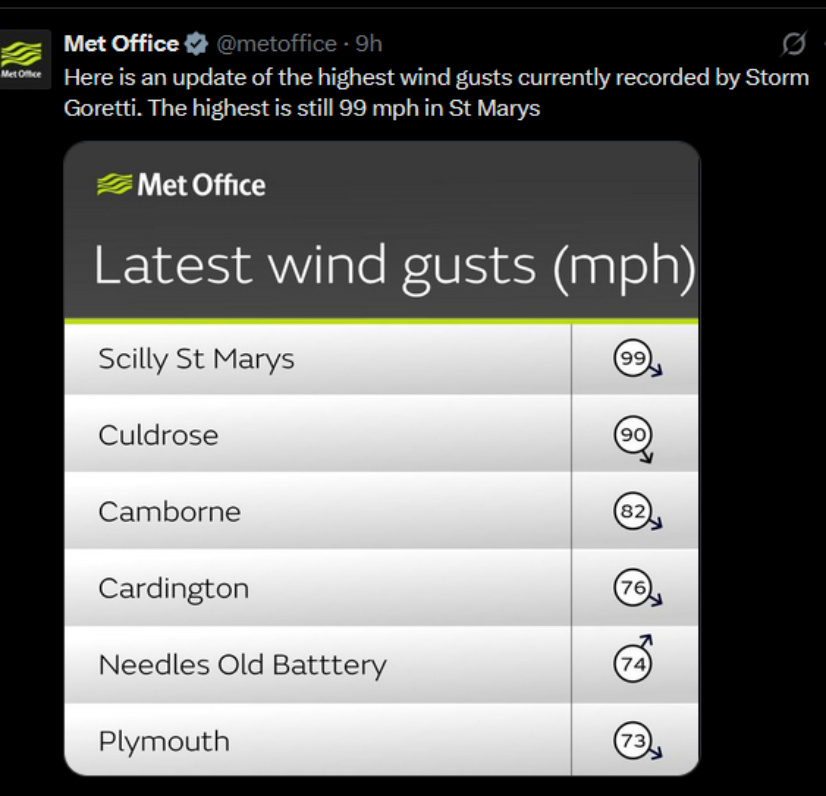
Wind speeds are usually higher on the Scillies than the mainland, exposed as they are 28 miles out at sea. The highest wind speeds in Cornwall during Goretti were only 90mph at RAF Culdrose, not exceptional in the least.
There have been other far more powerful storms in the region in recent years. The notorious Burns Day storm in 1990 brought winds of 107mph to Cornwall. But that paled into insignificance compared with the 118mph winds that hit Gwennap Head in 1979 – officially the strongest winds to hit the South West since digitalised records began in 1969.
But what about the Scillies? How come they had ‘record winds’ this month?
I asked the Met Office for wind speed data for the Scillies during the 1990 Burns Day storm. They told me that the St Mary’s Airport site started supplying data only in 1991. Previously data came from a nearby site on the island of St Mary’s – but crucially, that data stopped in 1981. There was therefore no data at all for the Scillies during the Burns Day storm.
Now, just take another look at the Met Office claim of a record:
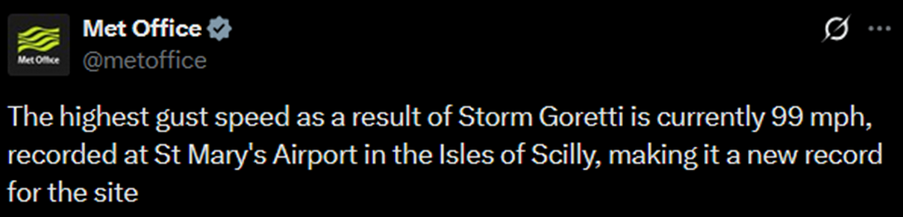
It is a record for the ‘site’, ie the airport, not the Scillies as a whole. In other words, it is only the highest wind speed since 1991 – still a powerful storm, but not the ‘once in 200 year event’ it has been portrayed as.
For reference, Met Office data shows that winds of 114mph were measured at Scillies St Mary’s during that 1979 storm. Last time I checked, 114 was higher than 99.
It is widely accepted that climatological records should be officially ratified only where there is a reasonably long data record, ideally at least 50 years. But the Met Office make a habit of ignoring this rule and claiming records at sites with just a few short years of data.
A classic example is the Needles, the rocky outcrop at the end of a long peninsula on the tip of the Isle of Wight. You could not find a better place for the highest wind speeds. Sure enough, the site holds the record for the highest winds ever recorded in England. The weather station there was established in 1996.
The top of Honister Pass in the Lake District is arguably the wettest spot in England, and unsurprisingly it often tops the rainfall lists. The Environment Agency started recording rainfall there in 1990.
The Met Office, of course, love to proclaim these ‘records’, as it helps them push their ‘extreme weather’ agenda.
But science it ain’t!
Trump pulls rug from under Paris Agreement
THE news that President Donald Trump has pulled the US out of several UN organisations seems to have attracted little attention in the media here.
But it could be one of the most far-reaching decisions of his presidency. One of the organisations involved is the little-known UNFCCC, the United Nations Framework Convention on Climate Change. It was established in 1992 to stabilise greenhouse gas concentrations and combat human-induced climate change, providing the framework for major agreements such as the Paris Agreement and Kyoto Protocol, with its secretariat supporting negotiations and implementation among its 198 member countries. It serves as the parent treaty for subsequent climate actions.
All sounds a bit bureaucratic. But the UNFCCC is the legal treaty foundation for the Paris Climate Agreement in 2015. Because Paris itself was not classified legally as a treaty, only an ‘agreement’, it did not need to be ratified in the US Senate. Obama signed it using his executive powers.
In his first term, Trump withdrew from Paris, but Biden simply opted back in again as soon as he was elected. Trump again pulled out of Paris last year, but there is nothing to stop a future president rejoining in future.
But legal experts now believe that withdrawal from the UNFCCC means that any future president will have to resubmit ratification to the Senate if they want to rejoin Paris.
Marc Morano of Climate Depot tells the story on Fox News:
There is very little chance that a future Democrat president could get the Senate to ratify a treaty to rejoin the UNFCCC or by implication the Paris Agreement. To get a treaty ratified by the Senate demands a 60-40 majority.
In 1997, the Senate passed the Byrd-Hagel Resolution by a unanimous 95-0 vote, which stated that the US should not sign a climate treaty that would ‘mandate new commitments to limit or reduce greenhouse gas emissions’.
This was why Bill Clinton never even put the Kyoto Treaty to a vote a few months later.