A political system, however efficient, cannot be good if it clashes with ethics. We have to work for the restoration of local autonomy. There are things in which centralized control is necessary and beneficent; but there is a vast multitude of things in which it is unnecessary, and derogatory to human freedom and responsibility.
 Man is by nature a social animal; this is the basic principle of the Thomist theory. Political society therefore is indicated by nature not only as a means of security and material welfare but also as an indispensable means to the positive attainment of the best life. The man who lives in isolation, as Aristotle remarked, is either subhuman or superhuman. If then to live in society is demanded by the end of human nature, it is a matter of moral obligation, for physical necessity with regard to the achievement of the natural end becomes in man an ethical imperative. The theory of a free contract therefore is not in se acceptable. What is the acceptable element in it? Simply this, that while political society in general is of natural law, the particular form which this or that society takes can theoretically be a matter of agreement, and will indeed necessarily differ according to divergent racial temperaments and characteristics—a fact sometimes overlooked by empire-builders.
Secondly, if the social life is a necessary condition of the good life, it follows, as we have seen, that in some respects the society exists for the sake of the individual. But not in all respects. The common good, according to Aristotle and St. Thomas, is “more divine” than the particular good of each individual inasmuch as the good of the whole takes precedence over that of the part. Aristotle’s hylomorphism is here applied: the individuals are in one respect the materials of the State, as bricks are of a house, and the end of the community is therefore greater than the sum of the ends of its parts, as that of the house is greater than the sum of the ends of the bricks.
It is a man’s duty therefore to act for the common good, the building up of a good social life—a good city, let us say, harmoniously functioning as an organism, each part perfect in its proper function. Each part perfect: in theory the common good includes all individual goods. In practice it is otherwise, for men do not act consistently according to reason, and a state of tension inevitably results which makes it necessary to delimit the rights and make plain the duties of citizen and State. Moreover, the common good is not a fixed thing; it varies according to circumstance, and in time of crisis the good of the individual must be sacrificed for the preservation of the whole society.
But men are not merely parts of a whole, cogs in a machine. They are self-subsistent, rational. They have personality, and a capacity for, and natural orientation towards, the contemplation of the truth. As persons they are not parts of a whole, but sui juris—they stand alone; as contemplative they have a perfection to achieve which is personal to themselves. And it is in the achieving of this perfection that the good life principally lies. Society then in its turn has a twofold obligation: it cannot interfere with this private and personal end; it must on the contrary foster it by providing the proper material setting for it. The starving man cannot contemplate; nor can the man who is over-active; contemplation demands a certain degree of wealth and leisure.
And what of sovereignty? It is clear that all cannot govern all—the power must be vested in somebody. A priori and in theory, according to St. Thomas, monarchy is the most perfect form of government, but he is too realist to leave the matter there. He was not familiar with courts for nothing. In practice, he holds, the regime most likely to succeed is a limited monarchy, for this provides the most efficient check on attempts at abuse of power.
It will be seen that the thomist politic agrees to some extent with all the varying theories of the State. With Spencer it holds that the State is an organism, though it refuses to allow that individuals are no more than cells in the organism: the principle of functional society emerges. With Plato’s Republic and all forms of communism and collectivism it holds that the end of the society is greater than the ends of the individuals who compose it, while refusing to admit that the State is omnicompetent and supreme: the principle of social ethic emerges. Even with Hegel’s pantheism it has this affinity, that it views the evolution of the society as a process of divinization—the working out of the divine idea in the material of human relationship—the principle of common striving after the bonum commune emerges. With the Contrat Social of Rousseau it has this much in common: that while denying the thesis that society is the outcome merely of convention, and the pseudo-mystic deification (political pantheism) of the General Will, it can see in the latter postulate the truth that there ought to be a general will, if not in the sense understood by Bosanquet (as a real or higher as opposed to an apparent or lower satisfaction of individual wills—Rousseau was not as subtle as this) at least in the sense of a striving after a common objective more divine than that of the will of each. With Hobbes and Locke it holds that the State must protect and safeguard the citizens’ perfection; but it will not narrow the scope of State action to this negative policy—what Bosanquet calls the hindering of hindrances—alone: on the contrary, to the principle of non-interference with the personal end of the individual and the safeguarding of individual rights it adds the positive duty on the part of the State of fostering actively the individual’s perfection by assuring him the material environment necessary for achieving it.
The same is true of the contemporary alternatives. Thomism is fundamentally opposed to totalitarianism in its denial of personal end and rights, though at one with its search for unity and a common goal. It is fundamentally opposed to individualism on the grounds of its social irresponsibility, its denial of the supremacy of moral law and of the rights of the society against the individual; but at one with its assertion of the validity of personal ends. It denies totally the omnicompetence of the State; but welcomes any political structure which expresses its two basic principles, of personalism and of social function. On the one hand, it sees society as an organism wherein each member has his function and therefore his duties to the whole community; duties which, as the bonum commune varies—for it will be a very different thing in time of prosperous peace and in time of war or famine—will demand more or less sacrifice and make possible to a greater or less degree the identification of the individual perfection with that of the whole. On the other hand, the citizens are persons, and the society therefore as a whole has the duty of respecting, safeguarding and positively promoting the personal good of each citizen. And as these mutual responsibilities are dictated not by utilitarian agreement but by natural law—the demands of human nature as such—their sanction is a moral sanction: the citizen is morally bound to further the interests of society, the State to further the interests of the person.…
The two great evils which threaten human society today are, on the one hand a progressive subhumanization, on the other hand, sudden and perhaps total destruction through nuclear warfare. The absolutist State forces subhumanity upon its subjects by treating them as cogs in the political machine; the liberalist State, by developing into a plutocratic oligarchy or an impersonal and anti-personalist bureaucracy, brings about the same result in a more underhand fashion. Subhumanity will not be remedied by partial expedients, any more than international chaos will be cured simply by talking of peace.…
A political system, however efficient, cannot be good if it clashes with ethics. We have to work for the restoration of local autonomy. There are things in which centralized control is necessary and beneficent; but there is a vast multitude of things in which it is unnecessary, and derogatory to human freedom and responsibility. Let us have centralized control; but let us have as our first concern, in Disraeli’s words, “that parochial polity of the country which secures to every labourer a home,” and, he might have added, a safeguard and a setting for the increase of his soul.
__________
This essay is taken from Morals and Man. Republished with gracious permission from Cluny Media.
Imaginative Conservative readers may use the code IMCON15 to receive 15% off any order of not-already discounted books from Cluny Media.
The Imaginative Conservative applies the principle of appreciation to the discussion of culture and politics—we approach dialogue with magnanimity rather than with mere civility. Will you help us remain a refreshing oasis in the increasingly contentious arena of modern discourse? Please consider donating now.
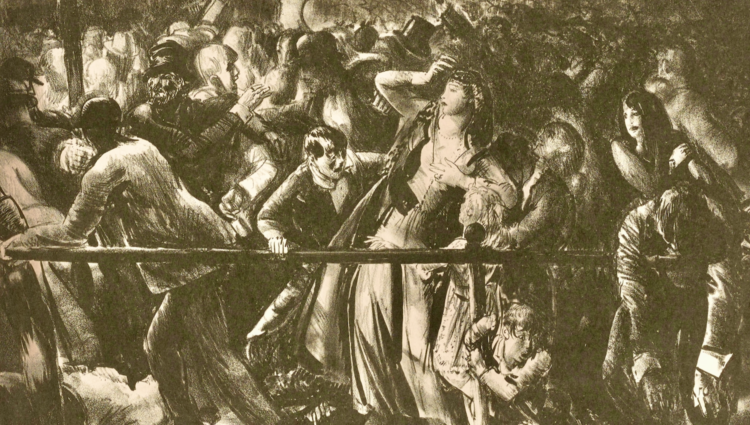
The featured image is “The Crowd,” by George Bellows (1882-1925), and is in the public domain, courtesy of Wikimedia Commons.