The Great Books bring us into communion with humanity, that expansive group of neighbours to which we owe allegiance and, in consequence, to which we owe obedience in terms of the need to give to our neighbours the love which is due to them.
 I’m very encouraged by the mission of Hildegard College, an undergraduate institution in the Great Books tradition recently founded in southern California. Taking its name from St. Hildegard of Bingen, the twelfth century nun and Doctor of the Church, the college is not, in spite of its choice of patron, a Catholic institution but is described on its website as “an ecumenical Christian institution”. Its faith statement indicates that the college adheres to “a historical and orthodox Christian faith, including the definitive doctrines the Holy Trinity; the passion, death, and resurrection of Jesus; original sin; human dependence on divine grace for salvation; and the life of the world to come.” It can be seen, therefore, as being broadly ecumenically “orthodox” in C. S. Lewis’s “merely Christian” sense or in the manner advocated by G. K. Chesterton in his book Orthodoxy, which rooted the highest common factor of authentic doctrine in the Apostles’ Creed.
Being supportive of the mission of Hildegard College, I am intrigued by a recently published essay by its president and co-founder, Matthew J. Smith, entitled “The Western Great Books Debate Continues”. He begins, as might be expected, with an eloquent and succinct defence of the Great Books themselves and what Mortimer Adler called “the Great Tradition” which furnishes the “Great Conversation” of western civilization. This could be said to have started with the founding of the great European universities in the middle ages, which emphasized philosophy and theology, especially the works of Aristotle, Boethius, Cicero, St. Augustine, St. Gregory the Great and St. Jerome’s Vulgate. In the high middle ages, the work of St. Thomas Aquinas became a key part of the canon.
The secularizing of the canon, and therefore of the tradition and the conversation, began with the Renaissance Humanists who added Homer, Livy, Tacitus and Ovid. There was also a revival of interest in Plato, whose work had been largely eclipsed by the Aristotelianism of Thomas Aquinas, the latter of which had dominated the philosophical conversation in the thirteenth and fourteenth centuries. Dr. Smith writes that “early modern school curricula, influenced by figures like Erasmus, shifted emphasis to rhetoric, adding Quintilian and Horace, and eventually also the vernacular Bible” to the conversation.
It was not until this centuries-old tradition began to be attacked by modernists, Marxists and other anti-traditional cultural iconoclasts that battle lines were drawn. In the 1930s, Mortimer Adler and Robert Maynard Hutchins defended the Great Tradition from those trying to cancel it. Their success in “canonizing” the Great Books ensured that the Great Conversation would continue in spite of the continual heckling of those trying to silence it.
It is to these hecklers to whom Dr. Smith turns in his own attempts to defend the Great Books. He is less successful than he could and should have been because he is not radical enough in his critique and perhaps his understanding of the enemy he is facing. Part of the problem, at root, is what appears to be his own philosophy of education. I will let him speak for himself:
[M]uch of what it means to become formally educated involves learning to identify yourself less with a reductive group identity and more with your own thoughts. Growing intellectually entails becoming an independent thinker, coming to own one’s ideas, so that one’s uninformed beliefs become justified beliefs.
There are several problems with this understanding of education. The most important is the implied cartesianism and relativism of the idea that we can “identify” with our “own thoughts”. There is nothing more “reductive” than one’s self. Nor is one’s self identifiable in itself. As G. K. Chesterton reminds us, “the self is more distant than any star”. The purpose of the self is to see itself and to understand itself in the light of what is beyond itself. This is the escape from the self-imprisonment of subjective opinion and prejudice into the freedom of objective reality and the objective truth that objective reality reflects. It is engagement with the great minds who wrote the Great Books which enables us to make this great escape from the shrivelled smallness of the narcissistic self. It is engagement with the Great Conversation that the Great Books facilitate that liberates us from identifying too much with our own thoughts.
A Great Books education enables us to identify less with ourselves and more with the expansive group identity known as humanity. It enables us to see that we are not isolated or alienated or self-sufficient individuals, lost in our own thoughts and trapped in our own microcosmos. The Great Books bring us into communion with humanity, that expansive group of neighbours to which we owe allegiance and, in consequence, to which we owe obedience in terms of the need to give to our neighbours the love which is due to them.
In brief and in sum, we cannot defeat the enemies of the Great Books with their own relativism. We can only defeat them with the wisdom that the Great Books themselves bring to the conversation.
__________
The Imaginative Conservative applies the principle of appreciation to the discussion of culture and politics—we approach dialogue with magnanimity rather than with mere civility. Will you help us remain a refreshing oasis in the increasingly contentious arena of modern discourse? Please consider donating now.
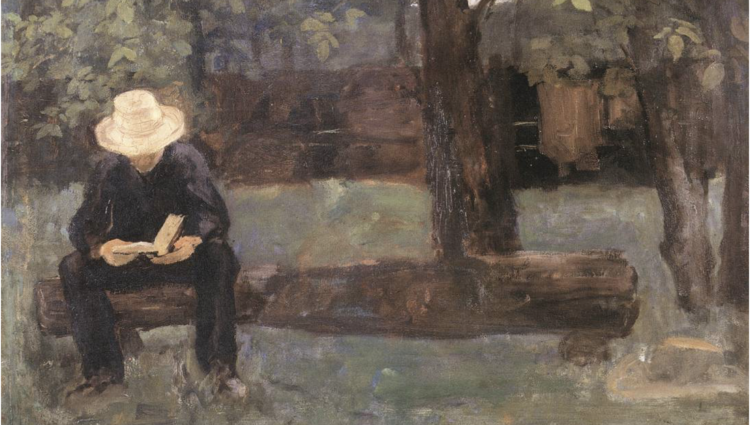
The featured image is “Man Sittings on a Log” (1895), by Károly Ferenczy, and is in the public domain, courtesy of Wikimedia Commons.