
IT WAS a time of darkness, so the enlightened ones said, when people were thick, uncouth and barbarous. Not so, we were told, was this during the classical age when big questions were asked about ethics, logic, and the natural world, when myth and divine authority were marginalised, and when architectural styles encompassed harmony and proportion that, we were told, reflected the beauty and sophistication of antiquity. Yet come the fall of the Western Roman Empire to Alaric the Visigoth in AD 410, darkness would reign until the ‘Enlightened ones’ of the period that has come to be known as ‘The Enlightenment’, self-styled of course by one of its darlings, Immanuel Kant, that ‘this sleep of forgetfulness’, to cite the Renaissance poet Petrarch, was finally ‘dispersed’ for all now to live once again ‘in the former pure radiance’. And so, the Western liberal moderns would carry this myth over generations to discredit all that was between Alaric and Kant with a few proto-Enlightenment exceptions that graced the so-called Renaissance. This was a world of Liberté, égalité, fraternité and of Whig teleological victory, a world in which Man stood triumphant over his creation, a world in which secularism, almost neo-paganism, prevailed over organised religion, a world averse to anything Catholic, a faith associated with everything undesirable; that is a world until it no longer was, or more to the point, was it ever thus?
Of course no period in history was ever as its patrons say it was. The virtues of the classical world sat easily with its vices, or those practices that all around respectable dinner tables would eschew, its deep hierarchy, patriarchy, elitism, crucifixion and reliance on slavery. In fact, no sooner had the ‘Enlightenment’ been announced to the world, than the first cracks in its ideological structure began to appear, the violence of revolution, the challenge of Romantic emotion and Herder’s cultural particularity. Even from within were doubts sown about its optimism, with Rousseau warning of Man’s propensity for corruption. All this even before nineteenth century conservatives got their hands into it with the likes of Burke assailing its abstract reasoning and universal rights for undermining organic, historic institutions or collectivists such as Marx critiquing its liberalism and individualism for masking class domination and capitalist exploitation.
It would be similarly problematic to view the medieval age as one of ubiquitous virtue and joy. The almost unbroken warfare, plagues, famine, population decline, low literacy rates, and persecutions by marauding strongmen saw to it that it most certainly was not. Yet it also was a time of immense transformation that saw inventions such as the mechanical clock, eye glasses and the heavy plough, and improvements to inherited technology such as windmills. It produced great centres of learning in Oxford, Bologna, Paris and elsewhere that nurtured great thinkers like Boethius, Anselm, Aquinas and William of Ockham. It fashioned engineering marvels like the Romanesque and Gothic cathedrals and produced the illuminated manuscript, early music notation, and epic poetry. Dark the Middle Ages certainly were not; grim – sometimes, a time which only a foolish man would dismiss as redundant for the modern age. But alas, many a foolish man and woman have ascended to great heights in this age of ubiquitous political chaos, corruption and incompetence, their deeds surely put to shame when juxtaposed with those of their predecessors of a distant past.
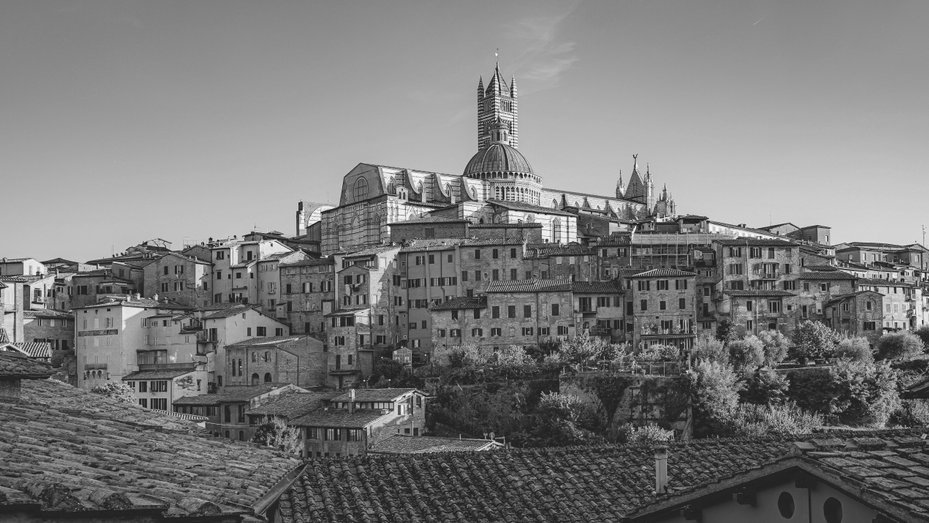
A striking example is offered by early fourteenth century Siena, whose elected council of Nine provided a model of governance. Guiding its wisdom was a piece of extraordinary art by local master Ambrogio Lorenzetti, whose The Allegory of Good and Bad Government provided both instructions on how to govern morally and virtuously and a warning of the consequences of ignoring the advice. It was created at a time of political and social instability on the Italian peninsula, with Siena’s merchant classes and banking establishment ever fearful of a descent into violent factional strife and political corruption. Commissioned by the councillors in 1338 and composed of a series of six frescos, the artwork is located in the council chamber of Siena’s Palazzo Publicco, facing the politicians to serve as a daily reminder of their moral and civic responsibilities.
The piece deals with the pressing issues of the day which have changed little over the subsequent 700 years. In Good Government, Justice is central, balanced, and tied to Concord (harmony) and where citizens co-operate for mutual benefit. Facilitating this is Lorenzetti’s good ruler who is surrounded by the key virtues of Peace, Fortitude, Prudence, Magnanimity and Temperance which are there to guide him towards moral responsibility and foresight, rendering him accountable to the people he serves. The impact of his governance is shown in a well-maintained, thriving city in which people are working, trading, building and dancing and whose affluence is extended to the countryside.
The contrast of Bad Government is all too clear: ruin and chaos, epitomised by crumbling walls, violence, poverty and fear. It is a place where justice is bound and silenced and replaced by tyranny and greed, and where accountability, ethical reflection and awareness of consequences are absent.
Siena’s golden age lasted roughly 150 years, from the late twelfth to the mid-fourteenth century. It was a time which saw strong civic identity, social stability, and much investment in infrastructure and art and where Duccio di Buoninsegna, Simone Martini and Lorenzettiplied their trade to define the city’s magnificent School of Paintingwhich blended spiritual and civic ideals. Unfortunately for Siena, however, its political elites disregarded Lorenzetti’s advice, and by the middle of the century, the city descended into the chaos that had long been feared. In 1355, its citizens, angered by corruption and mismanagement, revolted. The sudden labour shortage and financial collapse brought on by the Black Death weakened the merchant class that had supported the Nine, who were duly overthrown which initiated a long period of instability, factionalism, external interference, and eventually domination by its neighbour and rival, Florence.
Although brilliantly crafted, The Allegory of Good and Bad Government is far more than a piece of decorative art; it is one of the most profound visual commentaries on politics and ethics ever created. The fresco cycle doesn’t just illustrate medieval civic ideals but visualises the consequences of choices in ways that modern societies, from democracies to corporations, ignore at their peril. Its sophistication lies in its transcendence of puerile ideology that so dominates today’s political discourse, reminding us that good governance is less about ideology than about a fundamental feedback loop whereby justice leads to trust which begets prosperity which reinforces justice. Break the loop, and society burns. Lorenzetti vividly warns that when governance prioritises self-serving elites rather than justice, the result is not only political oppression but economic collapse and cultural decay.
Surveying contemporary Western societies, their broken institutions, factional strife, crime-infested cities, crumbling infrastructure, rural decay, oppressive legal systems, cultural vacuity and subservience to foreign oversight, one is struck by just how far the modern age has descended into barbarism. And at the root of all this lies the very causes that Lorenzetti associated with civilisational decay.
Although Siena’s golden age was relatively short-lived, its substance was resplendent, which can still be gleaned today from its architectural and artistic splendour. Once considered by men driven by haughty opinion to be part of a lesser time, Siena’s distant past, in Lorenzetti’s 700-year-old art, is alive in wise counsel that teaches that the fate of society rests on justice, virtue, and shared responsibility: lessons that remain urgent in an age that has lost its way.








_-_WGA13487.jpg)