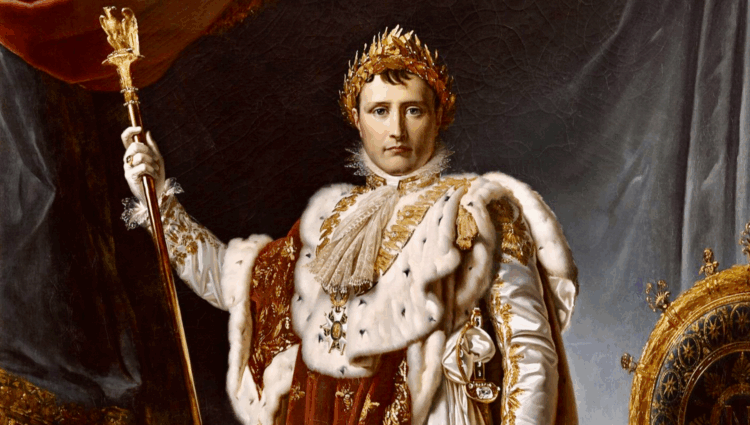
Eager for legitimacy and filled with the lessons of history, Napoleon Bonaparte knew that the title of Emperor that he had just assumed would not be irrevocable in the eyes of his subjects until he had become “the Lord’s Anointed,” like the kings of France.
 Events since the Concordat had unrolled an endless carpet of glory before the First Consul. His popularity had increased from day to day. In May 1802 the Senate had proposed that the consulate should be guaranteed to him for another period of ten years. Cambacérès and the Council of State, going still further, had suggested that a plebiscite should confer the consulate on Napoleon Bonaparte for life; and France had favoured this proposal by three million five hundred thousand against eight thousand three hundred votes. Two decrees of the Senate had inaugurated the new regime within the framework of the Constitution of Year X, and thereby greatly increased the powers of the head of State. The government had forged in quick succession two fresh instruments of authority: the Legion of Honour, which would surround it with a new and loyal nobility, and the high schools, which would train the youth of France to sound principles. The regime had also strengthened its position by promulgating the Civil Code and by a remarkable economic recovery.
Bonaparte, however, wished to go still further. He was well aware that the majority of Frenchmen, and the clergy in particular, retained an instinctive preference for the monarchical system. An abortive royalist conspiracy of March 1804, followed by the execution of the young Duc d’Enghien, snapped the last links with the Bourbons and their adherents, who were compelled to face the fact that Bonaparte was working not for the king but for himself. The Consul had already adopted a quasi-royal way of life: a regular court had been instituted at the Tuileries. Amid the excitement caused by the conspiracy it was easy for Fouché and the more zealous servants of their master to obtain from the Tribunate on May 3 a motion inaugurating the Empire. This motion became law by vote of the Senate on the eighteenth, and Napoleon Bonaparte became Emperor of the French.
Eager for legitimacy and filled with the lessons of history, he knew that the title he had just assumed would not be irrevocable in the eyes of his subjects until he had become “the Lord’s Anointed,” like the kings of France. Even before the legal establishment of the Empire by the Senate, Napoleon had confided to Cardinal Caprara during a reception at Saint-Cloud that he wished to be crowned by the Pope at a ceremony which would take place in Paris. This request placed the Curia in a very difficult position: must they confer on a man who was giving so much cause for complaint a privilege that would set him above all the Catholic princes of Europe? There was only one precedent, and even then, when Stephen II came to crown Pepin the Short, the latter had promised to fulfil the Pope’s “every demand and request.” Moreover it was doubtful whether the Sovereign Pontiff was entitled to absent himself from Rome for several months in order to please a single ruler; and those members of the Curia who would accompany the Pope to Paris did not enjoy the prospect of visiting a country which was represented to them as atheist, impious and even worse.
No fewer than five months of negotiations were required before Napoleon’s ambition was achieved, and more than once it seemed that they would come to grief. For example, the constitutional oath which the Emperor had to take at his coronation appeared to include the Organic Articles, and was therefore unacceptable to the Holy See. There was also difficulty over the possible presence of former constitutional bishops at the ceremony. But Pius VII decided on his own to accept the invitation. What was his motive? Gratitude towards the signatory of the Concordat, or the wish to seize an opportunity of direct talks with Napoleon on a number of outstanding questions? At all events, the “capital interests of religion” seemed to demand a favourable reply. On the French side the Emperor was so determined that the coronation should proceed in the manner he desired that he was ready to take all steps necessary for the attainment of his goal.
Pius VII left Rome on November 2 with a retinue of forty persons, after delegating his powers to Consalvi. He had reason for anxiety: how long would he be living far from Rome? His absence was in fact destined to last for nearly five months. Again, what sort of reception would he get in France? As things turned out, the warmth of his welcome among the rank and file exceeded anything that could have been expected; but the Emperor received him with somewhat less cordiality, and Pius VII quickly realized that the haughty sovereign he had come to crown was prompted by hidden motives in his dealings with the Holy See. The Pope, however, was prepared to overlook much for the sake of being able to discuss matters which he regarded as of paramount importance, and difficulties were resolved in a spirit of magnanimous conciliation: the Pope would not be present while the constitutional oath was sworn; the Emperor would be dispensed from communicating at the Mass, and, of course, from prostrating before the Pope as Louis XVI had done before the Archbishop of Rheims.
At the eleventh hour an incident occurred which nearly wrecked the whole proceeding. On the eve of coronation day Napoleon’s wife Josephine asked for an audience of the Holy Father, and informed him that she had been through no more than a civil marriage with her imperial spouse. Distressed by the discovery that he had been wilfully deceived, Pius VII acted with firmness: he demanded that the religious marriage should be performed at once, failing which he would take no part in the coronation. He gave permission, however, for a quasi-clandestine ceremony at which Cardinal Fesch would officiate alone, in a room in the Tuileries. And so it was done. Through the guile of a woman who hoped to assure her future, the all-powerful emperor was driven to “forced marriage.”
Next day, December 2, the coronation took place with a degree of splendour and magnificence worthy of the Capetians. The weather was fine, albeit cold; the thunder of salvoes and the peal of bells echoed in the keen pure air. In front of Notre-Dame David had erected an elaborate triumphal arch. Inside, tapestries and velvets hung from the galleries and vaulting. Pius VII arrived on time, but had to wait two hours before the procession entered. Then Mass began; the ceremonial in broad outline followed that used at the coronation of the kings of France, but the unctions had been simplified. During the Introit the sword, sceptre, orb and hand of justice were blessed by the Pope, who handed them to Napoleon with a reminder that the powers thus granted him should be employed to protect the Church of God and her members. Then the Emperor himself took the crown from the altar and set it on his head, as had been previously arranged; after which he placed a diadem on Josephine’s brow while the choir intoned Vivat Augustus in aeternum.
For the moment all was triumph. But what had the Pope gained? And what would he gain during the four months he spent in Paris hoping to succeed in negotiations that he had so much at heart? In vain the theologians of the Curia made representations on the subject of the Organic Articles; they met with an absolute refusal even to discuss the matter. As regards Melzi’s decrees, their overtures were equally fruitless; the Emperor replied that he wished to respect the freedom of the Italian Republic—an altogether fatuous answer, since he was preparing to make a kingdom of that republic with himself upon the throne. The only important point on which the Holy See made any progress was the situation of constitutional bishops who had been nominated by Napoleon but had not retracted. Persuaded by Napoleon himself of the uselessness of their resistance, they yielded.
__________
From “The New Charlemagne,” in The Church of the Revolutionary Age: Facing New Destinies, Volume 1
Republished with gracious permission from Cluny Media.
Imaginative Conservative readers may use the code IMCON15 to receive 15% off any order of not-already discounted books from Cluny Media.
The Imaginative Conservative applies the principle of appreciation to the discussion of culture and politics—we approach dialogue with magnanimity rather than with mere civility. Will you help us remain a refreshing oasis in the increasingly contentious arena of modern discourse? Please consider donating now.
The featured image is “Napoleon I as Emperor” (1805), by François Gérard, and is in the public domain, courtesy of Wikimedia Commons.