Restorationist church movements—whether they be traditionalist Catholic or Protestant sects—are products of their contemporary culture: well-meaning but artificial attempts at restoration, which end up being no more than the past viewed through a half-baked ecclesiology and a rose-tinted theology.
 As a boy, I attended a church that was founded in 1962. It grew out of a group of young Christians meeting together in their homes for Bible study. Disenchanted with the liberal drift of the mainstream Protestant denominations, they decided to get back to basics. They did not believe they were doing anything new. Instead they believed they were returning to the simple principles of the early church.
From their reading of the New Testament, they thought that, unbound by the “traditions of men”, the first Christians met in homes to sing hymns, study the Bible, and pray together. Eventually the founders of our little independent church wrote a constitution, bought land, and built a church building and school. They did not regard this as anything more than a natural outgrowth of their first, simple communal meetings in their homes.
The idea that a new church or denomination is really a return to the simple, early days of Christianity is called Restorationism. It is the religious expression of an underlying assumption called Primitivism, which is the belief that some earlier, simpler, and more basic society is better than the present one.
Christian Primitivism and its active expression, Restorationism, is not only written into the genetic code of Protestantism, but it also underlies much of the traditionalist Catholic mentality. Whether it is in religion, politics, or the arts, Primitivism is a natural instinct and a seductive ideal, but embedded in it are fallacious assumptions.
Before examining those assumptions it is worth being reminded of the history of Restorationism in the church.
The first Christian sect to have fallen into the trap were the Montanists in the mid-second century. Like modern-day Pentecostals, the Montanists emphasized the work of the Holy Spirit, evidenced in private revelation and prophecy. The Montanists’ opposition to the organized church and ‘loyalty’ to the Holy Spirit suggest a restorationist agenda.
Restorationism is invariably linked with a desire for uncompromised purity of doctrine and morals. Thus, the Novatian and Donatist sects of the third and fourth centuries also displayed a restorationist zeal.
Reacting to corruption in the post-Constantinian church, and questioning how to deal with those who compromised the faith during the Diocletian persecutions, the Donatists insisted on the moral purity of their clergy—deciding that the sacraments of compromised clergy were invalid. While Restorationism was not their essential ideal, the Donatists, like the Novatians, insisted on a pure and unadulterated church, revealing one of the main concerns of restorationist movements.
While the ancient schismatic groups had primitivist tendencies, the first group to be clearly motivated by restorationist zeal were the Paulicians. They were founded in the mid-600s by an Armenian named Constantine, who claimed to be restoring the pure Christianity of St Paul. The Paulicians were Adoptionists (believing that Jesus became the Son of God at his baptism). Influenced by Manichaeism, they rejected infant baptism, the clergy, monasticism, the doctrine of the real presence, and all iconography.
In Bulgaria three hundred years later a new shoot sprang out of the Paulician sect. The Bogomils (meaning Dear Ones of God) grew in reaction to what they perceived as the corrupt established church of their time. They met in their own homes, rejected the priesthood, rejected the doctrine of the real presence, and believed that all should be taught by the simple- minded. They also rejected monasticism and did not accept marriage as a sacrament. Like the Paulicians, the Bogomils were dualists—believing in equal good and evil forces in the world.
Henry the Monk and Waldes (from whom the Waldensians are descended) were wandering preachers in the twelfth century, who lived simple lives and preached against the corruption of the church. They gathered groups of disciples around them, while at the same time the Cathars carried on the dualistic and heretical teaching of the Bogomils.
All these pre-Reformation groups were primitivist in their beliefs and restorationist in their actions. As such they were the pre-cursors of the Franciscan and Dominican movements in the twelfth century, but they were also proto-Protestant—their anti-establishment ideals picked up in Bohemia in the late 1300s by Jan Hus, whose writings subsequently inspired Martin Luther a hundred years later.
While Luther and Calvin initially wished to reform the established church, the more extreme Protestants were more iconoclastic in their restorationist zeal. The Hussites and the Anabaptists were the most radical, and it is the radical restorationism of the Anabaptists which comes down to us today as the grandaddy of all the subsequent restorationist movements.
The Anabaptist line continued in the New World through the Quakers, Shakers, and other sects, to the Landmarkists, who claim a line of succession for Baptists right back to John the Baptist. The Calvinist and Wesleyan ‘Great Awakening’ in the eighteenth century was radically restorationist, followed by the similarly restorationist ‘Second Great Awakening’ in the United States, but by now the Restorationists were not only reacting against the Catholic Church, but against all the other historic Protestant denominations.
Through the nineteenth century in America, wave after wave of restorationist churches sprang up: the Christadelphians, Christian Conventions, Seventh Day Adventists, Latter Day Saints, and Jehovah’s Witnesses. At the same time, a strong restorationist movement (the Cambellites) fostered localized independent groups like the Churches of Christ, Disciples of Christ, and the Christian Church.
The tradition continues today with each new wave of Protestantism reacting not only against Catholicism and liberal Protestantism, but also against the previous generation of Restorationists. In the 1960s, my family helped found one of many independent fundamentalist Bible Churches. Then in the 70s, the charismatics, with their house churches and local communities, picked up the restorationist baton. The eighties saw the growth of charismatic mega-churches like John Wimber’s Vineyard and now a whole range of local community churches fly the restorationist flag.
There are eight problems with Primitivism and Restorationism. Five have to do with Restorationism itself, and three go to the roots of the primitivist instinct.
Firstly, each restorationist movement, although it seeks to return to the ancient church of the apostolic age, actually reflects the spirit of the age. For example, the Bogomils were part of a larger peasant revolt in a culture weighed down with corruption and aristocratic influence. The radical reformers in sixteenth-century Europe and the New World were influenced by the utopianism, the rise of the nation-state, and revolutionary spirit of their age.
Similarly, the American restorationist movement of the eighteenth and nineteenth centuries was determined more by the independent, anti-establishment mentality of the American frontier than by any real reference to the church of the apostolic age. Restorationists believe they are restoring something ancient. In fact, all they do is create an expression of Christianity that is a reflection of the circumstances and assumptions of the age in which they live.
Secondly, while restorationist movements are reflections of the particular age in which they live, they are also conditioned by the long history of restorationist movements. For hundreds of years Protestants have perpetuated a particular vision of the early church. Each new restorationist movement borrows those ideas, never questioning whether the tradition they are inheriting is actually true to the reality of the early church or not. Therefore, the Restorationist doesn’t so much restore primitive Christianity; he simply replicates earlier restorationist models, re-producing what he has been told early Christianity was like. Rejecting the “traditions of men,” he unconsciously bows to his own unquestioned traditions.
This unquestioned adoption of the restorationist traditions leads to the third problem: The Restorationists are usually ignorant of what the early Church was actually like. They assume that the early church was congregational, not hierarchical. They assume it was non-liturgical and non-sacramental. They assume it was Bible-based. They assume there was no clergy and that the congregation met in people’s homes. They don’t have any evidence for these assumptions, and all of these assumptions are simply not true, or if they were true in some isolated places, they are not the whole truth.
The fourth obvious problem with restorationist movements is that they are blind to their own inherent contradictions. On the one hand, they wish to go back to the basics, but on the other hand, they wish to be ‘relevant’ to the modern age. How can they be both? Can a restorationist church have a radio station? Can they have high-tech worship? Can they have a website? A podcast? What about moral issues? Can a primitivist congregation speak about in vitro fertilization, climate change, artificial contraception, globalization, and a whole range of other contemporary issues? If so, where does he find the information and authority to do so?
The fifth problem with the restorationist movements is that they contradict one another. If each group was simply returning to a beautiful, uncomplicated, and obvious Bible religion, wouldn’t they all agree? Instead the different restorationist movements all disagree with the other restorationist churches, and to make matters worse, the restorationist movements are notoriously fissiparous. If they were returning to a simple, clear, and unadulterated gospel message and church structure, why have they splintered into thousands of separate ecclesial groups?
Beneath the problems with Restorationism are the three inherent problems with the whole idea of Primitivism itself. Primitivism assumes that the earliest manifestation of the institution is the purest and best, but why should that necessarily be so? We know from the New Testament and church history that in every age the church was troubled with corruption. Furthermore, if the primitive church was the pure and unadulterated version, when is the cut-off point? When did the church cease to be pure and primitive—and who decides that?)
The second basic problem with Primitivism is the question, “How can anyone really know what the first-century church was like?” We have archeological evidence. We have Scriptural evidence. We have documentary evidence, but all we can do is the delicate and tentative work of the historian. We cannot really get back into the skin of first-century Christians. We can’t really understand the culture, the assumptions, and the worldview of former Jewish and Gentile Christians in the Roman Empire.
Even if we could come up with an accurate checklist of all the attributes of the primitive church, who would decide which of the attributes we wanted to re-create and which ones we would omit? Shall we have house-churches or mega-churches? Shall we exclude women from ordination, but allow them to not cover their heads in church? Shall we have simple Bible preaching, but not speaking in tongues and miraculous handkerchiefs? Shall we have sacraments but not slaves… Bible studies, but not bishops?
Linked with this problem is the third essential problem with Primitivism, and it is the biggest elephant in the room: “Why should it necessarily be a good thing to re-create the primitive church at all?” We live in the twenty-first century, not the first. Any attempt at recovery can never be anything more than an artificial reproduction—with the same relationship to primitive Christianity as my grandmother’s French provincial dining room suite has to the furniture of Versailles, or Cinderella’s castle at Disneyland has to Neuschwanstein.
The answer is that restorationist church movements—whether they be traditionalist Catholic or Protestant sects—are products of their contemporary culture: well-meaning but artificial attempts at restoration, which end up being no more than the past viewed through a half-baked ecclesiology and a rose-tinted theology… an ersatz church… a pastiche… a notion of what someone imagines the past might have been like, with a dream that it might somehow make the present better.
__________
The Imaginative Conservative applies the principle of appreciation to the discussion of culture and politics—we approach dialogue with magnanimity rather than with mere civility. Will you help us remain a refreshing oasis in the increasingly contentious arena of modern discourse? Please consider donating now.
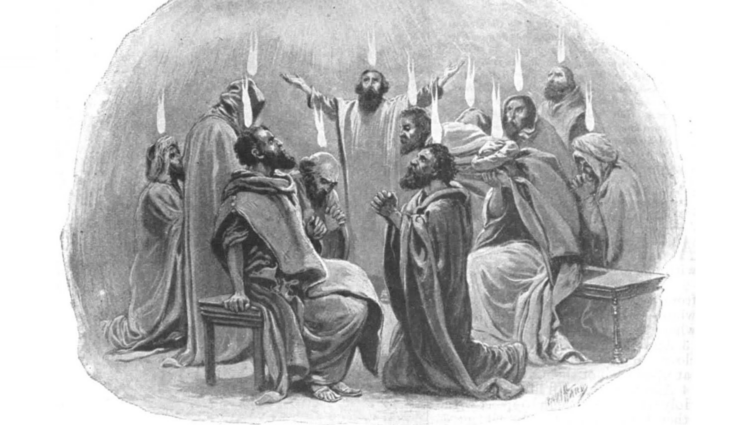
The featured image is “Apostles receive the gift of tongues (Acts 2).” This file is made available under the Creative Commons CC0 1.0 Universal Public Domain Dedication, courtesy of Wikimedia Commons.