 The sacrifice of Christ was totally effective. It could not be otherwise, given that He Who offered it was God. But it is important to grasp what it effected. Whatever it was meant to effect, it did effect. But what was it?
At the moment of His death on Calvary, Christ Our Lord said, “It is consummated.” Something was completed. But something was beginning, too, and the something that was beginning was not simply the paradisial enjoyment by men—either by all men or by an elect or even by Christ Himself—of what He had achieved by His sacrifice, but something with vast labour and anguish and the possibility of failure in it for men, and with work still for Christ to do. Something was completed. But, at the right hand of the Father, Christ Himself continues His work of intercession for us (Heb. 7:25); and we have seen His last days upon earth filled with the preparation of His apostles to continue His work among men until the end of time.
The thing that was completed was the Redemption of the race. The race had sinned in its representative man and as a result was no longer at one with God: so that Heaven was closed to it; bound up with the severed relationship of the race with God there was a mysterious subjection to the Devil: by his victory over Adam the Devil had secured some kind of princedom over Adam’s race, so that he is called the Prince of this World. His princedom carried no legal rights but vast power: in the decree Firmiter, Pope Eugenius IV says “no one has merit of the Mediator.” The primary effect of Our Lord’s sacrifice was the undoing of Adam’s sin. The princedom of the Devil was destroyed. And the breach between the race and God was healed, so that Heaven was opened to the members of the race. This fundamentally is the Redemption.
Let us consider these two results in turn. “If the Son of God was revealed to us,” says St. John, “it was so that he might undo what the devil had done” (1 John 3:8). It is foreign to our habits of thought to attach any real importance to the Devil, that strange intervening third in the relations between man and God. But this is a defect in our mental habits. It can never be intelligent to take lightly anything that God takes seriously. And God takes the Devil very seriously indeed. It will be remembered that when, after the fall of man, God had foretold Redemption, He had not only foretold it to the Devil, but had expressed it in terms of a victory over the Devil: the seed of the woman was to crush his head.
When the hour of the Redemption came, Our Lord was intensely preoccupied with this aspect of it as the struggle between Himself and the Devil issuing in victory for Himself over the Devil. Early in Passion Week He cried out: “Now is the judgment of the world: now shall the prince of this world be cast out” (John 7:31). At the Last Supper He returns to the theme twice: “The prince of this world cometh; and in me he hath not anything” (John 19:30); and again “The prince of this world is already judged” (John 16:11). Why was Our Lord so preoccupied with Satan? It may be because He was restoring the order of reality against which Satan is the great protest, so that Satan’s power was ranged against Him at the peak of intensity. What is interesting is that the Devil so little understood the nature of Our Lord’s mission, that he rushed upon his own defeat. For as St. Luke and St. John both tell us it was Satan who entered into Judas to cause him to betray Christ into the hands of His enemies, thus precipitating Christs redemptive sacrifice. It is some consolation to us to know that an enemy of intellect so powerful is not always well informed.
But the overthrow of Satan’s princedom is only incidental to the healing of the breach between the race and God, by which Heaven is opened to the race of men. Let us repeat that this was something done for the race. John the Baptist had hailed Our Lord: “Behold the Lamb of God. Behold him who taketh away the sin of the world” (John 1:29). There was a sin of the world, and Christ died to destroy it. “Now once, at the end of ages, he hath appeared for the destruction of sin by the sacrifice of himself” (Heb. 9:26). As a result, Heaven was once more opened to men. A man was enthroned there where no man had yet been, a man who had gone there to prepare a place for us. As the Roman Missal has it, in one of the prayers of Easter Week: “He unlocked for us the gates of eternity.”
Thus the sin of the race in the representative man, Adam, was taken away by the new representative man, Christ. “A man had brought us death, and a man should bring us resurrection from the dead; just as all have died with Adam, so with Christ all will be brought to life” (1 Cor. 15:21). It is magnificent, and the soul rejoices. Yet the intellect, trying to comprehend, may be faintly troubled. At first glance there seems something arbitrary and almost capricious in it. Adam falls, and we are informed that Adam represented us and we have all fallen in him. Christ atones, and we are informed that Christ represents us and we are all redeemed in Him. Where, we might wonder, do we really come in? Who and what are these representatives? Above all, why?
But there is nothing arbitrary. Each is our representative because of a real relation of us to him. We have already seen that this is so of Adam. There is a solidarity of the human race, linking us physically to one another, and to the first man from whom we all come: and because of it our fate was involved in his. Christ is entitled to act for us by a double title: first on the side of His Divinity, He is the God by whom and in whose image man was created; second on the side of His humanity, He is the perfect man, so that where Adam was the first man in time, Christ is the first man in value, Christ is the moral head of the race as Adam the physical. Adam represents humanity in that all of us come from him, Christ in that there is no element of humanity in any of us (Adam included) that is not better and richer and completer in Him. So that His act in compensation of Adam’s is available for all men (Adam again included). The barrier erected by man’s sin between the race and God is down. There is no longer a sin of the race to stand between us and sonship of God, between us and entry into Heaven.
But our different relationships to Adam and to Christ involve a difference in the way of our sharing in the result of their acts. We fell in Adam inasmuch as we are united with him: we are restored in Christ inasmuch as we are united with Him. Adam’s act becomes ours because we are (as we cannot help being) one with him. Christ’s act becomes ours only when we become (as we may unhappily fail to become) one with Him.
We are incorporated with Adam by the mere fact of being born; for incorporation with Christ, we must be re-born. “The man who came first came from earth, fashioned of dust, the man who came afterwards came from heaven, and his fashion is heavenly. The nature of that earth-born man is shared by his earthly sons, the nature of the heaven-born man, by his heavenly sons; and it remains for us, who once bore the stamp of earth, to bear the stamp of heaven” (1 Cor. 15:47). We fell as members of humanity stemming from Adam; we are restored as members of a new humanity stemming from Christ.
We may now look again at what was completed by Our Lords sacrifice on Calvary. Satisfaction was made, complete satisfaction, for the sin of the human race: the breach between God and the race was healed. That work was done, done completely, done once for all, because Christ had offered complete satisfaction for the sin of the race. He had not only satisfied but more than satisfied: He had merited for men restoration to the sonship of God, the supernatural life in which that sonship consists, the life by which we can look upon the face of God in Heaven. Heaven was once more open to men.
_________
This essay is a chapter from from The Book of the Saviour, Volume III.
Republished with gracious permission from Cluny Media.
Imaginative Conservative readers may use the code IMCON15 to receive 15% off any order of not-already discounted books from Cluny Media.
The Imaginative Conservative applies the principle of appreciation to the discussion of culture and politics—we approach dialogue with magnanimity rather than with mere civility. Will you help us remain a refreshing oasis in the increasingly contentious arena of modern discourse? Please consider donating now.
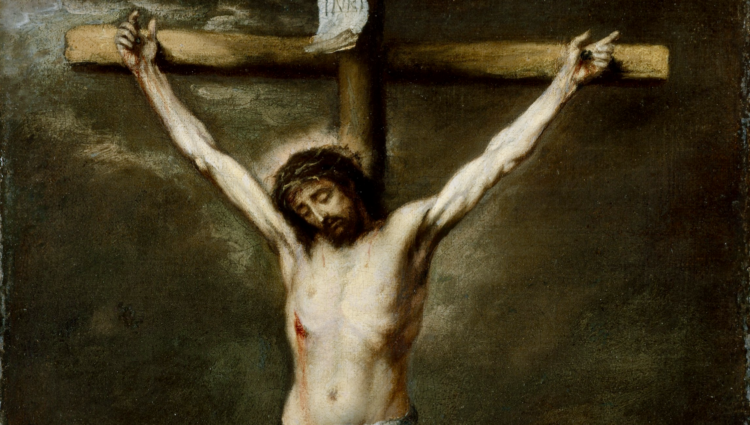
The featured image is “The Crucifixion” (circa ), by Bartolomé Esteban Murillo. This file is made available under the Creative Commons CC0 1.0 Universal Public Domain Dedication, courtesy of Wikimedia Commons.