Each of Aleksandr Solzhenitsyn’s speeches is a heroic utterance, each a step emerging from the blackness of the Gulag Archipelago. To read these selections is to renew a spark to the human spirit, while offering hope in these troubled times in which the totalitarianism Solzhenitsyn escaped seems to be emerging again as the West’s unfortunate future.
Unlimited power in the hands of limited people always leads to cruelty. If only there were evil people somewhere insidiously committing evil deeds, and it were necessary only to separate them from the rest of us and destroy them. But the line dividing good and evil cuts through the heart of every human being. —from The Gulag Archipelago
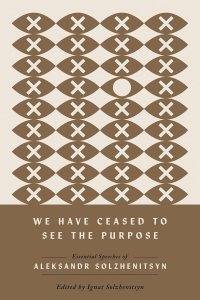
We Have Ceased to See the Purpose: Essential Speeches of Aleksandr Solzhenitsyn, by Aleksandr Solzhenitsyn, ed. Ignat Solzhenitsyn (228 pages, University of Notre Dame Press, 2025)
 He was a dissident laboring to raise awareness of political repression, which led to his arrest and sentencing to several work camps for political prisoners… after which internal exile. His biographers note that during his time of imprisonment, he developed the philosophical and religious principle of his later life, described in The Gulag Archipelago. He was freed from exile in 1956. The story of how the book was preserved by hiding from the KGB would make for a stand-alone novel.
He was deported from the Soviet Union in 1974, eventually settling in Vermont before returning to Russia in 1994.
Why mention this?
Keep this in mind when reading the Essential Speeches: Each is a heroic utterance, each a step emerging from the blackness of the Gulag Archipelago. Perhaps there is a bit of Stalin in every one of us. Perhaps…
*****
To begin, a few words on the editor, not as well-known as his father. Russian by birth and a middle son and with inclinations more musical than literary—what with serious piano study while also majoring in conducting, which is where his reputation has been made, leading a variety of symphonies in this country as well as orchestras in Russia, accompanying renowned soloists. Add concerto performances and chamber music collaborations, and the consensus is an uncommonly thoughtful musician.
Less well-known are his translations and editing of his father’s most memorable speeches, which with the timeliness own a relevance with conflicts happening to date. The scope, then, covers 25 years, and, as for point of view, Alexsander Solzhenitsyn considered these works definitive and it essential for a new generation of students to read his prophetic arguments, especially the human need for God.
The gathered speeches thus appear at an opportune time if we wish to argue that our days and hours own a shared malady of anthropocentrism, which has led to a sapping of faith and all moral precepts uprooted. So, then, life is now lived at breakneck speed, and what faces us might be a yawning vacuum.
Stop then and read these speeches but with this image in mind: each is an heroic utterance, each a step emerging from the bleakness of the Gulag Archipelago.
So wrote Solzhenitsyn’s son as he recapsulates his father’s life in letters before their depths pass away, one more cultural monument become forgotten dust, lost to history.
The selection covers a time period in Solzhenitsyn’s life from 1972 to 1997 and offers the reader a selection of ten speeches, beginning with the” Nobel Lecture” and then in chronological order, “An Orbital Journey,” “If One Doesn’t Wish to Be Blind,” “The Shallowing of Freedom,” Harvard Address,” “Templeton Lecture,” “Playing upon the Strings of Emptiness,” “We Have Ceased to See the Purpose,” “A Reflection on the Vendée Uprising,” and finally “The Depletion Culture,” all regarded as the most memorable and consequential addresses delivered to Western audiences. One should also mention that the speeches straddle the twenty-year period of Solzhenitsyn’s exile, during which he contemplated the nature of limitless freedom, materialism, the decline of faith, and—one should also mention—justice, which he figured not as personal conscience but as the conscience for the whole of humanity,
To read these selections is to renew a spark to the human spirit, while offering hope in these troubled times in which the totalitarianism Solzhenitsyn escaped seems to be emerging again as the West’s unfortunate future.
*****
 He passed from this earth on August 3, 2008, at age 89, and some 18 years after his Soviet citizenship was restored. We know him again as a Soviet and Russian dissident, which in 1972 led to the Nobel Prize in Literature for “the ethical force with which he has pursued the indispensable traditions of Russian Literature.”
His arguments?
The Soviet State suppressed traditional Russian and Ukrainian culture, and in an interesting if not timely manner argued for the creation of a united Slavic state, albeit a fierce opponent of Ukrainian independence. Some kind of unity he believed was necessary but not until massive amounts of cultural rubble was cleared away, and which would lead to the re-christianization of Russian culture, which had for decades suffered an epidemic, so to speak, an infection created by the Bolshevik Revolution.
He’s been criticized for some of his views, which has led to cries of anti-semitism… albeit as an observer he opposed the oligarchical excesses of Putin’s extreme nationalism, although he did remark that a Putin was the kind of leader bent on rediscovering what it means to be Russian.
The point being?
His criticism of the West argued that the United Staes in particular had declined in its spiritual life and needed a spiritual upsurge and the only way out would be through a moral revolution. In fact, the post World War II West had become so obviously flawed, riven with internal paradox, and thus unable to offer a model for worldwide emulation refuting the falseness of Soviet despotism.
*****
Turn we then to his “Harvard Address,” delivered on June 8, 1978. His remarks began with a reference to the university motto, Veritas, or truth, which he then notes slips away the moment we take our eyes off it, and thus leaving us with the illusion that we continue to follow its path… but having taken our eyes off truth the result is almost invariably bitter.
Is it true, then, he asks that we live in a world split apart as into, say, two world powers? Likely true, but is that truth the truth only of political conceptions, which could be resolved through successful diplomatic negotiations or a balance of armed forces.
In reality, he then argues, the split is more profound and more alienating, with fissures more numerous than one can see at first glance and threaten us all with manifold ruin.
Imagine, then, he asks this Harvard graduating audience, to think about the world’s surface spread wide apart, with deeply rooted self-contained cultures, but also full of riddles and surprises for Western thinking, which likes to use concepts like “Third World,” which would surely be a misnomer since to use the phrase is to assume a sort of uniform approximation.
Then, too, he argues that for one thousand years Russia was denied its special character and therefore never understood. Japan, on the other hand, which was understood to be “Far West” seems to be drawing ever closer to Western ways.
Israel, he then adds, can hardly be reckoned as part of the Western world if only because or inasmuch its state system is fundamentally linked to religion.
His concern, however, is that for some nations with a persistence blindness of superiority continue to support the belief that all the regions on our planet could develop and mature toward Western systems of thought which is to believe that those systems are the most evolved in theory and the most attractive to practice.
What is this other than a naive understanding of the essence of other nations by measuring all things with a Western yardstick.
The real picture, if not the anguish of our world, bears little resemblance to all this.
All well and good, but the issue is complicated with this theory of convergence, this soothing theory, which inevitably includes the acceptance for the other side’s defects. Imagine, then, this world’s convergence vectoring toward a leading West and a leading Soviet Union.
So what are the current aspects of the West as he saw them?
A decline in courage was likely the most striking feature that an outside observer could discern in the West at that time or this time. He means by that, civic courage as a whole and separately in each country, each government, each political party, and ironically, it goes without saying, in the United Nations.
Where is it most noticeable?
Among the ruling and intellectual elites, which creates an impression of a lost of courage by an entire society. Those with courage, again ironically, have no determined influence on public life; the political and intellectual functions exhibit this decay , this passivity, this befuddlement in their actions, states of mind, and complacency. Is it wisdom, he notes, to base government policy on cowardliness when sporadic outbursts of intransigence appear masked as bravery?
When, on the other hand, strong resistance appears, such leaders became tongue-tied if not paralyzed and thus unable to to offer any resistance to aggressors and zealots international.
He adds this portion to his “Harvard Speech” by addressing the students directly: “Must one point that, from of old, a decline in courage has been considered the first symptom of the end?”
More so, any defense of what is called the “common good” is nebulous and hardly advantageous, and this pursuit of well-being has begun to peel off its pernicious mask.
That was a speech delivered in 1978; the “Nobel Lecture” came in 1972, and the divine trinity, Truth, Goodness, and Beauty, where he notes early in the speech an enigmatic remark from Dostoevsky that beauty will save the world. Well, maybe not save the world but could art, literature in particular suffer succor to the modern world?
The speech that follows had been the labor of his in an attempt to discern that problem over the years, complicated by the question as to who will perceive and reconcile all the scales and create for mankind a single system of evaluation for evil deeds and good deeds, for unbearable things and for tolerable ones—or equally to the point an answer to the question as to how we overcome our perverse habit of learning only from our own experience.
The answer to that is to believe profoundly that it is literature that transmits incontrovertible condensed experience from one generation to another, and in that manner becomes the living memory of a nation. It sustains within itself and safeguards a nation’s bygone history in a form that cannot be distorted or falsified.
Literature preserves the national soul.
What then in this modern, cruel, dynamic, explosive world teetering on the brink of a dozen points of destruction is the place and role of the writer?
With courage he must neither retreat nor lose faith in the unshakeable nature of goodness, in the indivisible nature of truth.
But it’s not enough merely to recite to the world how bitter or hopelessly warped that world has become. Escape is also not open to the writer. “If the tanks of his fatherland have flooded the asphalt of a foreign capital with blood, then rust colored stains have forever spattered the writer’s face. How else to help a troubled humanity?”
*****
In 1993 Solzhenitsyn delivered the speech that became the working title for this book: “We Have Ceased to See the Purpose”; it was delivered in Mauren, Liechtenstein.
He introduces the speech by noting how the principality stood up to the relentless Soviet military machine, giving shelter to a detachment of Russian and Anti-Communists seeking refuge from Stalin’s tyranny.
What is it other than morality in politics, although history is replete with politicians who freely acted without the burden of moral constraints. “Moral impulses have always been weaker, among statesmen, than political ones, but in our time the consequences of their decisions have growing scale.”
As he warms to his thesis he notes that “if state, party, and social policy is note based on morality, then mankind has not figure to speak of.”
Of course it’s not only wry but rueful, and the behest of Jeremy Bentham, who defines morality as that which pleases the greatest number of persons. One should be grateful to anyone who resists this legalistic hypothesis, though widespread, and lulling many into spiritual lethargy and apathy towards the misfortunes of many.
And its cousin is progress, a concept misestimated as a high principle, disguising avarice.
Times are what times are but one wonders whether new have managed to slip free from the external questions.
We have if we have lost the internal harmony with which we were created and that clarity of spirit, and such concepts as good and evil “had yet to become a subject of ridicule.”
Faith in progress has blotted out all the vices of life.
The happiest arrival of all comes with the arrival of that naive fable, the end of history, democratic bliss, and every tranquil vision descending upon all of mankind.
That was 1993, and now is three decades later.
The question to ask here is to wonder whether “personality” is these days directed at values, at moral criteria, higher than the self or has it become invested with corruption and decay unrealized.
Or to quote a phrase from two other speeches: Has freedom become shallow and has culture become depleted?
He went to be with God in 2008, leaving behind the hope that a clear and calm courage would appear, with a willingness to surrender one’s own life to that which has given life sustainable meaning. Progress, after all, is not the sum total of the spiritual progress of individuals but, more properly, a human purpose, of being free and relational beings living in the truth under God.
There’s a lot more in this very good book.
__________
The Imaginative Conservative applies the principle of appreciation to the discussion of culture and politics—we approach dialogue with magnanimity rather than with mere civility. Will you help us remain a refreshing oasis in the increasingly contentious arena of modern discourse? Please consider donating now.
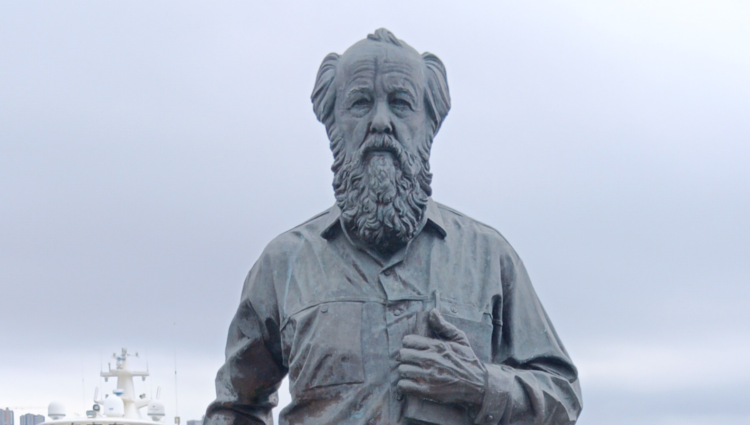
The featured image, uploaded by I13Robin, is licensed under the Creative Commons Attribution 4.0 International license, courtesy of Wikimedia Commons.