We can thank God for Joe “X.J.” Kennedy and his love of the sound of words and the delight of putting them together. And you and I can keep giving his collections to young children in whom we hope to instill that same delight.
 For years, our go-to gift for new babies and young children celebrating birthdays has been Talking Like the Rain: A Read-to-Me Book of Poems (1992), edited by X.J. and Dorothy Kennedy. With beautiful illustrations of classic poems by Hilaire Belloc, Edward Lear, Christina Rossetti, Robert Louis Stevenson, and many others, it is the ideal introduction to poetry for younger children. We went through at least two or three family copies, so often did we and our children turn its pages.
Dorothy Kennedy, who worked with her husband on a variety of anthologies, textbooks, and, for a few years in the 1970s, a poetry magazine reasserting the importance of rhyme and meter (not to mention their five children!), died in 2018 after 56 years of marriage. On February 1, 2026, X.J., known to his friends as “Joe,” died at the age of 96 in his home in Peabody, Massachusetts.
If the legacy of X.J. Kennedy were only the anthologies of children’s literature that he and his wife put together, that would have been blessing enough. The couple’s most famous volume, Knock at a Star: A Child’s Introduction to Poetry (1982), is perhaps a better and bigger collection, but the book is not as beautiful to look at, despite quite delightful illustrations by Karen Ann Weinhaus. Their anthology for college readers, The Bedford Reader (1982), has plenty of selections from all kinds of poems and poets. The Kennedys favored poems that rhyme and scan. They also favored poems that are funny.
Joe Kennedy was the kind of poet who had no fear of appearing to be less serious by virtue of writing poetry for children or in comic tones. He was deeply “skeptical,” he told Ernest Hilbert, of the “many people who perhaps for good reasons put on the robes of the poet and like to sport them.” For Kennedy, one is a poet when one is writing poems. And poems are things of delight. He described the origins of his own poetry to Hilbert in the following terse way: “I like the sound of words and the fun of putting them together.”
As a university teacher, he sympathized with students being introduced to poetry at levels they could not get and a perpetual seriousness that is not sustainable. He told the poet Dana Gioia that the method behind Mrs. Kennedy’s and his selections was this: “We give them one of the greatest poems in the English language, and the poor kids are exhausted. So then we give them just a silly, funny poem, and they get it.”
Perhaps he was so grounded in reality because of his origins. Joseph Charles Kennedy was born August 31, 1929, in Dover, New Jersey. His father worked in a boiler factory, and his mother was a nurse. He attended Seton Hall for a bachelor’s degree in English (1950) and then Columbia for a master’s (1951) before entering the Navy for four years. He had already begun his writing career as a science fiction and fantasy writer in the 1940s and early 1950s, writing pulp stories and editing magazines and collections. In the Navy, he served as a journalist and started writing poetry more and more. Due to his being “mercilessly” taunted as a youth for sharing the name of Joe Kennedy, Ambassador to England and patriarch of those Kennedys, he started sending in his poems and stories under different monikers, such as “Joquel” Kennedy. When he had poems accepted by the New Yorker under the initials X.J., he decided to stick with them.
After his service, Kennedy studied for a year at Paris’s Sorbonne and then for several years at the University of Michigan. Though he and Dorothy failed to complete their Ph.D.’s in English, he ended up teaching for many years anyway in at Carolina Women’s College in Greensboro, North Carolina, and then, for fifteen years, at Tufts University. He retired from teaching in 1977 to write full-time, but even before that retirement, his production was prolific.
Kennedy’s first volume of poetry, Nude Descending a Staircase (1961), won the Lamont Poetry Prize awarded by the American Academy of Poets. It included lyrics that dealt with serious subjects, sometimes in solemn and sometimes in comic ways, indicating why his own preference was for calling his work “comic” rather than “light.” “On a Child Who Lived One Minute” both downplayed and celebrated the power of words in times of tragedy in the last stanza:
O let us do away with elegiac
Drivel! Who can restore a thing so brittle,
So new in any jingle? Still I marvel
That, making light of mountainloads of logic,
So much could stay a moment in so little.
“Epitaph for a Postal Clerk” took the comic route:
Here lies wrapped up tight in sod
Henry Harkins c/o God.
On the day of Resurrection
May be opened for inspection.
That first volume promised much. Kennedy delivered. While teaching, editing, and writing textbooks, essays, and the occasional fictional work, he also wrote a lot of poetry. Cross Ties: Selected Poems (1985) collected poems from 1956-1985. Dark Horses (1992) picked from the next seven years. Lords of Misrule: Poems, 1992-2001 (2002) covered the next decade. In a Prominent Bar in Secaucus: New and Selected Poems, 1955–2007 (2007) and That Swing: Poetry, 2008–2016 (2016) rounded out his major collections. Plenty of other individual collections, as well as fourteen volumes of children’s poetry, two novels for children, and one novel for adults appeared. Despite his old-fashioned penchant for formal poetry and comic verse, Kennedy received many of the big awards—not just the inaugural Academy of Arts and Letters Michael Braude Prize for Light Verse.
If, as Dana Gioia suggested in his groundbreaking book Can Poetry Matter?, one of the problems with the modern poetry scene was that too many poets thought only of themselves, Kennedy never went along with the crowd. Perhaps he deserved a prize for team spirit. The many edited collections, with his wife and with others, showed that he was unselfish about promoting good poetry whether it was his or someone else’s.
There was, of course, the matter of letting down his friends in some of the volumes. He described the anthologist’s task as “a heavy cross to bear,” offering the suspicion that “there are many poets who hate my guts because I haven’t used their work.” Even some of his best friends were no doubt peeved that he hadn’t included their work. But, he reasoned, the kids who will be introduced to poetry require stringent selection. “You can’t just print all your friends.”
Perhaps that’s why he accepted editing positions. In the 1960s, he became poetry editor of The Paris Review, discovering after he took the position how underfunded it was (despite the sponsorship of Muslim philanthropist Aga Khan IV) and how much other editors interfered. Despite the backlog of good poems, Kennedy discovered that a European editor was slipping in bad ones from his “drunk friends” at the last moment. He quit after three years.
In the 1970s, when rhyme and meter were considered passé, Joe and Dorothy started that poetry magazine of their own called Counter/Measures. “If you sent a sonnet off to a magazine,” he told Ernest Hilbert, “it would come back like a boomerang. So we thought it would be interesting to see how much rhyme and meter were still out there.”
As it turned out, they were still out there in abundance. The Kennedys received submissions from big names such as Richard Wilbur, Anthony Hecht, and W. D. Snodgrass, as well as plenty of other poets whom they hadn’t expected. They also managed to become “an early market for youngsters like Robert Pinsky, Gjertrud Schnackenberg, and Timothy Steele. It was great fun, and we kept it going until our money and time and family obligations forced us to let it go.”
The New York Times obituary focused on Kennedy as defender of formal verse. This isn’t exactly false, but the tone of the piece made it sound as if this were some benighted or narrow-minded cause—even when they themselves gave evidence of Kennedy’s appreciation for other kinds of poets, including Allen Ginsberg. Perhaps Kennedy had ruffled too many feathers in lines such as “To a Now-Type Poet”: “Your stoned head’s least whim jotted down white-hot?/Enough confusion of my own I’ve got.” And, though he said once that he was more interested in poetry in English than in poetry from other languages, he translated poetry, too.
Kennedy had respect for things that he did not favor, prefer, and, perhaps, even those that he did not believe. In a 2015 essay, the poet A. M. Juster wrote that Kennedy had lost the Catholic faith in which he was raised but didn’t have the angry resentment that animates so many in the same position. Juster said he was “a man of God who no longer believes in God,” one who wrote sometimes lovingly of the beauty of his upbringing. Juster cites his poem “First Confession,” whose last stanza takes the reader beyond the confession itself to the communion for which it prepared.
Where Sunday in seraphic light
I knelt, as full of grace as most,
And stuck my tongue out at the priest:
A fresh roost for the Holy Ghost.
While there are ironies even in this stanza, it is clear that this is no straightforward rejection of Christian faith. No one can read his 1992 collection The Beasts of Bethlehem and come away thinking that Kennedy had lumped it all. The entry “Cow” reads:
He came to conquer death
And yet His hands are small.To warm Him in his Stall,
I breathe my clover breath.
Did he really not believe? Note carefully the capitalized pronouns referring to the Incarnate Deity.
Kennedy has gone on to meet the one who conquered death and who alone can judge whether faith, hope, and charity still dwelt in his soul or dwell in yours and mine. We can thank God for Joe “X.J.” Kennedy and his love of the sound of words and the delight of putting them together. And you and I can keep giving his collections to young children in whom we hope to instill that same delight.
__________
The Imaginative Conservative applies the principle of appreciation to the discussion of culture and politics as we approach dialogue with magnanimity rather than with mere civility. Will you help us remain a refreshing oasis in the increasingly contentious arena of modern discourse? Please consider donating now.
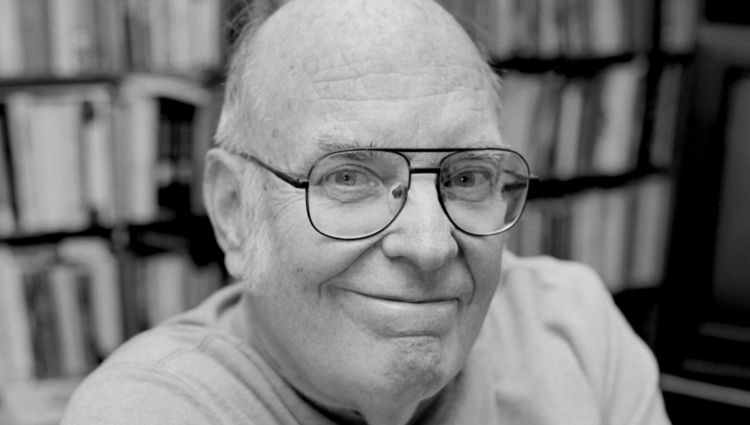
The featured image, uploaded by Man2mars28, is a photograph of X.J. Kennedy taken on 20 November 2017. This file is licensed under the Creative Commons Attribution-Share Alike 4.0 International license, courtesy of Wikimedia Commons.