A COUPLE of weeks ago I forced myself to watch an interview with the ‘World’s Leading Autism Expert’, Professor Sir Simon Baron-Cohen, on the podcast TRIGGERnometry.
Sir Simon has won gold in the field of autism research. He was awarded a knighthood in 2022 and given a medal by the Medical Research Council in 2023. He leads a research centre that employs at least 50 staff at arguably the best university in the world (Cambridge, my alma mater). He has been granted millions of pounds of taxpayer and charity funding to support research projects over the past 40 years. He has published more than 750 articles in peer-reviewed journals and five well-received books.
There is no bigger cheese in the world of autism research than Professor Sir Simon Baron-Cohen. He has spent decades on the international conference circuit pontificating about autism, so you’d think he’d have something useful to say. Indeed, the interview with Konstantin Kisin and Francis Foster was given the title ‘The truth about autism’ – likely as a rebuff to President Trump and Robert F Kennedy Jr who gave their press conference on autism just a few weeks ago.
In brief, Sir Simon told us that autism is a problem only because society doesn’t accept people who are different. He called on the government and employers to do more to make people to feel accepted and valued.
He argued that we live in an ‘ableist’ society and need better services and more open minds to allow autistic people to flourish.
He reported being happy that the incidence of autism has risen from about 1 in 10,000 people in the 1970s to 1 in 30 today. He believes this reflects more awareness and acceptance, as well as additional resources being put into assessment and diagnosis.
Sir Simon wants to celebrate the ability of autistic people to spot patterns and apply the kind of logic that makes them brilliant at maths.
He thinks there is nothing for parents like me to worry about.
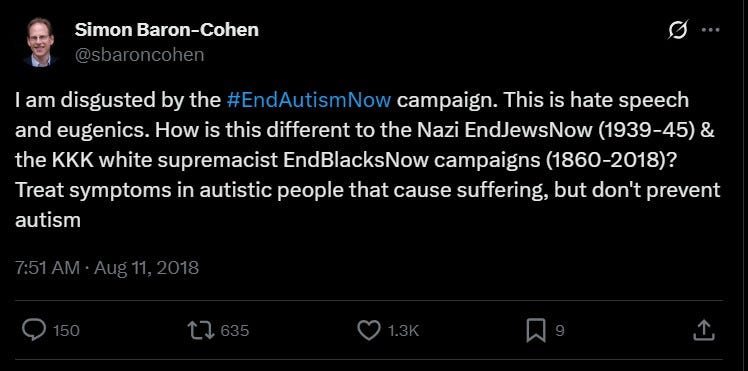
Worse, he says that trying to ‘prevent autism’ amounts to ‘eugenics’ and is a short hop, skip and jump to the Holocaust – a view he has shared before:
Baron-Cohen is the high priest of what’s called the ‘psycho-social’ school of autism. He believes autism is a set of behavioural characteristics or traits that are coded as ‘good’ or ‘bad’ due only to the social context in which people live.
His research has been all about identifying people with autistic characteristics and asking them questions about their behaviours, attitudes and experiences. He has devised ‘screening tools’ that ask people questions that reveal their Autism Spectrum Quotient (ASQ). If you are socially awkward, obsessive, good at order and detail, have a loathing of small talk and a fondness for repetition, you are likely to score very well (and this helps to explain why Mrs Thatcher has recently been added to the autism camp!) Sir Simon thinks that by ‘preventing autism’ we would be eliminating the people who score highly in his ASQ test.
This is nonsense. I have no animosity for the quirky, clever people who populate our universities, some of whom might describe themselves as autistic, and all of whom live independently and provide for themselves.
However, those people are not the whole story – in fact, they are a tiny fraction of what’s going on. Sir Simon is doing massive damage to the thousands of people who can’t live independently and don’t have brilliant minds and are not getting the help that they need.
Our son’s autism has always been intimately related to the immune dysfunction, chronic eczema, crippling constipation, sleep disturbances, odd behaviours (including self-harm), communication and learning difficulties that developed during his second year of life. He regressed into the condition that we call ‘autism’ and the behavioural and personality traits are a product of changes in his biochemistry and metabolism.
‘Preventing autism’ would mean trying to understand the way in which our physical health and metabolism affects our neurological development and function. I already know that reducing our son’s immune inflammation and improving the constipation impacts positively on the symptoms we call ‘autism’. At times, our son is calmer, he sleeps better and is more able to focus and communicate. Ironically, he becomes more able to demonstrate Sir Simon’s autistic behaviours when we try to treat his autism than when we do not!
Sir Simon wants to separate the ‘mind’ from the ‘body’ to which it belongs. He conceives of the ‘autism’ as one thing – a set of behaviours or traits – that is wholly unrelated to what is going on in the rest of the body. He wants to separate the autism from the crippling problems such as anxiety, depression and epilepsy which also occur. Indeed, when pressed during the interview, he called them ‘co-occurring’ conditions.
By defining autism as a personality trait, you can tick some boxes, agree a label and do nothing more. However, if you define autism as a whole-body disorder whereby biological dysfunction causes different degrees of neurological damage and ongoing suffering, it becomes imperative to find out what has gone wrong, why it is happening, and what can be done in response.
Listening to Sir Simon made me realise that we can’t avoid doing battle over the meaning and use of the word ‘autism’.
In the past, I have suggested that we ignore the neurodiversity crew and simply re-label severe autism and win over some researchers and doctors to our point of view. I’ve suggested calling it Paediatric Intestinally Mediated Encephalitis (PIME): our son’s autism came on during infancy, it was associated with a marked deterioration in the gastrointestinal system and is evident in ongoing neuroinflammation (or encephalitis).
Having ‘PIME’ would allow our son to be studied and treated alongside those with other neurodegenerative disorders such as Parkinson’s, Alzheimer’s and Huntington’s diseases, multiple sclerosis and amyotrophic lateral sclerosis (ALS or motor neurone disease). These conditions share certain features with autism including the dysregulated immunity, gastrointestinal dysfunction, unusual microbiome metabolites and neuroinflammation. Someone with less debilitating autism would be able to spot the patterns in this!
However, as long as Sir Simon and experts like him tell the mainstream media, politicians, doctors and even parents that autism is ‘good’ and parents like me are ‘eugenicists’, people with autism will be left to suffer. This is obviously terrible for children like mine, but it is bad for the higher-functioning people as well. Just have a look at the chat groups like Reddit online. There are many brilliant people trying to find ways to reduce their immune activation, improve their bowel function, regulate their emotions and get more sleep. Autistic adults are clearly suffering and self-medicating, and they could be mobilised to share their insights to help our children who can’t help themselves.
The American government are leading the way in endorsing a more sensible approach towards autism. They recognise it as an epidemic. They realise that it is caused by something in our environment (and this includes vaccines). They are sponsoring scientists who want to understand what has gone wrong. They understand that the future of our economy, society and even our species depends on getting to the bottom of the autism crisis. They are not eugenicists. Quite the reverse.
Science has always moved through paradigm shifts. The established hierarchy hang on to their power and stifle debate. When new evidence accumulates and the money and interest shifts to a new generation, the big cheeses are rolled to one side.
We are due a new big cheese in the world of autism. Professor Sir Simon Baron-Cohen and those who back the psychological view need to be replaced by a new generation who take a biochemical view. For parents, children, families and communities, as well as taxpayers, this change can’t happen too fast.
This article appeared in The Autism Tribune on October 17, 2021, and is republished by kind permission.