Ideology is not only lazy, it is, at heart, criminal. There never was an ideology that allowed for the fullness of man. Always, ideology denigrates the truth and the dignity of the human person.
 One of the most dangerous things to come out of the French Revolution was the notion and norm of an ideology. Edmund Burke, the great Anglo-Irish statesmen had mocked the “armed doctrine” of the French without having access to the word, ideology. That word, as it happened, originated with Napoleon as he criticized the more abstract elements of the Revolution. For Napoleon, ideology was the “science of idiocy.” Ideology quickly made its way into the English language through John Adams. From its beginning, it was seen as something misguided if not outright diabolic.
Though ideologies developed only slowly during the nineteenth century, develop they did. By the end of that century and the beginning of the new one, the most prominent ideologies became those of communism, nationalism, socialism, progressivism, fascism, and national socialism.
In every way, ideology demeans true meaning and offers something devoid of wisdom, even while it basks in facts and particularities. It loses nuance and context. Take, for example, communism. In communism, we see a truth: that we should love our communities. One would be a fool to disagree with this. But, if we love our community to the point where we damage other communities, we have failed. Or, take fascism. Fascism insists we love our countries. Again, what is false in this? We should love our countries. But, if we love our country at the expense and cost of other countries, we have failed.
As C.S. Lewis so rightly asked in his profound study, The Abolition of Man, what is an ideology? It is a truth exploded to madness, he answered. It isolates a good thing and exaggerates it. Much as we saw in modernism and modernity (in the previous post), truth becomes so particular and compartmentalized that it loses its connection to larger truth and reality. It becomes fact rather than wisdom, knowledge isolated and divorced from its context.
As such, the very term ideology and its “progress” mimics the change in thought from the eighteenth to the nineteenth century. In one of the greatest sentences ever written, Thomas Jefferson proclaimed: “We hold these truths to be self-evident that all men are created equal, endowed by their creator with certainly unalienable rights, among these are the right to life, liberty, and the pursuit of happiness.” Notice what Jefferson so brilliant does. He offers a minimalist definition of the human person—each man or woman created in the image of his Creator, equal before Him, and endowed by him with certain rights. There, critically, Jefferson stops. He does not attempt to go beyond this basic and fundamental definition. To do so would be to limit the necessary mystery and complication of man.
By the nineteenth century, though, the greatest thinkers of Western civilization—and each, to be sure, is a genius in his own way— had no problem reducing their subjects by restricting their definitions. Take, for example, Charles Darwin. In his very complex thought, man is, by nature, determined by his environment. When he encounters environmental adversity, he either adapts and survives or fails to adapt and falls out of the gene pool. At base, though, he is biological.
Or, take Karl Marx. In his rather complex thought, man is, by nature, determined by the existing economic structures. He responds by encountering and countering predominant forces. At base, though, he is economic.
Or, again, take Sigmund Freud. In his rather complex thought, man is, by nature, determined by his sexual relations with his parents. At a certain age, he either recognizes that his mother is something different from himself, or he fails to and falls into error (the leftists who once loved Freud no longer love him, as he seems to think issues such as homosexuality a psychological failing). Regardless, at base, man is psychological and sexual.
Well, of course, none of these things is false. Man is biological, economic, psychological, and sexual. He is all of these things, but he is a myriad of a million other things as well. Just as with ideological thinking, the greatest thinkers of the nineteenth century reduced man to one of two things. They took a truth and exploded it to madness. Such is the nature of all ideological thinking. Reality—and each human person—is immensely complex, a mystery even unto oneself. Going back to C.S. Lewis again, he has a wonderful secondary character in The Hideous Strength by the name of Hengist. At one point, just prior to his murder, Hengist proclaims that one cannot study man, he can only get to know him. How wonderfully true this is. Each one of us is so utterly complex that we never fully understand our own selves. How are we to understand another? We should bask in the mystery of each person, made uniquely in the image of God.
Ideology, therefore, is not only lazy, it is, at heart, criminal. There never was an ideology that allowed for the fullness of man. Always, ideology denigrates the truth and the dignity of the human person.
The answer to ideology, then, is not to create some kind of counter ideology, but, rather, to recognize a reality so complex as to transcend the limitations of ideology. Thus, we would never think of conservatism as yet one more ideology in a long line of ideologies. Rather, it is critically and importantly an anti-ideology, at once challenging and transcending ideology. Conservatism, by its very nature, embraces complexity, nuance, and mystery.
__________
The Imaginative Conservative applies the principle of appreciation to the discussion of culture and politics—we approach dialogue with magnanimity rather than with mere civility. Will you help us remain a refreshing oasis in the increasingly contentious arena of modern discourse? Please consider donating now.
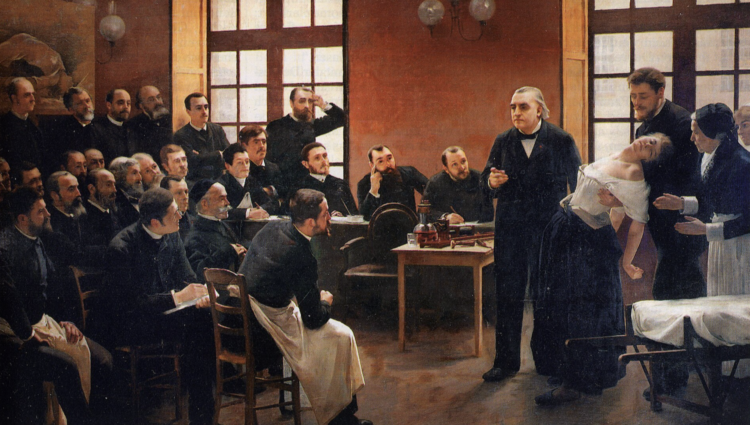
The featured image is “A Clinical Lesson at the Salpêtrière” (March 1887), by André Brouillet, and is in the public domain, courtesy of Wikimedia Commons.