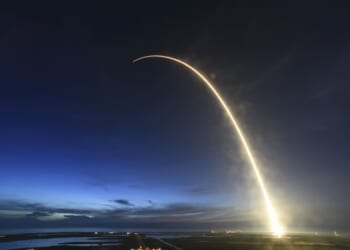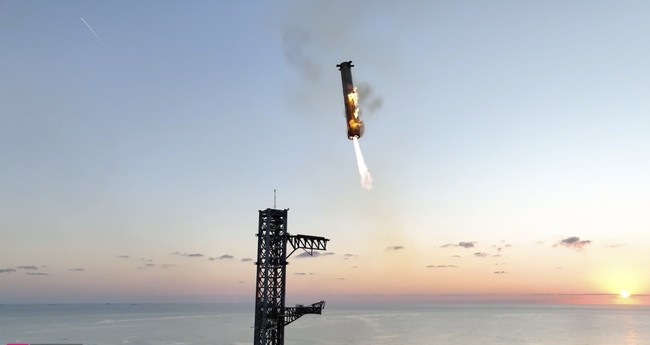
I wanted to follow up on John’s post from yesterday about the latest Starship test flight, the twelfth so far.
As John noted, the flight was a mixed bag. Some things went remarkably well, while other things that had been working well before went off the rails.
Although this was nominally the 12th test flight, it was actually the first test of new designs for the booster, spacecraft, and engines. In many important ways, it was the first test flight of a new spacecraft, drawing on lessons learned from prior versions of all these systems.
It has been seven months since the last test flight, which was one of Version 2, using Version 2 Raptor engines, a smaller booster, and an earlier design of the Starship itself. For SpaceX, that is a long wait between tests, as the company uses a test-fail-iterate approach instead of the more conventional design-for-perfection approach used by Blue Origin and ULA.
So what went right that hadn’t before? And what went unexpectedly wrong?
First, the good news: the Starship spacecraft—the second stage—performed far better than any previous version. Despite the failure of one of its Raptor 3 engines (more on that later), the spacecraft reached its projected flightpath, deployed test satellites (including 2 that had cameras to examine the heatshield) perfectly, survived re-entry intact, and made what appeared to be a perfect soft landing where it was supposed to.
Given all the problems with prior versions of Starship, and in particular the heat shield, it performed beautifully, only missing its goal of testing a Raptor relight in space due to the one failed engine.
What didn’t go well was the booster flight, which was probably a surprise since it had seemed that SpaceX had nailed the booster over the previous tests. And, apparently, that came down to one of the Raptor 3s exploding on relight, which is a really bad sign for the new version of the engine.
The Raptor 3 is an iterative version, obviously, of the Raptor engine, and is intended to be streamlined, easier to manufacture, and more reliable due to fewer moving parts and overall simpler construction and design.
Something is wrong with it though.
That’s a big deal, because the engines aren’t just supposed to be cheaper, easier to manufacture, and more reliable, but the increased power they provide is one of the keys to Starship reaching its full potential.
There’s a lot to love about what we are seeing with all the progress SpaceX is making, especially with the vastly improved performance of the Starship craft (although one test does not a successful program make), but the problems with the Raptor 3 are a very big problem that needs fixing.
If Starship weren’t key to NASA’s moon landing plans, we could argue that SpaceX’s progress on what is the most impressive and powerful rocket ever built has been blistering fast. But since Starship IS so important to achieving the goal of reaching the moon and landing men upon it by the end of the decade, NASA really needs SpaceX to move faster to stay on target.
Not that anybody else in the program is exactly hitting their timeline targets, and the Orion capsule has its own troubles with the heat shield. It worked, but it has shown worrying problems that worry many. And, of course, the Artemis spacecraft is a poor design for a program designed to make human spaceflights to the moon routine.
NASA was smart to get a second contractor for the Human Landing System for the moon, adding Blue Origin to the program, not banking on Starship being ready. Elon works on Elon time, meaning he accomplishes the impossible, but late.
I have little doubt that he will get Starship right; SpaceX has proven to have superb engineers and a proven track record of doing what once seemed impossible. But he has a terrible record of doing it on time.
The Angry Astronaut was true to his name, trashing the Raptor 3 in particular. I think he is a bit harsh, but then again, that is his shtick.
What do you think? Are you impressed? Disappointed? Half and half?
One last thought: while full reusability is part of the pitch for Starship, it really isn’t necessary to make it one of the most cost-effective ways to get large cargos into space compared to every other choice out there. While it would transform the vehicle from a cheap space truck to a more boutique way to get cargo into space, no other spacecraft could come close to what it could do.
Who else could deploy fully constructed space stations in a single launch? Or hundreds of satellites at once? It blows away the Space Launch System, where every launch is of a boutique, bespoke craft costing over a billion dollars. Starship is built in a factory by the dozen.
Still, the dream of space refueling and routine reuse is a key to Musk’s dreams of making human beings a spacefaring species, and he will, eventually, make it happen.
And the way he will do it? Starlink, which will fund his dream.
Editor’s Note: President Trump is leading America into the “Golden Age” as Democrats try desperately to stop it.
Help us continue to report on President Trump’s successes. Join HotAir VIP and use promo code FIGHT to receive 60% off your membership.