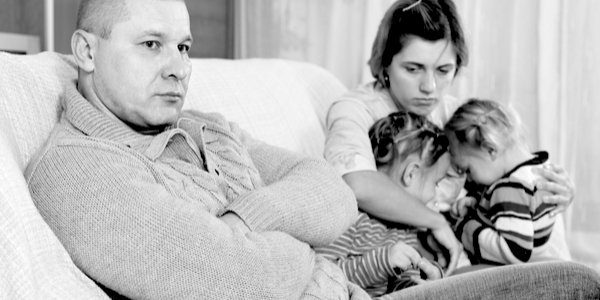
This is part of a series of articles we are publishing in TCW designed to challenge one of the most powerful orthodoxies shaping family justice across the Western world, an orthodoxy that is harming children and parents alike. You can read earlier articles here. Here a family psychotherapist underlines the importance of listening to children, even when it is not easy to do so.
ON WINTER mornings, when the mist hangs low over the lake and the first light struggles through the trees, there is a stillness that is difficult to describe. The swans drift quietly across the water, the ducks gather hopefully near the shore, and somewhere in the woodland beyond, squirrels begin their daily business as if nothing in the world could possibly be wrong.
For more than 20 years children and families have walked through these grounds. Some arrived frightened, some angry, some withdrawn, and some carrying burdens so heavy that it seemed almost impossible to reconcile them with the age of the child standing in front of me. Over the years I have come to realise that while adults often arrive armed with explanations, theories and certainties, children arrive carrying something altogether different. They carry relationships. They carry loyalties. They carry hopes and fears. Most of all, they carry love.
Long before many children trusted me, they trusted Millie and Lulu.
Millie and Lulu, my two golden doodles, possessed a remarkable gift. Children who found it difficult to speak to adults would sit happily beside them. Children who had spent the first hour of a session saying almost nothing would suddenly begin talking while absent-mindedly stroking a soft ear or leaning against a warm furry shoulder. I often joked that the dogs were the real therapists and I was merely there to take notes.
There is more truth in that than I once realised.
Children rarely reveal themselves when they feel interrogated. They reveal themselves when they feel safe. Some of the most important conversations I have ever had took place not in a consulting room but while walking through woodland paths; children often found the confidence to tell the truth about what was happening inside them.
What they taught me over the years was both simple and profoundly troubling.
Children caught in family conflict are often carrying responsibilities that do not belong to them. Again and again, I encountered children who seemed to believe that the emotional wellbeing of the adults in their lives rested on their shoulders.
I remember one little girl in particular.
She arrived wearing a bright turquoise-and-pink dress, carefully polished shoes and carrying a tiny handbag. She was around nine years old and looked exactly as a child should look. Yet there was something about her eyes that immediately caught my attention. They seemed older than the rest of her. As we sat together, she spoke quietly about the arguments between her parents. Nothing she said was unusual. Every family therapist hears similar stories. Yet what struck me was not what she said about her parents but what she said about herself.
She told me she loved her mother. Then she told me she loved her father. After a long silence she began to cry. ‘They can’t split me in the middle,’ she said.
What followed was one of the most heartbreaking moments of my professional life. This nine-year-old child, caught between two adults she loved, began apologising. Not for something she had done. Not for misbehaving. Not for hurting anybody. She apologised simply for existing in the middle of their conflict.
Twenty years later, I have never forgotten her.
What children taught me, repeatedly, is that family conflict is experienced very differently by children than it is by adults. Children think in terms of relationships. They are not asking who is right. They are asking whether they still belong.
This understanding sits at the heart of systemic theory. Human beings exist not in isolation. We exist within networks of relationships that influence how we think, feel and behave. Children are particularly sensitive to these relational systems because their survival depends upon them. When those systems become conflicted, children adapt in extraordinary ways. They learn which subjects upset particular parents. They learn what can and cannot be safely discussed. They become experts at reading emotional atmospheres. In many cases, they sacrifice parts of themselves in order to preserve relationships that feel essential to their survival.
What concerns me is how often these adaptations are misunderstood.
A child who appears mature may be carrying responsibilities far beyond their years. A child who appears certain may be suppressing enormous confusion. A child who rejects one parent may be responding to complex relational pressures that have never been properly explored. Without understanding the wider family system, behaviour can easily be misinterpreted.
For many years I assumed these observations reflected the families I was working with in Ireland. Then something unexpected happened.
I became involved in teaching on the Masters in Parental Alienation Studies at the Institute of Family Therapy and Systemic Practice in Malta. The programme attracts professionals from all over the world. Psychologists, social workers, lawyers, therapists, mediators and judges arrive from countries with different cultures, different legal systems and very different social contexts.
Yet despite these differences, they bring the same stories. Again and again, experienced professionals tell us that they feel underprepared for the complexity they are encountering.
Many arrived expecting straightforward answers. Instead, they encountered complexity. They discovered that family conflict rarely fits neatly into professional categories. They discovered that children can appear confident while feeling frightened, independent while feeling trapped, and certain while carrying enormous emotional confusion.
Most importantly, they discovered that listening to children and understanding children are not the same thing.
One of the most powerful lessons children have taught me is that what they say often makes sense only when viewed within the context of the relationships around them. Understanding those systems requires curiosity, humility and a willingness to tolerate uncertainty.
I was reminded of this by another little girl, this time wearing bright red shoes and carrying a worn stuffed rabbit with one ear standing upright and the other drooping to one side. She had not seen her mother for years. The day finally arrived.
When the door opened and she saw her mother, she ran. She threw herself into her mother’s arms and held on with all the strength a child could muster. Both of them cried. For a few moments, everything else disappeared. The reports disappeared. The opinions disappeared. The years disappeared. All that remained was a child and her mother finding one another again.
It was one of the most beautiful moments I have ever witnessed.
Then, gradually, something changed. The little girl became aware that she was being observed. Almost imperceptibly, she began monitoring the reactions around her. The spontaneity hardened. The freedom retreated. She became careful.
Watching that transformation revealed something fundamental about children. Even in moments of joy, many remain acutely aware of the emotional needs and expectations surrounding them. That awareness is not evidence of resilience. It is evidence of burden.
The older I become, the more I realise how much children have taught me. Most of all, they have taught me that beneath the complexity of family conflict lies a remarkably simple human truth.
Children want to belong. They want to feel safe. They want freedom from adult warfare. And they want permission to love the people they love.
The question that has stayed with me through all these years is not a legal question, a political question or even a therapeutic question. It is the question I hear again and again beneath everything else: ‘Can I still love both?’
No child should ever have to ask it. And yet far too many still do.