LAST Sunday we published the first of Brian Meredith’s recollections from his childhood in the 1950s, which he described as ‘A place which simply does not exist any more. Not in any significant aspect or detail.’
He wrote: ‘In the 1950s, England was a more gentle place, where people seemed to have more time for each other. Nowhere was this more evident than in the interactions between grown-ups and the children. These days, the mutual aloofness and distance which routinely characterises encounters between strangers across the “generation gap” make it difficult for anyone too young to remember to picture just how safe, friendly and perhaps, equally important for a child eager to explore the world around him, simply how accommodating the England of my childhood really was.’
This is the second of his four anecdotes from that time which hopefully illustrate the sort of unconditional kindness that a child might receive from complete strangers.
***
In 1957, there was still a railway through the village of Stanford-on-Avon on the cross-country line, now sadly vanished post-Beeching, which linked the West Coast Main Line at Rugby with the Midland Railway’s own main line north at Market Harborough. On our frequent Saturday afternoon cycle rides, Dad and I would often pause at the Stanford level crossing in the hope of seeing a train run past.
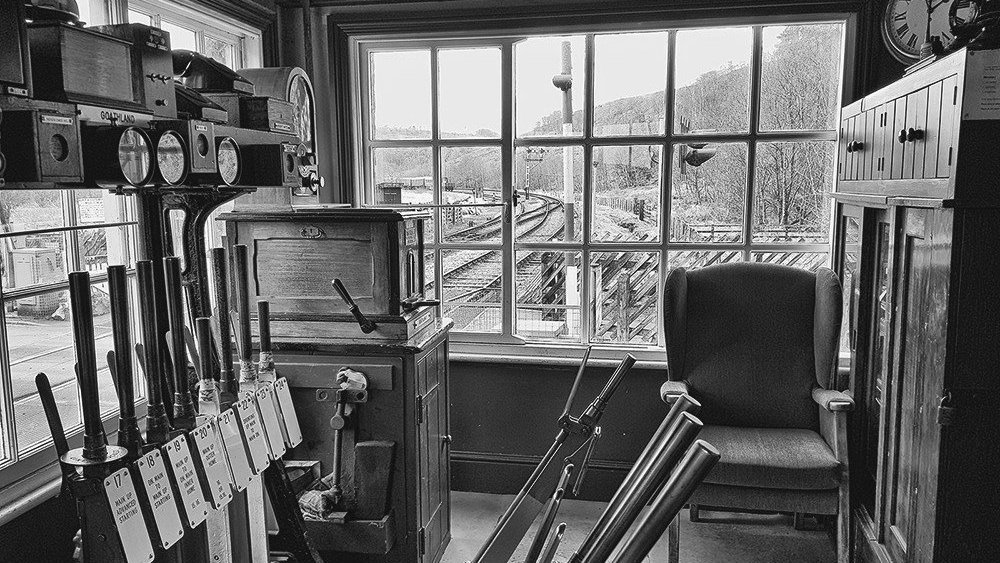
On one occasion, noticing us waiting by the gates, the signalman slid open his window and asked us if we’d like to come up and see inside the signal box. I was up those stairs almost before he’d finished his sentence and he treated us both to a conducted tour of a fascinating and beguiling little empire.
When bells started ringing, he explained about the bell code system and announced that there was a cross-country passenger train about to pass through Stanford, without stopping, on its way to Rugby. Suddenly, he asked me: ‘Would you like to signal this train through the station?’
‘Gosh, yes! Of course I would!’
The sequence started by closing the gates on the level crossing. These were the traditional, heavy timber gates, rather than the comparatively minimal lifting-barriers seen today. They were opened and closed by turning a huge ship’s wheel-type contraption in the signal box and it took all my strength, plus more than a little help from the signalman, to turn it sufficiently to get the gates completely closed. This reliance on a direct mechanical linkage is the reason why the signal box had to be immediately adjacent to the gates.
Next, it was the signals, which were operated by a system of wires opposed by counterweights. The signalman showed me which levers to pull. I had to pull with all my might to get that red upper-quadrant signal to rise. Pulling the yellow distant signal ‘off’ took even more effort, because its greater distance from the signal box meant that the wire was very long indeed. All these tasks were completed solely by manual devices without any mechanical assistance. It was a technology which hadn’t changed since Victorian times.
After what seemed like a long wait, the train eventually appeared in the distance and I felt so proud, hearing it whistling a greeting. Actually the whistle is a warning device, but I was only eight and I was convinced that the driver was saying ‘thank you’ as he steamed through the station past the signal box, courtesy of my hard work.
And just as it had been with the farm horses, it would not be long before Dr Beeching would sweep away rural railways, together with the way of life which went with them and make such experiences as this impossible.
Whenever I see a railway these days, with everything surrounded by high steel fences, their vertical pales topped with barbarous triple-spikes and further surmounted with coils of barbed wire, together with notices threatening huge fines for trespass, I’m reminded of just how lucky I was to grow up in a time when a signalman could invite a child and his father to join him and give them a singular experience which they would both remember for the rest of their lives.
(Header image courtesy of Glynnis Frith, Foss Photography Club.)
Next week: Helping to build Britain’s first ‘Autobahn’