CATHOLICS rejoice in the beautiful flexibility of language. We understand the power of metaphor, analogy and parable. We try to say things about the supernatural with naturalistic and therefore inadequate linguistic resources. We know that the Eucharistic elements of bread and wine are reassembled into the body and blood of Christ by a divine act of speech, but we have some difficulty in explaining quite how this works.
We acknowledge that literalism is useful only at the surface level of things, and that some if not most truths about God can only be gestured at or approached apophatically: focusing on what something is not rather than what it is.
We can cope, then, with the occasional de trop social media post from the rarely literal Donald J Trump, who talks and writes in the idiom of exaggeration that is so characteristic of a native of Queens.
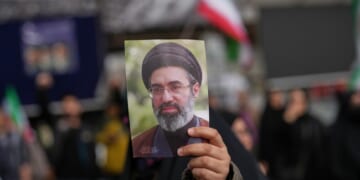
It should not really bother us when the President and the Pope start duking it out in the media space, as has happened recently over the intervention in Iran. On the contrary, it is good that the Holy Father has belatedly expressed a concern for the 90million people who are strapped to the suicide bomber known as ‘the Iranian regime’.
In my view their dispute comes down to this: Trump is happy to take out that suicide bomber before he gets a chance to attach a nuclear weapon to his vest, whilst Pope Leo, because of something called ‘just war theory’, would prefer him to hold off.
A quick mention of this thing called papal infallibility might be in order at this point, a wonderful innovation designed to remind us that except under the most extraordinary conditions the Bishop of Rome is very fallible indeed. He has no personal magisterium and is just as beholden to the law of non-contradiction as anyone else. He can, in other words, be wrong, and on Iran I believe that what he has said is inconsistent with the just war tradition, rather than being rooted in it.
The point of just war theory is to affirm that war can on occasion be an obligation and that Catholicism is not a pacifist religion. War, violence in general, are necessary correctives of final resort. It is therefore spiritually imperative to impose on both its activation and prosecution constraints intended maximally to preserve the dignity of allthose affected by it, including persons who are yet to be created.
Catholic teaching avoids the sin of relativism by evolving over time while protecting its essence as revelation. Issues around the morality of war are better thought of as contributions to a living tradition than as a collection of a set rules, whose application is clearly determinable in all instances. There is a messiness to war which is recognised by the Church. Catechism (2309) therefore says this:
‘The evaluation of these conditions for moral legitimacy [of war] belongs to the prudential judgement of those who have responsibility for the common good.’
Which is to defer to the secular authority (which in the case of the US is President and Congress) in its right to go to war if other conditions have been met. Have they?
Iran has spent five decades executing effective and lethal proxy aggressions in Lebanon, Gaza and Iraq, to name but three examples. It has put on disguises and murdered Americans, Jews and non-Muslims all over the world.
These aggressions, taken collectively, are surely sufficient for the conclusion that Trump’s intervention is prima facie more than merely preventive? You can’t prevent violence that’s already happened, and when you respond to such violence how is that not in self-defence?
The just war tradition was instituted by St Augustine and later consolidated by St Thomas Aquinas, who situated the teaching in the wider context of scholastic metaphysics. This is a system of thought which makes a distinction between the actual and the potential while insisting that because God made the world contain purpose and teleology, the latter are just as real as the former.
Why is this relevant? Because the Iranian theocracy, a grotesque intrusion into the culture and history of the Persian peoples, has made its intentions known: to bring about the end of the world in order to discharge what it takes to be its eschatological obligations.
It does not want to eliminate Israel; it wants to kill everybody.
If it has the potential to do this, that makes the threat present now – according, at least, to the Thomistic worldview which Trump’s Catholic critics are so selectively committed to.
I have no problem, by the way, with the Pope saying political stuff. As the Catholic commentator Taylor Marshall noted last week, ‘only corrupt politicians say that morality and politics must be kept separate’.
But if the Pope is going to do politics it would be nice to see him less associated with the Chicago Democrat political machine. Leo recently met David Axelrod, chief fixer in the Obama Administration, whose most salient contribution to the faith was the persecution of Catholic charities that did not wish to fund abortions. Soon after, three liberal US Cardinals, including the preternaturally slow-witted Blase Cupich, went on to the CBS programme 60 Minutes to do what such people do.
I am sure that this was just coincidence
Two things to sign off with. First, an unfortunate consequence of the coincidences mentioned above is that Catholics in the US seem to feel under some pressure to pick a side. This is theologically not required. Catholicism is a both/and, cake/eat cake faith. We are quite entitled to support both Trump and Leo, as a ‘paradox that is not a contradiction’ thing.
Second, why is it that the liberal commentators take Trump’s figurative speech literally while excusing the mullahs’ threats to kill us all as metaphorical?
Anyone help with that?