In the last resort, according to Friedrich Hayek, the conservative position rests on the belief that in any society there are recognizable superior persons whose inherited standards and values and position ought to be protected, and who thus should have a greater influence on public affairs than others.
The chief evil is unlimited government…. Nobody is qualified to wield unlimited power.— F. A. Hayek
There is no more dangerous menace to civilization than a government of incompetent, corrupt, or vile men. The worst evils which mankind has had to endure were inflicted by bad governments. —Ludwig von Mises
Query: Is it possible for any lawmaker to successfully design a constitution or a law that will produce the ends that the legislator wishes to enact?
I. A primer prepares a reader for what comes next in the pages following.
And so:
 What follows in this essay is a basic attempt to offer an introductory “primer” for F. A. Hayek in a chronological series of his writings including Studies on the Abuse and Decline of Reason, The Road to Serfdom, followed by an introduction to the magisterial The Constitution of Liberty including the “epilogue,” and concluding with volume three of Law Legislation and Liberty published in three volumes over four years. The time covers a half-century and Hayek’s legacy to classical liberalism: his arguments for limited government, free markets, and individualism.
But why?
Because there are laws against robbery.
Throughout is Hayek’s interpretation of classical liberalism: the belief that the state should have limited power directed toward protecting natural rights, economic freedom, and the rule of law which means everyone is accountable to the same laws including those in power.
Classical liberalism, distinguished from modern liberalism, is based on the inherent dignity of all people informed by a commitment to toleration and the idea of a spontaneous order whereby a society can evolve without central planning, [1] Such a market system is also more efficient and adaptive. We know Hayek borrowed the notion from Adam Smith, his Wealth of Nations, and the Scottish natural law philosophers and the generalization that society develops from a spontaneous order which is the result of human action and not human design.
In Hayek’s estimation, classical liberalism is a renewed belief in the idea that beneficial results emerge from decentralized actions of individuals pursuing their own interests without the tyranny that comes from government’s attempts to plan the economic workings of daily life.
A pox on that.
II. By Way of an Introduction
My college office was on the same floor as the economics faculty. We shared an aid and a smallish faculty lounge even though the yellowish-well-worn naugahyde furnishings were less than lounge-worthy. There was the aroma of tobacco.
And a refrigerator and a coffee maker.
We shared a copy machine which had an unusual start-up sound followed by a strangling noise and then belching out copies.
Once when collecting my own copies I by mischance included a copy of a colleague’s economics exam.
I confess I snooped.
I found two essay questions interesting.
The first was a question asking when did Great Britain suffer a long period of economic malaise? What was the cause? Who led the reforms and what was the effect of those reforms?
And the second question was to support, qualify, or refute: “Economic protectionism is good government policy.”
The answer to the first is that during the 1970s Great Britain suffered a period of economic malaise, which came about through the argument that governments should intervene with fiscal policies like increased spending or tax cuts to stimulate the economy and/or adjust interest rates. The purpose was for the government to act as an economic stabilizer to manage business cycles and prevent downturns.
Much of that came about with the belief that the private sector is insufficient in managing economic fluctuations. It’s often referred to as activist fiscal policy and even defined as a modified form of capitalism. The argument is that Keynesian policy intended to reform and sustain capitalism. In other words, why not a mixed economy model with the core notion that free markets can be the foundation but free markets are not always self-correcting? Central government planning becomes the necessary intervention to prevent recessions and depressions through a form of social democracy, which is the most common form of modern socialism.
The problem then?
It works on paper but comes up short in the real world. The problem occurs when government spending is deficit spending, which leads to increased taxes designed to refill the government coffers and the wonderment as to who will pay the deficit bill in the end.
If there is an end….
And the second question?
Margaret Thatcher who focused the argument on free markets economics reducing the power of the state though privatization and deregulation. The effect was an economic boom.
I should mention that the economics folks with whom I shared space are advocates of the Austrian School, which is not a mainstream part of economic education these days.
But why?
The school favors a more classical philosophical approach rather than mathematical modeling.
Here’s the fundamental problem: Can economic mathematical modeling solve the paradox of why diamonds are more valuable than water? Economically it “boils” down to the understanding that the price of a good, a diamond or a glass of water, is the scarcity of a diamond and the desire people have for the diamond.
One cannot become engaged with a glass of water, but one can with a diamond ring and a stone of good size.
So argued Carl Menger, considered by many to be the founder of the Austrian School and who solved the diamond-water paradox by arguing that “value” is subjective and not inherent in goods, but in the judgment of the good’s importance to human satisfaction.
But there’s an ironic twist in as much as Thatcher’s story, as it was with Reagan, arrives on our doorstep courtesy of Friedrich A. Hayek, who argued that markets signal economic information better than governments because governments are dependent on bureaucratic chains of data-gathering vulnerable to distortion. Nationalized industries are incompatible and inefficient and sheltered from competitive pressures.
National morale was low because of the economic advice from Keynes and raised because Thatcher rebutted Keynes in a dramatic way and restored national morale.
I should have taken that test.
Perhaps a generalization:
Lyndon Johnson years ago ran for president under the auspices of The Great Society, which had as its economic goals a society of abundance and liberty for all Americans.
The Great Society intended to eradicate inequality and poverty; the result would be a perfect society brought into being when democracy becomes unlimited.
Tools were needed to bring about this neighborly caring: legislation, laws, financing, and a promised order for that abstract “thing”: “The Great Society.”
Like any policy initiatives to enact such requires action from representative bodies whose function is to mobilize consent, which could just as well mean manipulate the opinions of those whom they represent or take those on the other side of the aisle to the woodshed.
About which a smart man once wrote that sooner or later the people will discover that not only are they at the mercy of vested interests and the machinery of a para-government that has like cancer grown up as a necessary consequence of the enlargement of government central planning—presuming an impossible level of social knowledge, producing in turn an impasse by preventing individuals from making their own informed choices, which in a changing world are required to maintain an existing standard of living let alone achieve a rising one.
And, yes, I wrote that culminating sentence with no shame. Re-read at your own pleasure.
The Great Society foundered what with the high cost of the Vietnam War and political opposition and changing economic conditions. There are those who question the effectiveness of the legacy and whether the long-term impact has been worth the cost.
Turn we then to that very smart man, Friedrich A. Hayek.
III. The Biography of an “Old Whig”
My belief is that the best biography of Hayek is Bruce Caldwell’s magisterial two volumes.
Hayek was Austrian-born but became British by nationality and citizenship, May 1899 to March1992. We know he fought in World War I and often said that his experience kindled a profound desire not to repeat the many mistakes that led to the war, which also in a round-about way led him into economics earning his degree from the London School of Economics, [2] where he also taught and later at the University of Chicago.
It’s important to note that combined with his study of economics, he initially studied philosophy and psychology both coming to influence his later exploratory studies in economics and a point to be enlarged upon in this essay.
And a scholar who labored to define himself not as a conservative but as an “Old Whig,” which we know was birthed by Edmund Burke in his “Appeal from the New to the Old Whigs,” where he defends his earlier Reflections on the Revolution in France and where he defended his distinction between true constitutional reform and the radical, destabilizing upheaval developing in France.
The problem that emerges here is the conservative regard held for Burke, referenced often as the founder of modern political conservatism and a view held by those followers who regard themselves as stalwart defenders of a political creed bestowed upon us by that treasury of ancient laws and liberties.
As an “Old Whig,” Burke stood in opposition to the “New Whigs” whose celebration of the French Revolution was regarded by Burke as an abuse of reason. The issue can be briefly stated:
Burke was a defender of ancient principle,s but it’s also clear that he embraced political beliefs one might call “classical liberalism,” also embraced by Hayek.
Having made that argument the word “liberalism” might set one’s teeth on edge but Hayek (and Burke) used the word with the understanding that it meant an emphasis on individual liberty with minimal government intervention in the economy and personal life.
More on that in a bit since such becomes the topic of interest in The Road to Serfdom and when the reader arrives at the seventeen pages in the “Epilogue” to The Constitution of Liberty.
IV. Groundwork: Arm Wrestling John Maynard Keynes
Part IV of Bruce Caldwell’s biography of Hayek’s life owns two interesting if not defining sections. The first narrates his encounter with John Maynard Keynes and the second is The Battle for Young LSE Minds.
The defining point of the first concerns the academic exchanges between the two over their respective monetary theories and how such theories might apply to policy. Caldwell understates suggesting the story has become folkloric.
It begins with a discussion on Keynes’ A Treatise on Money, published in 1930, whereby he argues that one of the perennial problems with a market economy is the failure of adjustments between savings and investment.
Keynes’ Treatise, which presumes to be a comprehensive analysis, is divided into two volumes: “The Pure Theory of Money” and “The Applied Theory of Money.” The Treatise develops the main points of Keynes’s theory, which proposes that government should use active fiscal policies to manage economic fluctuations by promoting spending during depressions through deficit spending on public projects.
If I understand the argument both “pure” and “applied” arrgue that the demand for money is based on three pure and applied motives: (1) for everyday spending, (2) for covering unexpected needs, and (3) to hold cash in savings anticipating interest rate changes.
All well and fine and even as far as theorizing is concerned, but there’s a “catch” and that “catch” is in the word “motives,” which may not be so pure unless political economy is understood through the statistical language of mathematics to express economic ideas.
Which confronts a problem and that is what if subsequent developments in economics historically come about for which the mathematics has not yet been developed?
Which brings us to Hayek and the Austrian School.
Caldwell notes that the Keynesian model was “exceedingly opaque” and Keynes himself prefaced his argument with the note that he felt a bit like someone who has been forcing his way through a confused jungle. He continues to argue that thrift in bad times is bad policy when the correct course of action should be government borrowing money and undertaking large-scale public works to stimulate an economy.
In theory.
Of course, there’s more to it including his thesis that when saving exceeds investment recession will occur. And so, discourage saving.
Hayek’s response came with an exchange of letters to Keynes in which Hayek took umbrage with Keynes’ theories; Hayek offered the argument that investment in public (free) markets was a better way to economic health rather than government spending programs.
Keynes believed the issue was moot and largely the result of semantic differences; Hayek was nit-picking and looking for trouble.
Well, the LSE debate became a bit heated when Hayek referenced Keynes’ book as a frightful muddle, an example of how, starting with a mistake, a remorseless logician can end in bedlam.
As for the second part, then, the Battle for Young minds: Hayek is still a decade away from The Road to Serfdom but is becoming more inspired by Tocqueville and Smith. Hayek is moving toward an argument on the abuse and decline of reason with studies on human behavior but hand-in-hand with his increasing concern over widespread enthusiasm for economic planning and at that time the ongoing debates with the social sciences and to the discussions about the role of government in the economy. So, in a series of social problem case studies Hayek was forming the critical basis for an argument as to how scientific principles of economic policy would lead to socialism.
The second major point here was to examine the increasing effect of Keynesian thought inside the LSE and juxtaposing it with Hayek’s “struggle” to develop an alternative framework. And as one might expect young men and women were making their way to the LSE from other universities determined to do missionary work for Keynesian ideas.
How then to rein in young proselytes filled as they were with enthusiasm?
Hayek, so goes the story, did not write a review of Keynes General Theory but thought to develop his own big book, The Pure Theory of Capital, which did not appear until 1941, and which frankly did little to slow the Keynesian Revolution. The issue is enormous and Caldwell notes that Hayek was becoming more and more exhausted.
And at that time the war was looming and Hayek confessed he was having difficulty fathoming Keynes’ theories to the point in which whatever could be gained was realizing only meager results.
So, one might say that Hayek’s desire is to be restrained but can only be restrained in this public arena with students looking on when as Caldwell writes, Hayek was hopelessly stuck in chapter 6 preventing disinterested fathoming. But the work to “deconstruct” Keynes brought others to the debate. Caldwell here references A. C. Pigous’ Theory of Unemployment, which had been critical of Keynes in the General Theory.
What’s interesting is that Pigous, a Cambridge Don, was a representative of the classic school whose subject was still largely mathematical but with the caveat that statistical information is largely tentative in character and thus inadequate for results pertaining to the real world. When Hayek becomes unrestrained, shall we say, with regard to Keynes, he becomes piqued with Keynes’ “faith” in himself that what he was doing for economics is what Einstein had done for physics. What Keynes was actually doing at LSE was resulting in followers who were more or less incompetent bunglers.
Still, Keynes was ascendant and Hayek the king of the outcast figures, which led to abolishing the Hayek Society and those inflated, old, free-market views.
It would be an interesting study of American colleges and universities granting economic undergraduate degrees as to whether Keynesian theory is predominant and based on mathematical modeling, or economics which mandates coordinate study with philosophy and history and sociology.
I suspect I know the answer.
V. From “Studies on The Abuse and Decline of Reason” to The Road to Serfdom
My sense is that Hayek’s “Studies” is a preface to The Road to Serfdom. The former should come first in what is becoming a series of grand works, but with the caveat that the “Studies” were published but never gathered as a single work until recently. Thus it’s sometimes referred to as Hayek’s greatest unfinished work.
To what point?
Wise to consider two principles guiding Hayek’s desire to shed critical light on the consequences of socialism: one, individualism; and two, spontaneous order.
“Individualism: True and False”
The term “individualism” is a label and to use a metaphor, “janus-faced.” One side is rooted in rationalistic individualism but owns an exaggerated belief in the powers of individual reason with a contempt for anything not fully intelligible to reason. Hayek’s concern was rationalistic individualism’s awe in the mind’s ability to engineer solutions for social problem-solving which leads to the centralization of power while seeking to impose comprehensive plans on society. Such plans are intended to serve as practical guides. The problem is that such guides are ambiguous and often mean nearly the opposite to different groups.
From false Hayek explained that true individualism is a product of an acute consciousness of the limitations of the individual mind which induces an attitude of humility toward the the impersonal and anonymous social processes which individuals daily confront. Hayek argues against positivism which claims scientific rigor but fails to create precise natural science outcomes. We should, rather, strive for a modesty of aspirations especially with a regard to social behavior.
He broadens his insights arguing that the merit of individualism can be found in what a man can achieve not only when he is at his best but also when he is at his worst. And if we are still arguing that this smallish essay is a preface to The Road to Serfdom one should relish individualism but advocate a common-law social system under which the worst of us can do the least harm. Surely it’s a truth that even with true individualism (and given the variety and complexity of social phenomenon) we are sometimes good and sometimes bad and if skeptical sometimes good but more often stupid.
Hayek goes on to explain that true individualism owns a modern development from John Locke, Bernard Mandeville, Adam Smith, and especially Alexis de Tocqueville and Lord Acton.
The problem is compounded when he argues that an analysis of social problems had over time led to a belief in scientific principles of economic policy which ultimately led to socialism and the idea that a classical liberal free market society was no longer viable. His response was directed toward arguments that a failed capitalism system was breathing its last and the intellectual class was advocating communism and fascism and German national socialism all of which was emerging as a planning mentality linked to the scientific impulse which meant the methods that had succeeded with the natural sciences applied to the emerging social sciences.
Spontaneous Order
Hayek’s notion here was to distinguish how and where societies come about about and do so spontaneously or designed. Obviously what he has to say is controversial even to this day when what we call a multitude of persons in a society are supposed to order their activities in a manner mutually adjusted one to another.
One might trace with our intellect that in a society there are haves and have-nots. Upon reflection, such does not contribute to order in a society which suggests that policies need to be created to distribute from the haves to the have-nots.
It’s a working argument but as a principle exists only in our minds or on a sheet of paper as an abstraction.
For Hayek his conception of a social order is what comes into being spontaneously, which begins with the proposition that our horizon of knowledge is restricted which makes it difficult to abide by abstract rules when we know by experience that kind of action owns a probability of unfavorable effects.
With that in mind, as well as Smith’s “invisible hand,” Hayek argues that social and economic orders spontaneously emerge from the decentralized and uncoordinated actions of individuals pursuing their own interests but not from a deliberate central plan.
When this spontaneous process is shaped by the rule of “common law,” the result is efficiency since individuals make their own decisions based on their own knowledge and incentives
The best example is a free-market system which in history arose from human action and not deliberate design. [3]
I should add here that Hayek claimed the superiority of common law over statute law for economic growth. More on this when we turn out attention to Law Legislation and Liberty.
VI. Turn we then to The Road to Serfdom
Wise to single out the ideology of of Sidney and Beatrice Webb for whom the Soviet Union was the model as to how science was to be pursued with positive social results.
Hayek reviewed the 1937 Webb book Soviet Communism: A New Civilization, in which the Webb’s reported that administrators in the Moscow Kremlin genuinely believed in their professed faith in science. No vested interests hindered them from basing their decisions and their policy on the best science they could obtain.
The whole community was eager for new knowledge.
What it is a showcase for the Marxist interpretation of history as a science.
Hayek would dub all this as “the abuse and decline of reason.”
When Hayek came to London, he found that the England he had read about had nearly vanished. What he found was an anticipation among the intelligentsia for a “vision” of a planned socialist society, which had been favored by the 1895 Fabians. Once the “masses” were educated to the benefits of socialism’s proposed reforms the results would be put into place via the electoral process.
What’s unique is that Sidney Webb placed no ideological tests on those hired to teach at the LSE even though the aim of the school would become the scientific investigation into the social phenomena of industrial life.
Hayek arrived in 1931 amid persuasive arguments against capitalism.
The Road to Serfdom was written in England during the war years and as the 1956 edition notes, “It was in no spirit of mockery that [Hayek] dedicated it ‘To the Socialists of all Parties’.”
In that same preface, Hayek explains that when Hitler came to power, Hayek kept in touch with friends on the Continent, which led him to believe that among many friends who held advanced views on social matters they misconceived the political movements that constituted a serious danger.
The book was to a be understood as a warning.
I recall a conversation with Czeslaw Milosz who had become a convert to individualism following his departure from collectivist orthodoxy. He noted that Hayek’s book was for him a revelation especially from what Milosz, witnessed during the war. Professor Friedman further notes in his prefatory notes to the book that the revelation was in keeping for many young men and women who had been in the United States armed forces during the war. These witnesses had a front row seat to the consequences of collectivism and understood Hayek’s analyses with an intimacy. Milosz argued just so in his The Captive Mind.
The problems that led to the war brought about more than one post-war thesis ,but for Hayek it was the collectivist jargon of the time, which as Friedman argues is revealed in the talk of social justice crises that led to vastly expanded government programs.
Unfortunately, as Friedman writes, the relation between the ends and the means remains widely misunderstood.
The problem is that the kind of individualism Hayek praises can only be achieved in a social order in which government activity has limits within the classical liberal framework, in which individuals are free to pursue their own objectives. Lest we become confused, however, the term “liberal” again has to be understood in the context of the nineteenth century argument for limited government and free markets and not in the corrupted sense it has acquired in the United States, which has come to mean almost the opposite.
Good point since the free market is the only mechanism that has ever been workable for participatory democracy.
So then: the social evils arising from collectivism do not of necessity arise from the activities of evil men or in the belief that if only good men wielded power all will be well.
The difference is that the argument for collectivism is simple even if fraught with emotional appeal and self-praise. The argument for individualism is more a rational argument appealing to reason whereas collectivism appeals to the emotional faculties which are more highly developed in modern man than the rational.
So, then, The Road To Serfdom is both economics and philosophy while using both to warn the dangers arising from government control of decision-making through centralized planning which comes about when classical liberalism’s spontaneous order and true individualism are abandoned.
We suffer much of this because modern organizational culture requires a collectivist outlook begetting social progressivism and group behavior, which are also fond of the word “theory,” but which old Max Weber argued confined “workers” to a kind of prison, his famous iron cage metaphor, and/or the bureaucratization of the social order as the “polar night of icy darkness.” [4]
He may have exercised a bit of hyperbole and I do doubt we are all walking around living our lives based on teleological efficiency, calculation, and control. I may be wrong but am one with Murray Rothbard who argued that the state is an organization of robbery systemized and writ large.
Sounds a bit “fringy” but then again it’s all complicated.
If that becomes the case, the abandonment is replaced with democratic socialism, which defined and put into perspective leads to massive centralized economic planning, which leads to collectivism—which negates most aspects of human choice—leading to totalitarianism, whereby power is sustained through propaganda. When such economic authority becomes the framework, the rule of common law wanes as does the framework by which individuals can go about their business.
Furthermore, according to Hayek, when a population becomes impatient with the very slow progression of satisfying that population’s self-interest, the consequence is a rise in socialism and the import of socialist ideas to hurry matters along. But Hayek argues that those concepts are nothing more than illusions: Classical liberalism increases individual freedom and socialism by definition restricts it. More so, that socialism, what he calls the great utopia of the last few generations, is not only unreachable but to strive for it has produced something so utterly different that few of those who now wish it would hand over their freedom to an economic dictator.
What has been wished or advertised for destroys democracy.
And by propaganda it’s important to note that when democratic socialism becomes an attitude directed toward social change it does so by way of promising a new freedom, a shibboleth.
The result?
The loss of freedom, an oppressive society, the tyranny of a dictator, and the serfdom of the individual. It is, however, not the same as slavery, which is forced servitude. The ironic difference is that the legal status of slaves is the same as any other piece of property. Serfs, on the other hand, as we find in history, were considered human beings with some rights but were bound to provide certain services to a landed aristocrat, an elite.
All of which doesn’t sound like current times, but imagine Russia in 1861 with the Emancipation Reform, which ended the system for 23 million serfs who were granted personal freedom, property rights, and civic rights, and no longer subject to an aristocrat’s control.
And here’s an interesting note: They were obliged to pay taxes.
The book was rejected by three American publishers before being published by the University of Chicago Press at the behest of Aaron Director, a law professor at Chicago. My sense is that Director should be better known especially for his work in what was known as the “Free Market Study.”
The book became, and I hope remains, popular among traditional conservatives and libertarians and what is now known as neo-liberalism, while being bad-mouthed as the cause for poor collective health care and according to one study an emphasis on self-reliance, which has led to less life satisfaction and increased loneliness.
What is this neo-liberalism, however?
Free-market capitalism—although there are competing definitions. My historical understanding is simply that the free market is a system in which goods and services are determined by supply and demand expressed by sellers and buyers and not by the intervention of a government which would argue for a regulated market.
I suspect there are other factors. I’m unsure how a variant of capitalism can cause less life satisfaction and increased loneliness unless regulation and less privatization and more government is an antidote; you know, to cut or reduce government spending on social programs becomes an unsavory effect.
Life is better with more state interference and likely, therefore, The Road To Serfdom is impeachable and heretical and not a masterwork. And so better in the minds of many to place a greater value on the collective good and higher social trust.
A pox on that.
Stay tuned for future news.
VII. 1960 and the Publication of The Constitution of Liberty and That 52-Word Paragraph That Took Six Weeks to Draft
With time and patience and after nearly 600 magisterial pages, a reader arrives near the end of the 1960 definitive edition of F.A. Hayek’s The Constitution of Liberty—a majestic work of classical liberalism which was panned when published, but which since Hayek’s Nobel Prize has achieved its rightful status.
The book covers a massive amount of groundwork, which led to ad hominem attacks or perhaps simple ignorance of the form of government under which our American greatness grew. He has in mind the American Constitution of liberty, especially the Preamble, but supported also by his fondness for the Bill of rights.
That form is best characterized by Hayek’s “faith” that a person is free only if that person is not subject to coercion in any form which is unjustifiable.
There is, still, a domain or order defined by rules with which a free person may use his knowledge for his purposes and to pursue his own aims and within the Preamble of the American Constitution which Hayek understood to be absent a central planner but rather, once again, a system of spontaneous order. Hayek’s point being that such is superior to systems of planned order since such will draw on the wisdom from a multitude of people or what we find in the meaning of “We the People.”
The difference, again?
With a planned system of order there is always a central planner who designs and constructs a system of order to accomplish some designed purpose. Whoever this designer is, his purpose is to make sure that the system accomplishes its goals by him issuing orders to subordinates who in turn are accountable to the commander and, interestingly can be fired.
The spontaneous order, on the other hand, signifies that power comes from the wisdom of the citizens of the nation for current and future generations outlining goals like justice, peace, defense, general welfare well-being and all under the rubric of “forming” a union
Fifty-two words and a collection of infinitive verb forms which enacted create the structure of the Preamble: establish, insure, provide, promote, secure for ourselves and our posterity.
The language is not ambiguous.
The problem is that if old truths are to retain their hold on men’s minds they must be restated in the language and concepts for successive generations but without profoundly changing the intent. Hayek then argued that a frequent recurrence to the fundamental principles in that Preamble was absolutely necessary and that any argument for a controlling central government would be a danger to individual freedom outlined in that Preamble. That stance, of course, is classical liberalism write large.
Surely the old truths could be found in the American constitution which when adopted owned an order the framers wished to enact. Hayek argues that embedded in that document is again a spontaneous order rather than a legal institution which would over time produce countless outcomes that the framers either would not have liked or anticipated. How, for example, could they have anticipated the expansion of thirteen states to fifty states.?
But why?
Well, no originalist, Hayek is prescient in arguing that the underlying ideas are not alien when they refer to the problems that are still with us. His core argument is again that in his own time modern civilization is once again in crisis because the West has lost faith in the principles of liberty in favor of central planning rather than a spontaneous order. And again, such an order flows from the “common law” which is a guiding ideal.
For Hayek, the, he American Constitution, then, is a foundation however imperfect, and should still be admired for its separation of powers, its federalism, and the Bill of rights as a general set of rules limiting government power. Unfortunately, some of those safeguards have weakened with the tendency for modern democracy’s perpetual tendency for legislative bargaining and creating statute laws that fail to foster a spontaneous order of freedom.
What should be growing organically contrasts now with a planned order and even discriminatory state action, where majorities impose their will undermining liberty.
And so again, government ideally should be limited to general rules of order apart from economic mandates. The government must not stray from is its core role as the enforcer of those general rules implied in the Preamble to the Constitution, including promoting the general welfare.
Hayek argues just so using a sort of case-study approach to many areas of contemporary policy concern: social security being one; also, taxation, healthcare, housing and urban planning, education, and so on.
The usual rubric for such these days rubric is social justice, and here the reader should be prepared for a few surprises.
Hayek is prepared to be willing to have government provide a range of social services in line with the general rules implied in the Constitution but adds more than enough vehemence with policies that aim at wealth distribution under the rubric of social justice. Having said that, an argument could be made that depending upon the interests of a community, there are situations in which the community can coerce individuals in emergency situations. One could thus make the argument that Hayek has made room for a kind of relativism as part of common law but discounting transcending standards.
These are issues Hayek takes up in PART III: Freedom in the Welfare State and at some length in Chapters Eighteen, Nineteen, Twenty, Twenty-two, Twenty-three, and Twenty-four.
Hayek is defending in these chapters his classical liberalism and social safety nets. There are, after all, and in time, general fluctuations of economic activity which includes large scale unemployment. It becomes a pressing problem and although it requires planning (in the good sense) it does not require the kind of planing which according to its advocates replaces the market.
It’s perhaps wise to note that there is such a thing as bad luck. It’s also important to note that labels very often acquire emotional, sentimental attachments. Thus when it comes to Hayek’s interest in social safety nets, he is not interested in something like government taking over and managing education or health care A Great Society is still and always will be a mirage. No one, in other words, should support ridiculous proposals which create disincentives.
The epilogue bears the title “Why I Am Not A Conservative”
Some pages, then, are devoted to the “why,” which is laid out with his understanding of classical liberalism and how those “principles” differ from modern conservative and liberal thought.
It’s a serious point but reminds me of a George Booth cartoon in which a dating couple are seated on a couch and she addresses Harold by asking whether he would say he was “left of center, right of center, left of left, right of left, left of right, or right of right or what?” Of course, the couch is sagging in the middle pushing the couple closer together and there’s a bird in a cage and the wallpaper is atrocious and to one side of the couch is a flea-bitten dog.
Well, so what?
It’s not a mangy-dog question but a concern about “pigeonholing” into something that doesn’t quite fit and about which Hayek has concluded over time. It’s important to note that his critique of conservatism is neither harsh nor demeaning.
Well, although a bit inappropriate, methinks, the question has. been addressed to F.A. Hayek at one time or another which has led to his answer in the epilogue and the why.
We can, therefore, parse his concerns which appear in The Constitution of Liberty, its 600 pages making the argument that the Constitution is a document best defined as embodying classical liberalism.
In the last resort, according to Hayek, the conservative position rests on the belief that in any society there are recognizable superior persons whose inherited standards and values and position ought to be protected, and who thus should have a greater influence on public affairs than others.
For liberalism, well, the belief is much the same but the liberal denies that anyone has the authority to decide who these superior people are.
He goes on to argue that some kind of brake has to be applied to the vehicle of progress lest the conservative become dragged along a path not of his own choosing. It’s a fundamental trait of conservatives who own distrust of change and are inclined to use the powers of government to provide that brake to prevent change or to limit its rate.
And a good thing.
What emerges in his discussion is an argument that the difference between liberalism and conservatism is the former accepting what he calls the spontaneous forces of adjustment without apprehension even though he does not know how the adaptations will be brought about. As for the latter, when these spontaneous social forces come about the conservative will feel safe and content only if there is assurance that some authority is charged with keeping change orderly and not in keeping with modern views.
His introductory point, however, owns a conciliatory tone when he grants conservatism a legitimate, probably necessary, and certainly widespread attitude of opposition to drastic change. Conservatism has held that point of view since the French Revolution which ghastly played an important role in European politics and until the rise of socialism its opposite was liberalism. But there is an existing confusion as to whether attempts to transplant to America the European type of conservatism. With that in mind he notes that the attempt is alien to the American tradition and somewhat of an odd character.
And he notes, furthermore, that when formulating policies of freedom, order is for the conservative the result of the continuous attention from authority which is not tied to a rigid rule but pre-supposes an understanding of the general forces by which the efforts of society are coordinated.
Of course he notes that such a person is a type and who by no means lacks moral principles.
And we know Hayek is clearly on record opposing centralized economic planning and replacing such with decentralized market arrangements. And of course such an argument is clearly present in what we know as the conservative camp and since we know that it’s a core tenet of limited government for both classical liberals and conservatives. More so, to quote once more Burke’s famous idea of little platoons as the foundation of a stable society, Hayek and conservatives are on equal footing in that small foundational social units are the building blocks of social order. One hesitates to use the term “policy” but Hayek, like Burke, was in favor of small schools of virtue, like the family, extending outwards, becoming crucial for a functioning society.
All of which would argue that with these points of agreement Hayek was more conservative than not. The problem he underscores is a sort of blunt reality differing what he again calls classical liberalism and conservatism from those he called “men of science” who suffered from a pretense of knowledge believing they could could design a society from top down. This “scientism” is a grave intellectual error albeit classical liberals are interested in making adjustments to change whereas the conservative wants to slow change but cannot offer alternatives to the direction in which the social world is moving.
As for adjustments, the classical liberal is aware that the complexity of human societies makes precise long-term predictions unlikely driven by fallible human action.
In a nutshell, once again, the conservative lacks an understanding of economic principles. Equally so is the argument that the conservative tends to see a hierarchy of individuals which stands as a sort of proxy for the superiority of authority.
What Hayek is assuming is formed by classical liberalism in the tradition of Adam Smith who argued that people are natural equals with no one more or less superior to one person or another.
The picture he sees, however, is what’s being brought about in 1960 by progressivism, which has stolen conservatism’s thunder.
There is no single factor, but he does in a sort of cartoon-like way to describe the conservative as someone who feels safe and content only if he is assured that some higher wisdom of authority watches and supervises change, and only if he knows that authority is charged with keeping the change “orderly.”
To be brief, then: Professor Hayek defines himself once again as an “Old Whig.”
VIII. A Final Note: Law Legalization and Liberty and “The Political Order of a Free People….
To begin a summing-up:
Hayek died on March 23, 1992 at the ripe age of 92, leaving behind an exceptional legacy of influential work on free markets and individual liberty.
My concluding interest is on the last of the three volumes titled Law Legislation And Liberty and subtitled “The Political Order Of A Free People,” which appeared in 1979. The three volumes were published separately over a period of time, but when combined become Hayek’s comprehensive treatise on the study of the relations between law and liberty, which the Mises Institute argues serves as a synthesis of his notions about man, mind, and society, and his remarks on the preservation of a free society.
The large question concerns the kinds of rules or laws that can be derived from a spontaneous order compared to a planned order. His keen observations suggest a chasm-like divorce between the two and contribute in 1979 to a sobering experience. His main theme, then, in this third and concluding volume concerns his argument that democracy has degenerated into unprincipled conflicts among rival factional groups whose demands are incompatible. Whatever basic political principles that traditionally ordered free societies have lost defining contours to the point in which what was once reasoned distinctions between liberalism and conservatism have become progressive disillusionment about democracy.
Here’s Hayek remarking just so in his introduction with my emphasis added:
When the activities of modern government produce aggregate results that few people have either wanted or foreseen this is commonly regarded as the inevitable feature of democracy. It can hardly be claimed, however, that such developments usually correspond to the desires of any identifiable group of men. [Rather it] appears that the particular process which we have chosen to ascertain what we call the will of the people brings about results which have little to do with anything deserving the name of the “common will” of any substantial part of the population.
We have in fact become so used to regard as democratic only the particular sort of institutions which today prevail in all Western democracies and in which a majority of a representative body lays down the law and directs government, that we regard this as the only possible form of a democracy As a consequence we do not care to dwell on the fact that this system not only has produced many results which nobody likes… but also has proved unworkable.
Subsequent chapters build on this argument including the loss of the functions of the original constitutional conception of a legislature and the process by which representative institutions have been shaped by the needs of government and not of legislation constitutionally providing rules for ordering society.
Furthermore, the elective legislative assemblies have become more and more subject to coalitions of organized special interests and what Hayek calls the “apparatus of para-government” and the hypertrophy of government.
The final sections offer the reader a breath-taking rebuttal of Freud and Marx such that his “keen” observation requires enlarging and his reflections contribute to a sobering experience especially the destruction of older values. His parsing of scientific errors is equally keen.
His critical point?
If our civilization is to survive it will do so only if it renounces our inheritance from such misleading notions as freedom from repressive morals, and my favorite, permissive education.
In his previous The Constitution of Liberty, he praised constitutional restraints, which he believed had failed in practice to limit the growth of government. What had been occurring instead was the decline in esteem for individual responsibility and individual liberty, the result of incorrect interpretations of the lessons one might find in what are called the social sciences.
Hayek states this thesis by first giving pride of place to what one might call his heroes: Acton, Burke, Hume, Montesquieu, and Smith. And he lists his anti-heroes, who require some drubbing and include Bentham, Descartes, Hobbes, and Rousseau.
Here, Hayek asks us to consider the limitations of the individual man and the limitations of the human intellect. These limits are far more important than one might expect simply because demands for social engineering come about by an elect or select few who own an hubristic exaltation of reason; such persons are social planners who articulate previously unarticulated social rules, which are then argued to be necessary for survival, and social rules for which deviated behavior can be corrected.
The problem then posed is a survey of the American Constitution, the purpose of which was to protect the liberty of the individual by the constitutional device of the separation of powers.
Thus this trilogy purports to restate the ideals of constitutionalism in the language of rules and order.
But how and to what end?
Well and fine, but history illustrates that over time these safeguards have become inadequate solutions for our more modern problems. What, then would those framers do today what with all the historical experience gained over time?
Consider for a moment that post-World War II and the profound reality of Great Britain laid waste. The power of nationalization on the part of the British government developed welfare statism, all of which led to a British economy in torpor and the British people dependent.
The problem, then, is that in this modern time far removed from the time of the framers is that more and more order is something deliberately designed by those elites Hayek drubbed. An analogy is language that owns an order never deliberately designed, but which we use within the framework of useful institutions—colleges, for example—which has a regular structure that serves a human purpose every day and that is deeply embedded in thought back to antiquity, and which provides and promotes forms of conduct we have adopted. From this comes something we call culture.
Such is also the value of something we call a constitution which can’t stand with the cultural moral confusion and the decay of language. Turn the tables, Hayek writes in his concluding pages and by turning abolish the myriad monopoly of government services and at the same time dethrone politics.
And so consider in these final sentences what Hayek has to say about the discipline of freedom. Centuries ago there was a leader, a monarch or an emperor, someone with momentary moods meant to obey, impersonal rules ,and arbitrary violence. Suppose, then, in time, each individual evolved and was to build for himself a protected domain with which no one else is allowed to interfere and by which he can make use of his own knowledge for his own purposes.
Such freedom is an artifact of civilization, but this great change also produced an order and for the preservation of which he has to learn rules which could be opposed to instincts. Liberty requires discipline.
We can learn from this that we owe our freedom to restraints of freedom. Here Hayek quotes Locke’s Second Treatise of Government: “Who could be free when every other man’s humour might domineer over him.” [5]
Lest we forget, such an argument led to the American Declaration of Independence, the American War for Independence, the American Constitution, and the Bill of Rights.
And, by the way, according to Hayek, the answer to the query at the beginning this essay would be “no.”
__________
The Imaginative Conservative applies the principle of appreciation to the discussion of culture and politics—we approach dialogue with magnanimity rather than with mere civility. Will you help us remain a refreshing oasis in the increasingly contentious arena of modern discourse? Please consider donating now.
Notes:
[1] Hayek will use the word evolve in relation to culture which relies on social learning and communication and the mental and material achievements of a society over time.
[2] Hereafter, “LSE.”
[3] For more on this, consult Ludwig von Mises’ Human Action.
[4] For more on this, consult Weber’s 1904 book, The Protestant Ethic and the Spirit of Capitalism.
[5] Much to the chagrin of Sir Robert Filmer and his argument (see Patriarcha) for the divine right of kings and that monarchs have absolute power inherited from Adam.
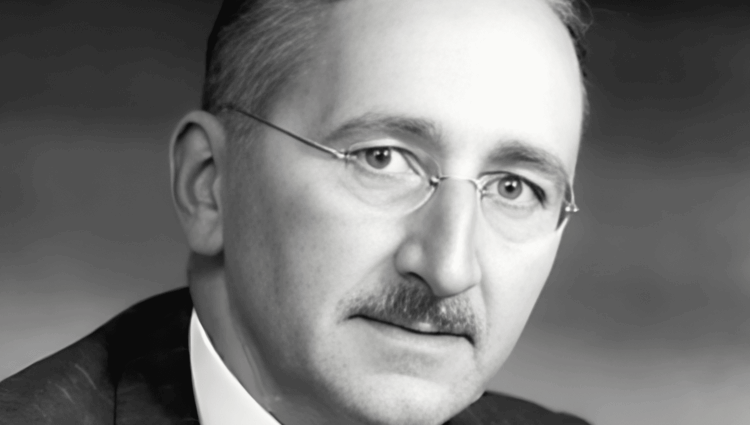
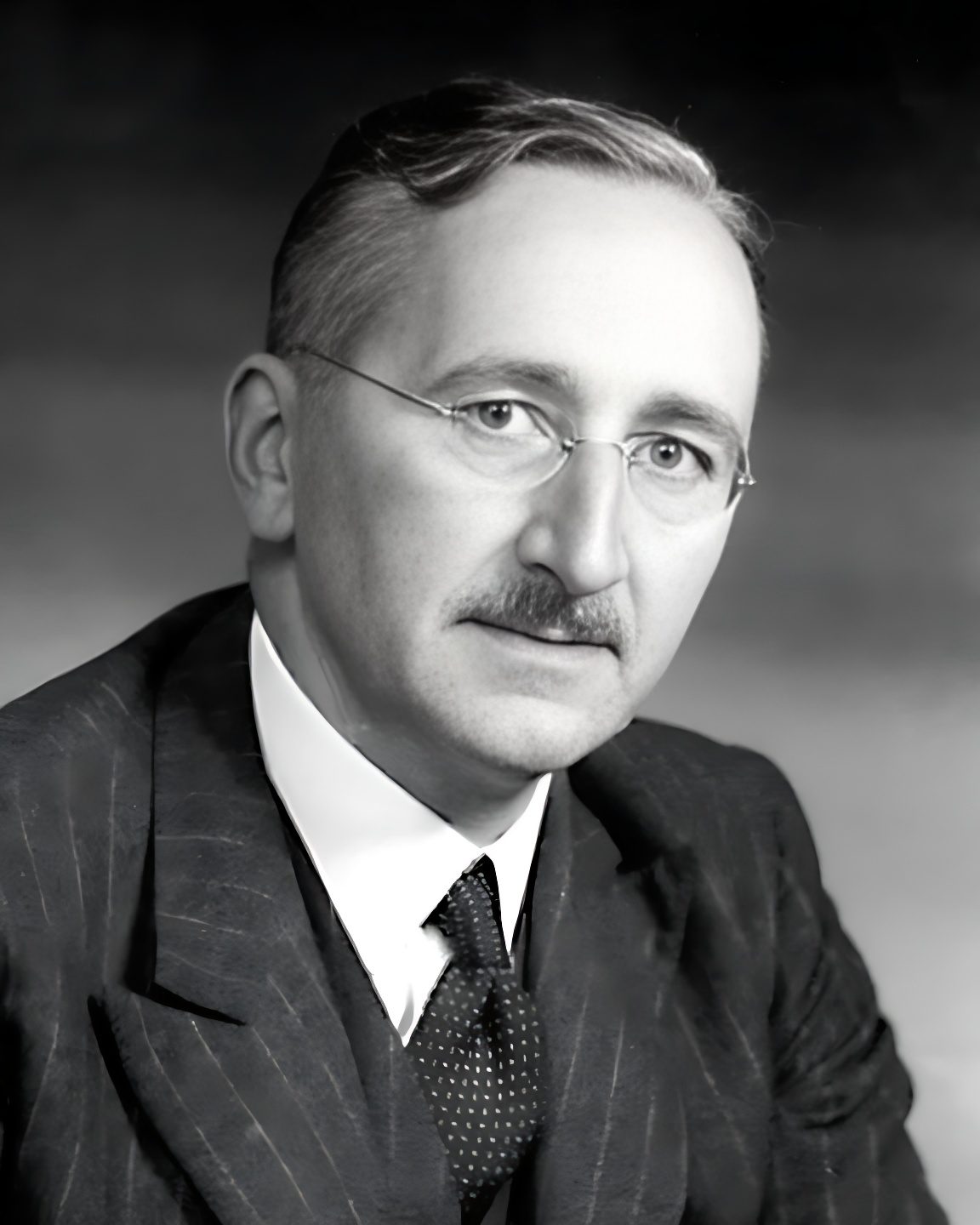
The featured image is a picture of F.A. Hayek to replace fair use images that are used in some articles. Released by the Mises Institute. This file is licensed under the Creative Commons Attribution-Share Alike 3.0 Unported license, courtesy of Wikimedia Commons.