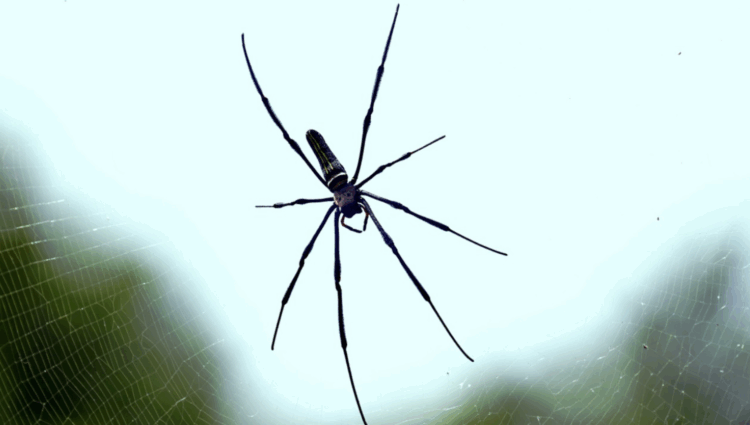
What is this fear of spiders? There is a natural fear of venomous creatures, but the spider’s venom is not the only threat. She spins a web. She entraps her prey. She wraps them tightly to eat them later. As the ghost in Hamlet cries about his own venomous murder: “O Horrible, O horrible, most horrible!”
 The Halloween decorations are out: Twelve-foot-tall skeletons, mechanical monsters that move, vampires and zombies, wicked witches, gruesome ghouls, and jack o’lanterns abound on the lawns of suburbia.
One of the notable Halloween props are all sorts of spooky spiders. Gauze is strung from porches, folks drape cobwebs made of rope from their gutters and place giant purple inflatable spiders on the lawn. Spiders are scary for sure, and arachnophobia is a thing. I had a girlfriend once who suffered from it. We could get her to scream and burst into angry tears and tirades by leaving a tomato stem upside down on the kitchen counter.
There are certainly enough spooky spiders in stories and movies to make Halloween more trick than treat. Harry Potter and his chums encounter a giant spider named Aragog in Chamber of Secrets and H.D.Lovecraft offers Atlach-Nacha – a spider type monster in The Dream-Quest of Unknown Kadath.
There are a couple of forgettable arachnophobia movies, and in the Tom Cruise/Steven Spielberg film Minority Report, there are some spectacularly spooky robotic spiders that scuttle across floors, creep under doors, and climb walls to invade, spy, and report back to their masters.
However the modern master of the spooky spider must be Tolkien. Bilbo and his band battle the spiders of Mirkwood in The Hobbit, but Tolkien’s most memorable monster must be Shelob—the terrible arachnid to whom Gollum delivered Frodo and Sam in Torech Ungol—the caverns of Cirith Ungol:
There age long she had dwelt, an evil thing in spider-form, even such as once of old had lived in the Land of the Elves in the West that is now under the Sea, such as Beren had fought in the Mountains of Terror in Doriath, and so came to Lúthien upon the green sward amid the hemlocks in the moonlight long ago. How Shelob came there, flying from ruin, no tale tells, for out of the Dark Years few tales have come. But still she was there, vast, silent, and her malice was woven about her, an evil net, and the shadows were her dwelling. Her eyes were pits of blackness, lightless, save for an evil glint, and her bloated body, swollen with the juices of her endless feasts, hung above her shining web.
What is this fear of spiders?. we might ask. There is a natural fear of venomous creatures, but the spider’s venom is not the only threat. She spins a web. She entraps her prey. She wraps them tightly to eat them later. As the ghost in Hamlet cries about his own venomous murder: “O Horrible, O horrible, most horrible!”
But there is more than fear of being bitten or the claustrophobia of being wrapped up to be devoured anon. There is something deeper and darker into which Tolkien taps.
Shelob dwells in a tunnel in a cave, and therefore she is a creature of darkness, the place where wild things are. She is the monster under the bed, the dweller in the depths— a creature of the underworld, and as such she is the inhabitant of the realm of myth and the subconscious. After all, the arachnids take their name from Arachne, the sly girl who wove a tapestry of evil, then hanged herself before being transformed into a spider by the goddess Athena.
On the mythic level, in Tolkien’s Silmarillion we’re told of the beast Ongoliant, a malevolent being of darkness who allies with Melkor to destroy the Two Trees of Valinor. She is Shelob’s ancestor, described as a vast, spider-shaped creature who weaves webs of unlight. Japanese folklore speaks of the Tsuchigumo—giant spider-like demons who dwell in the dark places, while Afro-Caribbean folklore features the mischievous manipulating spider spirit named Anansi.
Shelob, the female creature of the dark is the shadow side of Galadriel, the female creature of light. As the dark female is she the shadow side of the feminine—Kali Ma— the devouring Mother of the Hindu myth and the Jungian imagination?
Or let us spin a Freudian web: If the horrible spider is female, is there a level of gynophobia here? Does Shelob represent a deep, irrational fear of the female? Is the fear of her web the fear of female entrapment? Is fear of her venom the fear of the insane, venomous, murderous, vengeful woman—that Glenn Close villain in Fatal Attraction? Is Shelob Tolkien’s Morgan le Fay—the femme fatale of his mythos?
Such speculation is interesting perhaps, but like spiders… nothing to be afraid of.
Happy Halloween!
__________
The Imaginative Conservative applies the principle of appreciation to the discussion of culture and politics—we approach dialogue with magnanimity rather than with mere civility. Will you help us remain a refreshing oasis in the increasingly contentious arena of modern discourse? Please consider donating now.
The featured image is courtesy of Pixabay.