Remember that Halloween is simply the eve of All Hallows, All Saints Day, which is followed by All Souls Day on the Christian calendar. Death, and one’s own future death in particular, ought to be remembered, but not as a morbid fascination. Rather, it should be meditated on as the inevitable gateway to eternal life if we persevere in God’s will, or eternal death if we should give our will to the wiles of the dark one.
 As October fades into November, the season brings crisp temperatures, apple picking, and the ogling of autumn leaves. It also brings disturbing ghoulish yard displays and images of ghosts, gore, and the monstrous. At month’s end children dress in death to solicit sweets from strangers. When Halloween themes are in the air, many readers seek out goosebump eliciting books. Much of what is on offer – but not all – is not only lacking in merit, but quite unhealthy, even dangerous. How does one distinguish safe literature from unsafe within the spooky genres? Are all scary ghost and monster stories to be avoided by those striving for virtue? The case is clear that it is not only safe to read good quality scary literature, but that the literary encounter with evil has a long and healthy tradition.
Some books ought not to be read at all. Among these are the badly written (we shouldn’t waste our time nor encourage untalented authors), the explicitly immoral (lest they lead us to sin), and the evil (which provide an opening for the demonic to enter our life). The content and the author’s intent should be evaluated, and so should the reader’s motivation. It is advisable for those who are committed to spiritual health and virtue to choose their reading diet as carefully as they would their nutritional diet.
First, avoid poison. There are many genres of literature that are healthy and good while eliciting suspense and chills. The bad can be dispatched quite simply. They include books that promote sympathy for wicked characters, romanticize evil, encourage curiosity into the occult and preternatural, or intend to titillate by fanning the flame of fear in order to enjoy the feeling of being terrified. This sort of evil in literary form is rather two-dimensional and plentiful, prowling around like a lion, as it were, seeking someone to devour. Once identified it can be deftly avoided.
The reader’s motivation should also be evaluated. Just as fire is useful for warmth, light and cooking, in the hands of an arsonist it renders destruction and death, even so, good scary books can do harm to the reader who recklessly pursues only dark pleasures or the adrenaline rush of fear. Such readers are guilty of emotional gluttony. They would be well advised to refrain from misusing literature for a purpose harmful to their souls. Recreational curiosity about encounters with evil should be shunned while an honest understanding of our own frailty ought to be cultivated.
A healthy concern for death, one’s own particularly, on the other hand, is to be encouraged as a means of avoiding actual danger, both physical and supernatural. Thinking of our own future death by way of reminder – the memento mori – is, paradoxically, to remember and preserve our life, both in the here and the hereafter. Many great works of literature allow us to vicariously do battle with evil, hone our ability to identify it, strengthen our defenses against it, and guide us in discerning when to engage and when to flee. Reading heroic tales, both fictional and factual, should be a spiritual and intellectual work-out in preparation for the real battle in our own lives.
The great works of literature nearly always present to us encounters with evil. These can and should be enjoyed without any concern. Children’s fairy tales of any worth are scary, terrifying even. Take, for example, “The Three Little Pigs,” “Sleeping Beauty,” “Hansel and Gretel,” “Br’er Rabbit,” “Snow White,” and “The Three Billy Goats Gruff.” Sometimes they have been cleaned up, removing the grisly Germanic gore (Red Riding Hood’s Granny is put into the closet, rather than gobbled up), but the disquieting terror remains. Without it, there would be no point in the story.
Casting back over almost three millennia, we find Homer’s classic, The Odyssey, part history and part frightening fantasy. Odysseus and his unfortunate crew contend with fickle gods, a man-eating Cyclops, and numerous terrors of land and sea. This masterpiece has not survived because it is merely an exciting yarn, but because it shows man his moral frailties and how such frailties expose him to monstrous dangers which are not visible to the eye. This is the main benefit of reading good, yet nightmarish works; they make visible the invisible enemy that threatens our eternal reward.
A walk through the centuries shows us other frightful literary works collected into the canon of those which ought not to be forgotten. Greek and Roman mythology give us myriads of monsters such as sirens, the Minotaur, the hydra, the lemures, and the Gorgons. Moving forward in time, dreadful tales with fiendish beasts of note include Beowulf’s encounter with the demonic Grendel and his unlovely mother; Gawain’s quest for the menacing magic of the Green Knight; and Spencer’s depiction of the Blatant Beat in The Faerie Queen. Shakespeare simply shimmers with ghosts and mischievous sprites, spirits, and fairies (Hamlet, Macbeth, The Tempest, and Midsummer Night’s Dream). The most charming of Dickens’ works, A Christmas Carol, is nothing without ghosts.
This same purpose can be found in fantastic literary encounters with vampires, werewolves, genies, and other magical creatures unleashed by the author’s creative gift. Frightening tales make visible to our imagination the invisible demonic battle waged every moment under a variety of guises. It is to our benefit to become familiar in this way with the enemy’s various tactics. Vampires, made wildly popular by Bram Stoker’s surprisingly hokey Dracula, suck life from their victims, costing them their eternal life. It is appropriate that in the literary rules of this genre, the vampire must always be invited or willfully admitted. It is the same with the actual demonic; cunning demons beckon the unwary alluringly, seeking a fiat to a small evil that gains them permission to enter.
The fantastic is an inflated image of something real. Hair-raising Werewolf stories are dreadful because real wolves have menaced and caused dread in man for ages. Whether encountering Little Red Riding Hood’s talking wolf or Tim Powers’ take on werewolves in his spine tingling My Brother’s Keeper, fictional wolves reflect and inflate the real-life danger that terrestrial wolves pose. In Willa Cather’s My Antonia, the account told by the Russian neighbor upon his deathbed of the pack of wolves pursuing the wedding party’s sleighs in the night-time journey through the forest has stuck with me for decades as one of the most terrifying narratives I remember reading. The horror of the vicious wolves was surpassed only by that of the murderous self-preservation in the heart of the sleigh driver.
Another type of bone-chilling story is populated with evil humans who rule the world. Works such as Benson’s Lord of the World, Orwell’s 1984, Huxley’s A Brave New World, and Solzhenitsyn’s One Day in the Life of Ivan Denisovich are cautionary tales which elicit as much terror as speculative fiction’s monsters because they expose hideous dangers crouching in our world that are very real and against which we can feel helpless. Similarly, true tales of heroes who have overcome life threatening challenges, or who have endured insurmountable hardships, such as Red Scarf Girl and Left to Tell can make our skin crawl at the evil that resides in the hearts of men. Lastly, and most terrifying, are accounts of real encounters with demons. These are not for the faint of heart.
With regard to these horrifying realistic tales, whether fictional or non-fictional, the sensitivity of the reader must always be respected. Those who are very sensitive, including all small children, should be spared any literature that will cause bad dreams or dread in their daily lives. Storytelling is only valuable if it allows us to emerge with a better understanding that we will be victorious when we abide in God.
If you have an appetite for spooky reading that won’t endanger your soul as the days darken, and the inflatable ghouls appear on your neighbors’ lawns, there are several volumes you can safely read without disturbing your moral compass. Elanor Nicholson’s novels in the Gothic tradition, The Bloody Habit, Brother Wolf, and Wake of Malice, find the unflappable Dominican, Fr. Thomas Edmund Gilroy, confronting preternatural creatures with the wisdom of philosophy and theology. This Thing of Darkness by Fiorella de Maria and K. V. Turley brings the reader into a creepy interview with the Dracula-obsessed Bela Lugosi and the dangerous mysteries uncovered by an unsuspecting journalist. You will not be disappointed with anything written by the weird, wonderful, and literarily agile Tim Powers. The phrase “page turner” describes all his books.
Remember that Halloween is simply the eve of All Hallows, All Saints Day, which is followed by All Souls Day on the Christian calendar. Death, and one’s own future death in particular, ought to be remembered, but not as a morbid fascination. Rather, it should be meditated on as the inevitable gateway to eternal life if we persevere in God’s will, or eternal death if we should give our will to the wiles of the dark one.
__________
The Imaginative Conservative applies the principle of appreciation to the discussion of culture and politics—we approach dialogue with magnanimity rather than with mere civility. Will you help us remain a refreshing oasis in the increasingly contentious arena of modern discourse? Please consider donating now.
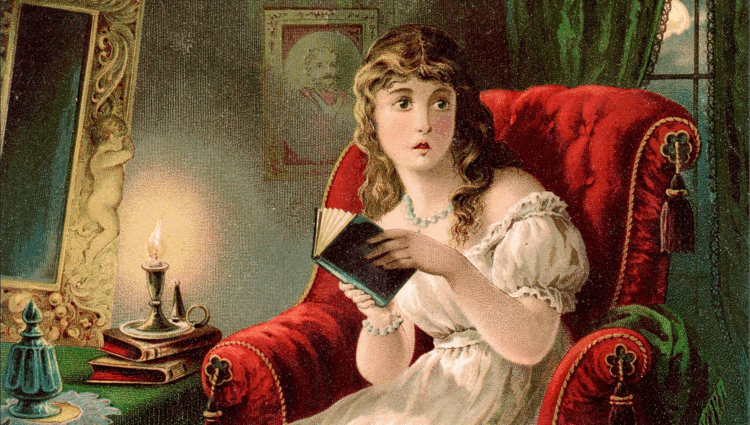
The featured image “The Ghost Story” (circa 1874) by Robert William Buss, and is in the public domain, courtesy of Wikimedia Commons.