A Christian humanist embraces not only the ethics and morality of Socrates and Christ, but he also loves the liberal arts and liberal education as a means to distance oneself from the immediacy and materialism of this world. As a Christian humanist, one seeks the eternal within time.
This is part three of a series. See the second essay here; see the first essay in the series here. -Editor
 My fourth argument. In what has become known as “postliberalism,” Patrick Deneen calls us to very high things at the end of Why Liberalism Failed? First, he notes that we should take into account the many successes of liberalism and not dismiss them. Second, like T.S. Eliot, Deneen argues that we should not destroy modern and post-modern forms, but, in essence (my language, not his), baptize them. Third, echoing Robert Nisbet, Deneen rightly calls us back to a love of family, church, associations.
While I don’t disagree with any of this—and I have yet to read Regime Change, for which I am very sorry—I believe there has to be something more, something that promotes and cherishes humanity dignity, individuality, and community. I am here reminded of Russell Kirk—so very much like Deneen—in the aftermath of the incredible success of The Conservative Mind. First, Kirk was frustrated that so many of his admirers as well as his critics viewed his book and his ideas through a political lens. Second, Kirk was concerned that while his form of conservatism served as the best means of understanding the past, it did not embrace the future. To counter this, Kirk adopted, importantly but briefly, the term Christian Humanist. In so doing, he placed himself in a community that included Babbitt, More, Eliot, B.I. Bell, Laura Ingalls Wilder, Willa Cather, Dawson, Jacques Maritain, Etienne Gilson, Thomas Merton, Flannery O’Connor, J.R.R Tolkien, C.S. Lewis, Owen Barfield, Alexander Solzhenitzsyn, and Romano Guardini, but also fellow travelers such as Robert Nisbet, Ray Bradbury, Leo Strauss, and Eric Voegelin.
Critically, Christian Humanism was not yet another ideology, but an anti-ideology, something that transcended the simple and ridiculous left-right horizontal spectrum, and, instead, viewed life vertically. One was either God or anti-God, Christ or anti-Christ, man or anti-man. A Christian humanist embraced not only the ethics and morality of Socrates and Christ, but he also loved the liberal arts and liberal education as a means to distance oneself from the immediacy and materialism of this world. As a Christian humanist, one sought the eternal within time.
Here are five tenets of the Humanist, Christian or fellow traveler:
First, humanists believe in the dignity of the human person. Each person is unique, born in a certain time and place, never to be repeated. She or he comes into the world, burdened by many flaws but also armed with unique gifts, each to be made excellences over time and usage, through community.
Second, humanists saw liberal education as the most proper education for the development and nurturing of a human being. True education seeks wisdom, not mere knowledge or technical skill. It does not believe in shaping the person for the here and now, but for the eternal.
Third, contrary to so much of our current understanding, real humanism never placed the human person as the highest of all things, but as and in the middle of all things. Man is higher than the animals but lower than the divine. Thus, humanism sought context (Justice) and place for each person throughout all of Creation. Man possesses the spiritual nature of the divine but the material nature of the animal. He, alone among all worldly creatures, wields free will. Some humanists have written about this as an “economy of nature or grace” and Renaissance humanists explained the concept of a “great chain of being,” connecting the perfect creator to even the lowest order of creation. Nothing could exist outside of this hierarchy. Even evil existed only as a corruption of the good.
Fourth, the humanist upheld citizenship of the Republic of Letters—across time—as higher than loyalty to any nation or worldly power. A Roman Catholic might refer to this as a communion of saints or as the mystical body of Christ. The great pagan, Cicero, however, spoke of this as simply, “reason,” the language that connects not only man to the god, but all men of good will to all other men of good will, from the beginning to the end of humanity.
Fifth, while the humanists have never exactly agreed about a god or God, the humanist has understood that someTHING stands above any one person or all of humanity together. Perhaps that someTHING is Yahweh or the Trinitarian God or the Natural Law, but a power of some supernatural order transcends all of humanity, time, and existence.
These, I believe, offer a better path forward than progressivism, classical liberalism, welfare liberalism, conservatism, or postliberalism. And, for what it’s worth, I get to teach a semester-long course on Christian Humanism every few years at Hillsdale. When I get to the modern period, I mention three of the greatest living Christian Humanists: James Matthew Wilson; Joseph Pearce; and, of course, Patrick Deneen.
__________
The Imaginative Conservative applies the principle of appreciation to the discussion of culture and politics—we approach dialogue with magnanimity rather than with mere civility. Will you help us remain a refreshing oasis in the increasingly contentious arena of modern discourse? Please consider donating now.
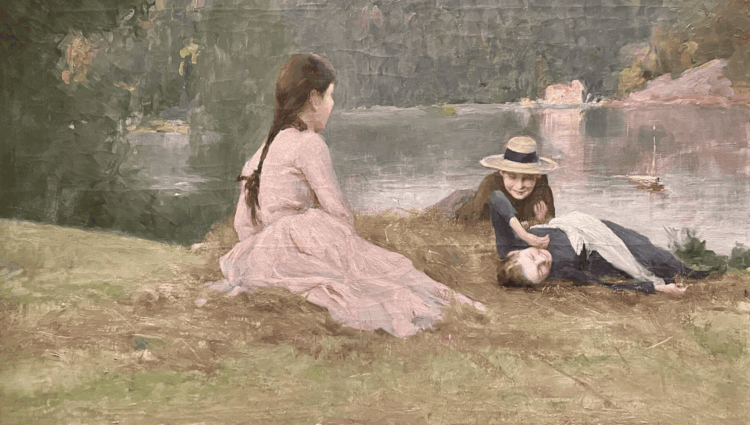
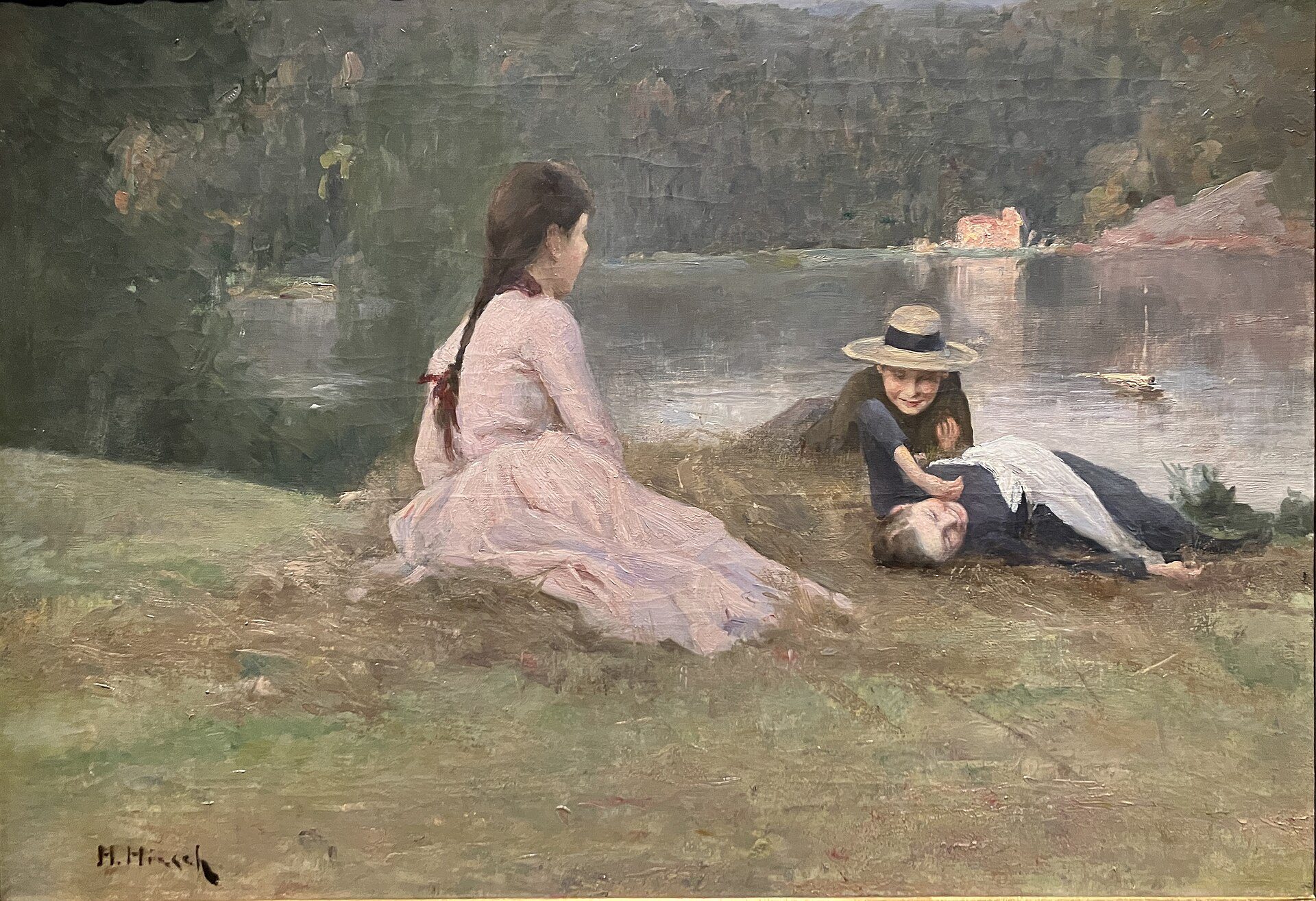
The featured image, uploaded by Gotogo, is “Quiet Summer Evening” (1887), by Hanna Hirsch-Pauli. This file is made available under the Creative Commons CC0 1.0 Universal Public Domain Dedication, courtesy of Wikimedia Commons.