A beauty-first approach recovers a sense of life as a great adventure. To be human is to be disposed to fall in love with reality, to be struck by the beauty of the things of this world and thus, through the wound it opens in our heart, to be drawn into reality, to want to penetrate to the deepest essence of things, and be surprised ever anew by grace upon grace.
In a recent, well-regarded book entitled The Ethics of Beauty,[1] Orthodox priest Timothy G. Patitsas has argued for a paradigm shift in the way we conceive human behavior and activity, the various expressions of which we can gather under the name, “ethics.” In contrast to what he has called the “truth-first” approach, which he believes has dominated the rationalistically-inclined West, Patitsas proposes that we draw on the more-or-less untapped resources of the Christian East to recover a “beauty-first” approach. Among the many advantages Patitsas expounds in this rich book are the properly integrative capacities of beauty and the spiritual depths it is able to open up in human life. Where a “truth-first” approach has led us to conceive of ethics simply as a rigorously rational science of morality, which leaves outside all of those activities that do not immediately concern the question of right and wrong, a “beauty-first” approach recalls us to the more traditional sense of life as an erotic pursuit of excellence, having its foundation in a falling in love with the beautiful, ultimately with Christ as manifest in the Church, and gathering up the whole of existence, both individual and common, in essentially meaningful form. A beauty-first approach connects ethics moreover with the sacramental life, with the mystical depths of liturgy, with prayer and the historical realities of grace and providence. A recovery of the ever-ancient, ever-new “beauty-first” approach restores the sense of human life, from top to bottom, as a glorious adventure—a sense that stands in such stark contrast to the oppressive monotony of banalities to which we have largely reduced existence in the contemporary world. Indeed, it may not be too much to say that the greater part of the psychological, social, and cultural problems we face today are due to our having lost the capacity to experience life as a great adventure.
Now, I noted that Patitsas has described this flushing of eros from life as an ailment that specifically afflicts Western thought; he does not discuss in this book the work of Aquinas, so it is not clear whether he would include Aquinas as a representative of the impoverished “truth-first” approach to ethics. But it is not uncommon for Orthodox thinkers to lay a good part of the blame on Aquinas’s shoulders for what they call Western rationalism. In any event, Patitsas does not appeal to Aquinas as a source for his proposal of a “beauty-first” approach. What I would like to do in this brief presentation is to suggest that he could have drawn on Aquinas, though to do so admittedly requires reading Aquinas in a somewhat unfamiliar way.[2] There are a number of reasons I think it is worthwhile to make this suggestion: not only would it show that Orthodox and Catholic thought are not opposed to each other, but share the classical tradition, even if they tend to emphasize different aspects of that tradition, but it would also promise to introduce a conceptual clarity that is sometimes lacking in the more spiritually or mystically inclined East. Perhaps most of all, at least to my mind, if this suggestion can be justified it would open up a relatively new way of thinking about Aquinas’s own interpretation of human action.
My argument will be rather simple. I will first recall, and elaborate, Aquinas’s claim that love lies at the foundation of all human activity without exception. This claim can be demonstrated directly on the basis of Aquinas’s own texts. Second, I will propose that love ought to be interpreted most fundamentally in relation to beauty as distinct from the good. This is a more speculative claim. Although Aquinas does indeed gesture toward this interpretation, he much more evidently and frequently presents love in connection with the transcendental property of goodness. I will thus offer reasons to think that connecting love specifically with beauty offers a more satisfying account of human action, even on Aquinas’s own terms. In other words, I am going to argue that this is the way we ought to interpret Aquinas, even if it cuts against some of Aquinas’s explicit statements and clearly against the most common view of his thought. Finally, in light of Patitsas’s book, I will reflect briefly on some of the implications of this proposed interpretation, namely, that love lies at the foundation of all human action, and that beauty lies at the origin of love, showing that Aquinas does indeed offer his own version of a “beauty-first” approach to ethics, which could bear fruit in our contemporary context.
I. Love as the root of all action
Aquinas treats love in Questions 25-28 of the Summa’s prima secundae. This is love specifically as amor, as the natural human passion, as distinct from caritas, which is the theological virtue, love specifically as a divine gift of the Father in Christ through the Holy Spirit.[3] I will be making amor the focus here since we are discussing the nature of human action in general (though it would be fascinating, in another context, to think through the distinctively supernatural dimension of the matter).
There are three things that I want to highlight from this extraordinarily rich section of the Summa, things that will more or less place on the table what is essential about love with respect to the argument we will be making. First, I note that the discussion of love occurs in Aquinas’s treatise on the passions,[4] and indeed in the opening pages of that treatise. This location of his discussion of love is significant for several reasons: Aquinas in fact defines love specifically as a passion, which is to say it is something we undergo rather than something we first do: passion comes from patior, meaning “to undergo” or “to suffer”; it is directly related to the word “passive,” which indicates a receptive event rather than an action.[5] One frequently hears it said that love, for Aquinas, is essentially “willing the good of an other,” but this is not in fact Aquinas’s view. He distinguishes love from benevolence, i.e., which literally means willing the good of another, by saying that love includes good will, but adds to this a bond of affection.[6] Love is not in the first place an action but a state of being, a condition we undergo, from which action subsequently proceeds. We do of course will the good of another in love, but love is more than this act of will, as we will see in a moment. Another thing to point out about Aquinas’s characterizing love as a passion is that the passions involve both the body and soul operating together.[7] As distinct from the activities that stem principally from the body (like digestion) or the activities that stem principally from the soul as spirit, which is to say in its transcendence of the body (acts of the intellect and will),[8] love involves both body and soul; the subject of the passions, like that of the sensations, is specifically the body-soul composite, the union of the two taken as one. To say that love is a passion is therefore to say that, in its human expression, it implicates the whole of human nature at once.
The second thing I wish to highlight in Aquinas’s treatment of love here is the definition he formulates. It consists in fact of a single word: complacentia.[9] The typical English translation of this word is a bit misleading: “complacency,” in English, is something negative; it means something like smug self-satisfaction. The Latin is different: complacentia means being pleased (placere) with (cum), in the sense that one experiences the other as a good in which one takes delight. The prefix, “cum,” can either be an intensifier (signifying a delight that is complete), or it can indicate a reciprocity: two beings take delight in each other. This reciprocity is reinforced by another word that Aquinas uses in this context to explain the experience, namely, coaptatio, which means a reciprocal adaptation of one thing to another.[10] In love, the soul is rendered apt for the other, it is positively disposed to the other; the other is revealed in love as “fitting,” or “right.” Perhaps I didn’t know it before, but I now see: this (person or thing) is just what a wanted; it or he or she is perfect for me! This is complacentia. As Aquinas puts it, in love, “the appetible object” (in Aquinas’s Latin, “appetite” means desire in general: the appetible object is the desired object[11]) “gives the appetite . . . a certain adaptation to itself, which consists in complacency in that object.”[12] So, this is the basic definition of love in Aquinas: complacentia, in the sense of a positive disposition toward some object (whether a thing, or a person, or even an idea, or God); when I love some thing, I relate to it in a fundamental way as good, and indeed in some sense as specifically good for me.
The third thing I want to highlight from this discussion is the profoundly significant fact that Aquinas defines love, not just as a passion, but as the first of the passions.[13] All of the other passions that we experience presuppose the existence of the basic disposition of love. Aquinas mentions here the four principal ones from the classical tradition, joy, sadness, hope, and fear: we take joy in receiving what we love, we are sad when what we love is taken away; we hope to receive it again, and we fear losing it forever. Love is also more basic than the negative passions that stem from hatred, Aquinas explains, because, while every instance of hatred presupposes some basic love, the opposite is not true.[14] I can love without hating anything (indeed, this is the perfection we all aim for), but I cannot hate something unless I love something else.[15] According to Aquinas, love, the positive disposition toward what is good, lies at the basis of all other experiences. To say that love is the first of the passions is to say that love characterizes our most fundamental relation to reality; everything else, every other relation, is, so to speak, a further specification of love, whether it be a positive or a negative specification.
And this leads to the concluding observation of this first section of my presentation. In the last article of his discussion of love, Aquinas asks “whether love is the cause of all that the lover does”? It seems to me that he saves this question for last because it allows him to sum up the glory of love and reveal its central place in human existence. The corpus of his response to this question is short and sweet: “Every agent acts for an end. . . . Now the end is the good desired and loved by each one. Wherefore it is evident that every agent, whatever it be, does every action from love of some kind.”[16] Note that this claim could not be any more absolute and unqualified. The question might seem to specify a certain group, lovers rather than non-lovers; but the ensuing response reveals that there is no agent anywhere that is not a lover, which is to say that nothing acts except as disposed to some good to be achieved. And the actions at issue are not some subset of an agent’s acts. It is every action, by any agent whatsoever, whatever it might be. We can’t develop this point here, but it is interesting to note that we are not talking only about rational agents, but all agents: everything that happens in the universe is an expression of love. This includes not only human beings, but animals, plants, and minerals, planets and stars, hot and cold, and so forth. (One thinks here of the Canticle from scripture: cold and rain, bless the Lord, and so forth!).
II. Beauty as the cause of love.
It will have been noticed that the texts I have cited from Aquinas speak of the good rather than of the beautiful. As I observed earlier, the standard interpretation of Aquinas classifies love in the order of the good, which is the order that pertains to the will, in distinction from the order of the true that pertains to the intellect. Love lies in the order of the good because it concerns the appetible dimension of the human soul, our inclination toward the good: For Aquinas, and indeed for the whole classical tradition, goodness is defined as “appetibility”: “bonum est quod omnia appetunt.”[17] This standard interpretation of Aquinas has what seems to be a clear support that would settle all possible debate a priori: Aquinas begins his discussion of the causes of love, question 27 of the prima secundae, by asking in the first article whether the good alone is the cause of love, and considers as an objection the classic text from Dionysius the Areopagite’s Divine Names, which states that the beautiful too is a cause of love. In the corpus of his response, Aquinas states clearly that the good alone is the cause of love, and in response to Dionysius, he explains that “the beautiful is the same as the good, and they differ in aspect only.”[18] It would thus seem perfectly evident that, if beauty is relevant to the understanding of love at all, it is only in an incidental sort of way: beauty is a cause of love only to the extent that it is identical with the good, but, presumably, not to the extent that it differs from the good. But I want to propose that this inference is mistaken. Aquinas’s definition of love, I want to suggest, itself compels us to place beauty at the center of love. It is not yet clear to me whether the argument I will sketch out here has the force of logical necessity; I will content myself with saying it is an argument based on fittingness—but I would add that the fittingness is so powerful as to be virtually inescapable.
Why beauty? It is not only because beauty is the essential principle of love for the whole classical neoplatonic tradition, beginning with Plato’s incomparable meditations on love and beauty in the Symposium and the Phaedrus (a tradition, incidentally, to which Patitsas appeals); it is also because Aquinas’s texts themselves point in this direction, however much this has been overlooked by commentators. One of the reasons the claim is so compelling is that it is so simple and obvious. In his response to the Dionysian objection just mentioned, Aquinas distinguishes beauty from goodness by saying that “beauty adds to goodness a relation to the cognitive faculty: so that good means that which simply pleases the appetite; while the beautiful is something pleasant to apprehend.”[19] So, beauty is goodness specifically as apprehended. But in the very next article, Aquinas asks whether knowledge is the cause of love, and responds thus: “I answer that, as stated above, good is the cause of love, as being its object. But good is not the object of appetite, except as apprehended.”[20] Let us pause here: given what Aquinas just said a paragraph earlier, we can translate this claim as stating that “good is not the object of the appetite, except as beauty.” If we make this substitution, are we reading too much into the text? Not at all. Aquinas continues in his exposition thus, “And therefore love demands some apprehension of the good that is loved.” What is the good qua apprehended? It is, again, beauty. “For this reason,” Aquinas goes on to say, “the Philosopher says that bodily sight is the beginning of sensitive love.” He is referring here to a passage in the Nichomachean Ethics in which Aristotle writes, “the pleasure of the eye is the beginning of love. No one falls in love without first being charmed by beauty.”[21] The pleasure of the eye is indeed just what Aquinas had described as the essence of beauty, which, we recall, “is something pleasant to apprehend,” referring specifically to seeing and hearing. And so Aquinas concludes, “in like manner the contemplation of spiritual beauty or goodness [contemplatio spiritualis pulchritudinis vel bonitatis] is the beginning of spiritual love. Accordingly, knowledge is the cause of love for the same reason as good is, which can be loved only if known.” Only if, he says: nisi. There is therefore no love of the good except as apprehended, or as contemplated, which is just to say that the good is the cause of love only as beauty. (We should note, moreover, that the word “beginning” that Aquinas uses here is principium, which is to say principle or cause, not just starting point. Aristotle had used the preposition dia in his text, specifically in its causal sense. There can be no doubt that cause is meant, not just the first step of the appetitive movement.)
Now, it seems to me that this attention we’ve given to the first two articles of question 27 already presents a decisive case for the role of beauty in love, but there is even more to be said in its favor. Let us return to the definition of love Aquinas had formulated in the previous question. As we saw, love is a complacentia, or co-aptatio; it is a disposition of the soul toward a thing or a person as good. This disposition is not just a part of love; it is the very essence of love. Love is thus distinct from both the desire that follows upon this being disposed, which Aquinas says implies a movement toward the good,[22] and the joy that consists in resting in the good once attained: “the first change wrought in the appetite by the appetible object is called love, and is nothing else than complacency in that object; and from this complacency results a movement towards that same object and this movement is desire; and last, there is rest, which is joy.” The complacency is not the movement or the rest, but the principle that enables both, and the principle is the event whereby an object “gives its form” to the soul. Love, in other words, is the reception of the form of the beloved object into the soul, a form that renders the soul apt for the object in its real existence, thus enabling the soul to pursue that object. We might say that love inspires; as Plato put it, love gives the soul wings, elevating it so that it can approach its object.[23] In the De Malo, Aquinas says that, in love, the lover is transformed into the beloved[24]; and this is possible only by receiving the beloved’s form into the soul.
As it turns out, in the beginning of the Summa, question 5, Aquinas defines beauty in its relation to the good in just these terms: the good, he says there, has the ratio finis, which is to say that being an end, a terminus or goal of appetite, is the intrinsic logic of goodness.[25] In this respect, we ought to say that goodness corresponds specifically to desire and joy as it was just characterized; both, after all, involve the end, either as that to which the soul moves or that in which it rests. But beauty does not have the ratio finis; instead, it has the ratio formalis,[26] which is to say it is about form, the display of form. (Indeed, one of the Latin words that gets translated as beauty is formositas, “formliness.”) But it is precisely the relation to the good, not specifically as end, but instead specifically as form that distinguishes love from desire or joy. As T.S. Eliot puts it, “Love is itself unmoving, / Only the cause and end of movement.”[27] This means that love is nothing but the soul’s relation to beauty. To say this does not in the least require us to reject Aquinas’s claim that love disposes the soul towards the good; goodness and beauty, as transcendental properties, are not only inseparable from each other, but are identical in re. It only requires us to see that the disposing of the soul, which is love in its essence, is a function of beauty: in other words, it is precisely beauty—goodness just insofar as it is apprehended, or in other words insofar as it communicates its form into the appetite of the beholder so as to render him apt for it—that disposes the soul to pursue a thing, qua good, which is to say that what specifically defines love is not goodness but beauty.
There is one last point I wish to make, drawing on the recent work of Daniel Parkinson,[28] before concluding this section, because it will be important for our final observations. Aquinas defines the transcendentals goodness and truth as being perfective of the human soul: goodness perfects the appetite, or will, which is to say that it brings satisfaction, fulfillment, to our desire; and truth is perfective of the intellect, which is to say that it fulfills the mind, satisfies our desire to know. But what of beauty? There does not seem to be any specific spiritual faculty left over, which would allow us to distinguish beauty from the other two transcendentals. It is worth noting that this seems to be one of the principal reasons beauty has always had an uncertain status in the thought of Aquinas, and why Thomists continue to debate the question whether beauty is a distinct transcendental property of being at all. To encapsulate in a nutshell a point that Parkinson works out in systematic detail through an analysis of a variety of texts in Aquinas, we might say that what distinguishes beauty as a transcendental property is precisely its not being perfective of any particular human faculty. Aquinas makes just this observation in the De veritate, when he distinguishes beauty from goodness and truth.[29] But this quality does not make beauty therefore imperfect; instead, it seems to me we ought to interpret this as highlighting the gratuity of beauty, the fact that it is a revelation of the perfection of the thing in itself, independently of whether it directly satisfies one of the faculties of my soul. This quality is affirmed in a central way above all in German aesthetics: there is something “disinterested” in the experience of beauty, which means, not that beauty is uninteresting, but that it lifts me out of my self-preoccupation. To see something as beautiful is to see it as good supremely in itself, without worrying in the first place about whether it is specifically good for me. I celebrate it; the world is better because this piece of music, this work of art, this person exists. It is good that you exist![30] Just this fact makes me happy. But this is the very essence of love.
III. Beauty as the wellspring of action
This last point brings us around to the theme with which we began, namely, Timothy Patitsas’s proposal of a “beauty-first” approach to ethics. Our argument has led us to see that this is precisely what is offered, in principle, by the thought of Thomas Aquinas. Let us put our claims together. “Every agent,” we have seen, “whatever it be, does every action out of love of some kind.” This is because love is the absolute first of the passions. We do not do any action at all unless we are moved to do that action, and what moves us is first of all the reception of form, which enters into our soul and gives it the capacity to pursue the desired good. Without first receiving form, the soul would be unable to act. But the appreciative reception of form is nothing other than the experience of beauty. To say that every action whatsoever springs from love is to say that all activity—not just human activity, incidentally, though this has been our focus here—is inspired by beauty. Beauty lies at the very foundation of human existence.
So, what does this imply? There would be dozens of paths to pursue, but we do not have time for everything: I actually think a person could spend the rest of his life just pondering this point, and it would have been a wonderful life indeed! But I will just make three observations in closing. First, recognizing not only that every single human action arises out of love of some kind, but also to say that love springs from an encounter with beauty such as we have just described it, opens up what we can call an essentially “contemplative” dimension at the core of human existence, which we might otherwise tend to displace to the margins of our activity. It is not uncommon to think of human life as a tedious repetition of essentially the same series of activities: we first more or less passively register information, in a detached mode, and then we seize on some bits of that information to set off on one effort at gratifying an interest after another, in monotonous succession. This is the pragmatic reduction of existence that has become so familiar to us all: it has been encouraged no doubt by the Darwinist account of life as a struggle for survival, a struggle that has really no point beyond that survival itself, and more recently by the reconception of human intelligence after the model of “AI,” which reduces intelligence to problem-solving calculations. Perhaps at the deepest root of this radical impoverishment of human life is a forgetfulness of beauty. The point is not just that we fail to stop and admire beautiful things from time to time, but that we do not think of beauty as centrally important, the ground on which we build our existence. The theologian Hans Urs von Balthasar has written some marvelous things about the forgetting of beauty in this regard, judging, for example, that the soul that grows insensible to beauty finds itself unable to pray and eventually unable to love.[31] The reason I say that a recollection of beauty would restore a contemplative dimension to life is that beauty implies a kind of meaningfulness in which we can dwell, a meaningfulness that includes a robust affirmation, a recognition of value. To relate to the world most basically under the sign of beauty is thus radically different from the passive registration of information.[32] Beauty is a revelation, which is dramatic and full of mystery. Moreover, as a matter of form in distinction from finality, it does not in the first place address itself, as I pointed out, to our appetite in the mode of self-interest. Instead, it is a revelation of what is good in itself first of all. All of this is to say that, under the sign of beauty, the world presents itself most fundamentally as something to marvel at, something that provokes wonder and even awe, and if and when we pursue our interests in this world, we do so with an encompassing spirit of gratitude and reverence. Another way to put this is that the “beauty-first” approach introduces a sense of gratuity, or gift, at the foundation of our experience.
Still another way to put it is to say that such a conception of beauty as a wellspring of action introduces into the soul a fundamental disposition of festivity and playfulness.[33] One of the most remarkable books to read in this context is Friedrich Schiller’s set of letters entitled, On the Aesthetic Education of Man. In this little book, he writes, “Man shall only play with Beauty, and he shall play only with Beauty.”[34] In the presence of beauty, we feel liberated from the stress and anxiety of accomplishing, or failing to accomplish, one external purpose or another, and we gather ourselves as a whole (remember: love, as a passion, concerns body and soul precisely together in their unity) in a time of celebration and affirmation. Rather than seeing this spirit as an exception to the seriousness of human life that relentlessly persists in demanding our attention, we should recall it at the center of our lives: we are most fully human when we gather together in celebration.[35] And if the direct occasions for celebration are episodic rather than constant, it nevertheless remains the case that something of this spirit belongs at the root of everything we do: every agent whatever it be does every action through the inspiration of beauty. If beauty is first, the playfulness it inspires will suffuse the whole.
Second, because, as we have seen, beauty is essentially a matter of form, rooting human action in beauty makes form more centrally relevant to human action than we might otherwise have realized. What does it mean to make form central to human action? At the outset, I mentioned Patitsas’s observation that, when we think of ethics, we tend to think more or less narrowly about determining which discrete acts are morally right and which are morally wrong. While this is not problematic in principle—indeed, it is crucially important for us as human beings, and especially as Christians, to know what is right and what is wrong—such a restriction leaves a great deal of our lives out of consideration. The moments in which we face a dilemma, when we have to make a serious decision about some moral matter, are—fortunately!—relatively rare. The temptation is therefore to think that the great majority of things we do in a day-to-day sort of way are essentially indifferent with respect to ethics. But when the ancient world asked, with great existential seriousness, What is the good life? What does the good life look like?, it was not asking simply for a list of evil actions that ought to be avoided. Instead, the question asked about how to live excellently, in a manner that represented the pursuit of an idea. The word for good in this ancient context, incidentally, is “kalon,” which is in many cases better translated as “beautiful.” The ancient world sought to live a beautiful life, a life built on and toward the beautiful. Such a life was not only a matter of moral effort, but sought to make radiantly manifest what was best and truest in human existence. It is interesting to note in this context that John Paul II’s great encyclical on morality is called “veritatis splendor,” the splendor or radiance of truth, which is in fact just what beauty is.
What becomes most relevant from this perspective is, again, not in the first place the moral value of one discrete act or another; instead, more positively, what stands out as a matter of fundamental importance is the order of life, how we organize existence, which includes the outward manifestation in culture. For example, from a “beauty-first” perspective, we realize the significance of the life of the home: the rhythms that constitute that life, the forms we give to the way we live together, the daily rituals and traditions of the family meal, of chores, of praying together and preparing for bed, of the celebrations of special events, of the way we follow the seasons, and especially those of the Church, and so forth. Fo another example, a beauty-first approach to work, and the economy, would implicate in extremely concrete ways the organization of the aspects of work, the way we relate not only to other people but to the natural world, the realities that inspire us and shape our imagination, the common goods we pursue, even at the cost of more immediate necessities. It is possible to imagine an approach to work that is entirely formless, that is cynically pragmatic and driven only by the interests of pure self-interest, and that nevertheless does not directly and explicitly offend any particular moral principle. Such a way of working may not be immoral, but it is nevertheless not part of the good life in the more traditional sense. The point is not in the end to have someone say of us (to quote Eliot again), “Here were decent godless people: / Their only monument the asphalt road / And a thousand lost golfballs.”[36] By recovering a sense of the primacy of beauty, we can see that ritual is fundamental to proper human existence, and that ritual inevitably has a religious depth. This allows us to grasp a bit better what St. Paul meant when he said, whatever you do, whether eating or drinking, do all for the glory of God (1 Cor 10:31). Christian life is more than a moral life, it is a life that tends toward liturgy and celebration in all its dimensions, even outside the church. To borrow a phrase from Isaak Dinesen’s marvelous short story, “Babette’s Feast,” we ought to recognize “the world [as] not a moral, but a mystic, concern.”[37]
Finally, a beauty-first approach recovers a sense of life as a great adventure. To say that love is the foundation of all action and beauty is the foundation of all love is to say that the whole of our existence is meant to have the character of falling in love: to be human is to be disposed to fall in love with reality, to be struck by the beauty of the things of this world and thus, through the wound it opens in our heart, to be drawn into reality, to want to penetrate to the deepest essence of things, and be surprised ever anew by grace upon grace (charin anti charitos: Jn 1:16). The reason beauty essentially takes us by surprise, why it therefore never ceases to inspire us to wonder, is that it does not simply present an end, a purpose, that fulfills a need that is already there. Instead, it transforms us as Aquinas said: it introduces a new form into our soul, which inspires a new desire and a new capacity to follow it out. To recall Plato’s image, it gives the soul wings, which lift it beyond the mundane self-preoccupation into which we are regularly tempted to re-enter. Life becomes a genuine drama, in the best sense of the word. And because the beauty that gives the soul wings is not just a rare experience at peak moments in our life, but lies, however hiddenly, at the very core of things, at the origin of absolutely everything we do— “every agent, whatever it be, does every action out of love of some sort”—this adventure can gather up the whole of our existence, and give us a profound sense of meaning.
I mentioned in passing at the beginning that the a great deal of the psychological, social, and cultural problems that face us today might in fact be caused most basically by our having lost the capacity to experience life as an adventure. We have seen that this capacity depends in part on our recollecting the central place of beauty in our lives as the wellspring of all our action. And I hope to have shown that, to recover this sense, we do not need to abandon the West in order to drawn on the treasures of the Eastern Christian tradition, great as these treasures most certainly are; we possess indeed a treasure at the center of our tradition, namely, the wisdom of Thomas Aquinas, whose feast we celebrate today.
__________
The text of this essay was delivered at Christendom College, January 28, 2025, as their annual “Aquinas Lecture.” The spoken style has been preserved, but a few references have been added to what was originally presented.
The Imaginative Conservative applies the principle of appreciation to the discussion of culture and politics—we approach dialogue with magnanimity rather than with mere civility. Will you help us remain a refreshing oasis in the increasingly contentious arena of modern discourse? Please consider donating now.
Notes:
[1] Timothy G. Patitsas, The Ethics of Beauty (Maysville, MO: St. Nicholas Press, 2020).
[2] I have made arguments for the essential connection between beauty and love through a kind of “reading between the lines” of Aquinas in “Love and Beauty: The ‘Forgotten Transcendental’ in Thomas Aquinas,” Communio (Summer 2017): 334-356, and Love and the Postmodern Predicament: Rediscovering the Real in Beauty, Goodness, and Truth (Eugene, Oregon: Cascade Books, 2018), 85-117.
[3] Aquinas’s “Treatise on Charity” can be found in the secunda secundae, questions 23-27. Cf., also, the Quaestiones Disputatae de vertutibus, question 2, articles 1-13.
[4] ST 1-2.22-48.
[5] Aquinas writes that “the word passive is employed in its proper sense when something is received, while something else is taken away,” ST 1-2.22.1.
[6] ST 2-2.27.2: “to love, considered as an act of charity, includes goodwill, but such dilection or love adds union of affections.”
[7] In ST 1-2.22.1, Aquinas argues that a passion is “in the soul,” but as a passion is so “only in respect of a bodily transmutation.”
[8] ST 1.97.3: “we must observe that the rational soul is both soul and spirit. It is called a soul by reason of what it possesses in common with other souls—that is, as giving life to the body; whence it is written (Gn. 2:7): ‘Man was made into a living soul’; that is, a soul giving life to the body. But the soul is called a spirit according to what properly belongs to itself, and not to other souls, as possessing an intellectual immaterial power.”
[9] ST 1-2.25.2 and ST 1-2.26.2.
[10] ST 1-2.26.2.
[11] Appetite is “something like a motion toward a thing” (ST 1.5.4ad1); cf., De ver., 22.1. This description derives from the etymology: ad (toward) and petere (to seek out). The motion itself Aquinas names desire, desiderium (ST 1-2.26.2), which implies that appetite and desire are essentially the same.
[12] ST 1-2.26.2.
[13] ST 1-2.25.2.
[14] ST 1-2.25.2: “the quest of a good is the reason for shunning the opposite evil.”
[15] ST 1-2.29.2: “nothing is hated save through being contrary to a suitable thing which is loved.”
[16] ST 1-2.28.6.
[17] ST 1.5.1.
[18] ST 1-2.27.1ad3.
[19] ST 1-2.27.1ad3.
[20] ST 1-2.27.2.
[21] NE, IX.5.1167a4-6. The preposition “by,” dia in Greek, is meant in a causal sense. Interestingly, Aristotle goes on to say, after the passage cited, “but one may delight in another’s beauty without necessarily being in love; one is in love only if one longs for the beloved when absent, and eagerly desires his presence.” We could say that love requires entering into the bond, and pursuing what was disclosed as beauty now also specifically as good.
[22] ST 1-2.26.2.
[23] Plato, Phaedrus, 251b-d.
[24] De Malo, 6ad14.
[25] ST 1.5.4.
[26] ST 1.5.4ad1.
[27] T.S. Eliot, “East Coker,” The Poems of T.S. Eliot, ed. Christopher Ricks (Baltimore: Johns Hopkins University Press, 2015), 184. Cited in Thomas Pfau, The Word Unheard: Poetry and Theology in Hölderlin, Hopkins, Claudel, Eliot, forthcoming.
[28] Daniel Parkinson, “The Symphony of Beauty: The Transcendental Status of Beauty and its Anthropological Significance in the Thought of Thomas Aquinas,” PhD dissertation, Durham University, 2025. Cf., Parkinson, “The Implicit Transcendental: Beauty and the Trinity in the Thought of Thomas Aquinas,” The Thomist 87:3 (July 2023): 415-49.
[29] In De veritate, 22.1ad12, Aquinas explains that goodness adds the notion of perfectiveness to beauty, which implies that beauty does not feature that quality itself.
[30] This is of course the well-known line that sums up the essence of love according to Josef Pieper: Faith–Hope–Love (San Francisco: Ignatius Press, 1997), 164, 170, 173.
[31] Hans Urs von Balthasar, The Glory of the Lord, vol. 1: Seeing the Form (San Francisco: Ignatius Press, 1989), 18-19.
[32] On this, see my more extensive discussion in Schindler, Love and the Postmodern Predicament, 31-81.
[33] See Josef Pieper, In Tune with the World: A Theory of Festivity (South Bend, Ind.: St. Augustine’s Press, 1999).
[34] Friedrich Schiller, Letters on the Aesthetic Education of Man (Mineola, NY: Dover Books, 2004), 80.
[35] For an outstanding reflection on this point, see Erik van Versendaal, “Reason for Being: Festivity, Perfection, and the ‘Very Good,’” Communio (Fall 2017): 502-58.
[36] Eliot, “The Rock,” 162, cited in Pfau.
[37] Isaak Dinesen, “Babette’s Feast,” in Babette’s Feast and Other Anecdotes of Destiny (New York: Vintage, 1988), 32.
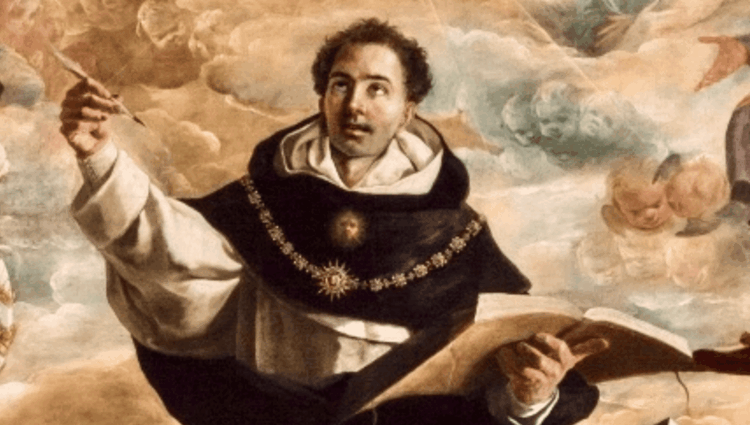
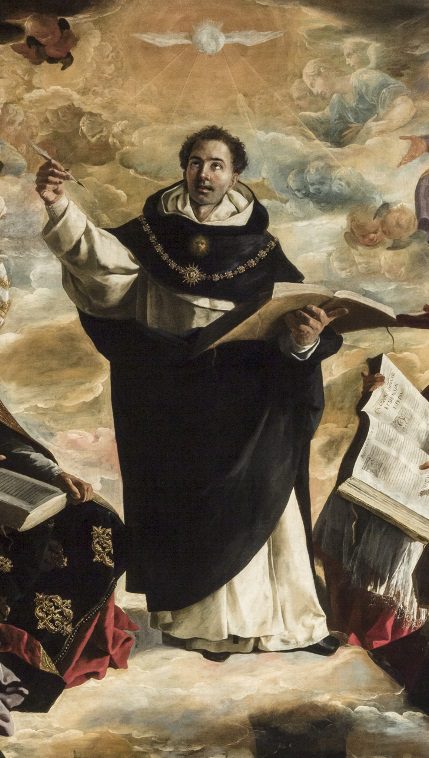
The featured image is “The Apotheosis of Saint Thomas Aquinas” (detail, 1631), by Francisco de Zurbarán, and is in the public domain, courtesy of Wikimedia Commons.