This is the second in a three-part series. You can read yesterday’s instalment here.
***
IV. Why Lloyd’s of London is the wrong model
Every major shipping company in the world pays Lloyd’s of London extraordinary sums to insure their vessels against maritime threats. Lloyd’s prices risk. It does not eliminate risk. And here is the part nobody says out loud: Lloyd’s has no institutional interest in eliminating risk. A world where the Strait of Hormuz simmers indefinitely is a world where Lloyd’s collects maximum premiums for ever. The insurance model is structurally incentivised to manage threats, not end them. Lloyd’s has been profiting from managed maritime misery for generations from their towers in the City of London, insulated from every consequence of the wars they price.
Consider Maersk, which owns one of the largest commercial fleets on earth. It could put five .50 calibre rifles on every major vessel it operates tomorrow, staff them with trained shooters on every watch, and make boarding attempts extraordinarily costly. It will not, because the moment Maersk arms its ships it accepts a legal identity as a combatant. The Geneva Conventions and the law of the sea were built around the distinction between civilian and military actors. Civilian shipping companies operate under a framework that requires them to appear defenceless in order to remain legally protected. That distinction has become a gift to every IRGC fast boat crew and every Houthi drone operator. They have learned that the ships will not shoot back.
A licensed Private Military Company (PMC) operating under a letter of marque dissolves that problem entirely. The PMC is not a civilian. It is a commissioned combatant operating under lawful authority. The waterways it patrols are defended by men who have decided that anyone threatening transit dies, and who have the legal standing, the equipment, and the financial incentive to ensure exactly that.
V. The target is not Somalia
The comparison to Somali piracy is useful up to a point and then becomes misleading, and intellectual honesty requires drawing the distinction clearly.
Somali pirates were young men, often high on khat, in open skiffs carrying AK-47s and rocket-propelled grenades. They were economically motivated opportunists operating from a failed state with no navy, no air cover, no mines, no missile systems, and no institutional backing. Arming merchant vessels with private security teams worked against them because the threat they posed was roughly equivalent to what a reasonably equipped private security team could handle. Even then it took a decade and billions in insurance losses before the model was implemented seriously enough to matter.
The IRGC Navy is a different order of problem entirely, and the PMC model has to be scaled accordingly.
Iran’s maritime deterrence doctrine is built around what analysts call a mosquito fleet: more than 1,500 small attack craft under ten tons, designed to convert numerical density into kinetic saturation rather than platform survivability. These vessels reach speeds between 50 and 110 knots and exploit acceleration and manoeuvrability to compress engagement timelines, forcing advanced radar and fire-control systems to divide targeting resources under swarm pressure.
The IRGC controls three major islands positioned directly along the shipping corridors, with underground bunkers, swarm boats and anti-ship missiles networked together. Their swarm tactic deploys ten to 20 fast attack boats against a single cargo ship from 360 degrees, targeting the bridge to blind the vessel and the engine room to leave it dead in the water.
This is not a khat-addled pirate in a dinghy. This is a structured naval doctrine built around swarming, speed and saturation. It requires a response built around the same principles, executed by men with better weapons, better intelligence, and a stronger financial incentive to win. And then there are the mines, which require a separate answer entirely.
VI. A hard question: What about the mines?
Anyone making the privateer case who skips past the mines is not being straight with you. I will not skip past them.
The IRGC has spent decades developing a mine warfare capability specifically designed to make the strait impassable at low cost. Mines do not require a crew. They do not require fuel. They do not need to be commanded. They sit on the bottom or tethered below the surface and wait. A fast interceptor doing 70 knots cannot outrun a mine it cannot see. Armed privateers solve the swarm boat problem. They do not inherently solve the mine problem at all.
This is the asymmetry Iran has always known it held. The fast boats get the headlines. The mines are the weapon that actually closes the strait to commercial traffic, because insurance underwriters will not send a $200million tanker through a waterway where the mine threat has not been cleared, regardless of how many armed interceptors are on patrol.
The answer exists and the technology is already fielded. It is just not a fast attack boat with a bounty hunter at the wheel. The US Navy declared its mine countermeasures mission package at initial operational capability in 2023. It is an integrated suite of unmanned maritime systems and sensors that counteracts mines in littoral environments while increasing the host vessel’s standoff distance from the threat area, conducting the full spectrum of detect-to-engage operations, hunting, neutralising, and sweeping against mine threats using sensors and weapons deployed from unmanned surface vehicles. The French Navy’s SLAM-F programme has delivered an unmanned surface drone equipped with a high-resolution towed sonar capable of missions lasting up to 40 hours, designed specifically for mine detection and neutralisation.
Drone boats running ahead of the shipping lane, operated by contracted technical teams paid per cleared corridor mile and per confirmed mine neutralised, are the first layer of the privateer system.
The second layer is fast armed interceptors hunting the swarm boats that attempt to interfere with the clearance operation or attack vessels transiting the cleared corridor. Both layers incentivised by results. Both layers keeping American uniformed personnel out of the primary kill zone. One technician with a laptop. One contract that pays him when the corridor is open.
VII. What the right men actually do
Nato has not solved this. They have refused and have demonstrated repeatedly how worthless they are in many ways as allies to the US.
The US Navy is running Aegis-equipped destroyers designed to fight conventional navies against fiberglass boats and tethered mines. The UAE cannot project the kind of lethal sustained force needed. Diplomats are negotiating with the people who closed the strait while the clock runs and the economic damage compounds.
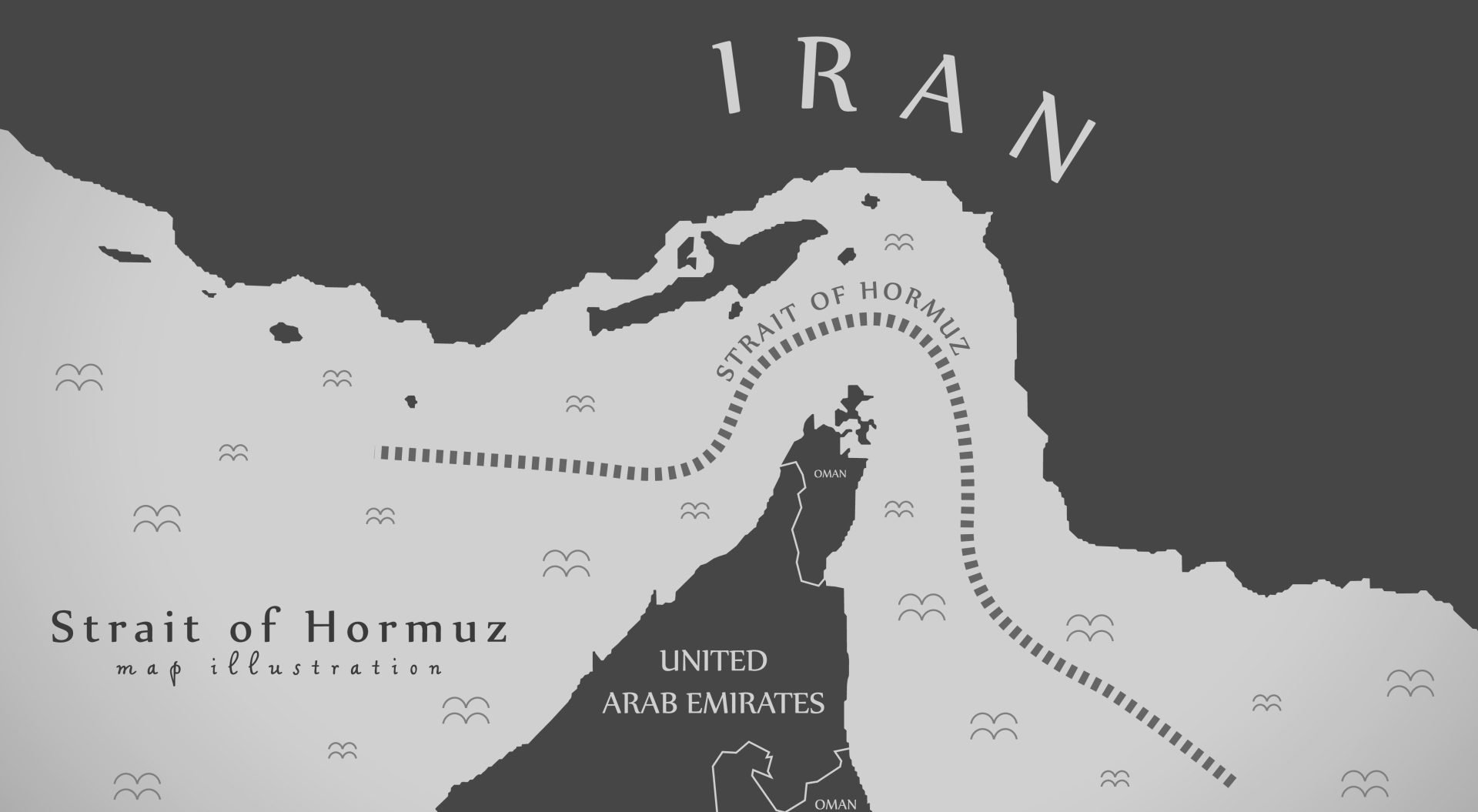
Iran has deployed hundreds of missile-equipped fast boats at 16 strategic points around Larak Island. Their bases are known. Their patrol routes are mapped. Their vessels operate on the surface in a strait only about 21 nautical miles wide at its narrowest point. Every one of them is visible to American satellite and aerial surveillance within seconds of departure.
Purpose-built interceptor vessels doing 60 to 80 knots, carrying 30mm autocannon and fed by American targeting data from overhead assets already in theatre, engage IRGC boats from outside the range at which those boats can effectively return fire. The 30mm GAU-8 fires 3,900 rounds per minute and can shred small boats in seconds. The IRGC boats are fast. They are not armoured. A burst of 30mm fire ends them.
Smart PMCs would not wait for IRGC boats to emerge from their island bases. They would send armed drone boats in after them. A semi-autonomous drone boat carrying a shaped charge warhead, launched from 20 miles offshore, requires no sailor in the kill zone. It requires a technician with a laptop and a contract that pays him when the cave is empty and the strait is open. Bunkers concentrate assets. Concentrated assets in a known location are easier to target when the targeting does not require a manned platform inside the threat envelope.
The men willing to crew the interceptors and operate the drone systems are not difficult to find. Special operations veterans, private maritime security contractors, former naval officers from a dozen allied nations: the professional class that does this work is large, experienced, and currently watching the strait close from the sidelines while diplomats argue about Article 13 of a memorandum that Hezbollah violated the same week it was signed.
Tomorrow: How to solve the problem