The Catholic faith is not firstly a body of dogmatic truths, but a body full of love that rose from the dead on the first Easter Day. It should begin then by teaching the young how to come to know and love Jesus Christ, as soon as possible, by introducing them to true Catholic meditation.
 After a parish priest asked me to speak to his parishioners about meditation, I approached him for the feedback that I did not expect. What I said was very interesting, it seemed, moving, inspiring even, but not actually very practical, at least not for most of them. It was for the birds, as one busy housewife put it. Or rather for religious who have noviciates, quiet chapels and cells into which they could retire to do what busy working men and women with families simply cannot find the time to do. Their understandable response enables me to highlight what is seriously wrong with Catholic Education in modern times. We have forgotten its true meaning, which is first and foremost, and above all else to introduce new converts or young children to come to know and love God’s infinite loving goodness, as embodied in Jesus Christ.
This was precisely what happened in the early Church, above all else. This is what took place when newcomers were prepared for Baptism in what came to be called the catechumenate. Two years were set aside to prepare them to be taken up and into the Risen Christ on Easter night. The very essence of this preparation was to introduce them personally and deeply to Jesus Christ, so that in knowing him through the teaching, the testimonies, and the writings of those who had known him personally, and then meditating on all they heard or read, they would be prepared. This would enable them to generate the love that would prepare them spiritually, psychologically as well as sacramentally to “put on Christ” permanently through the rites of Christian initiation on Easter Night. At the end of the rites of initiation they would be clothed in a shining white garment because it was believed this was how Christ was attired when he rose from the tomb on the first Easter Day. They would continue to wear this garment for a week, until the next Sunday, to remind them, and to demonstrate to others and especially those who might ask what happened to them when they were re-born on Easter night.
A similar sort of Catechetical preparation should be given to all new converts and children today, who were naturally too young to undergo the sort of preparation for baptism that newcomers, or neophytes as they were called underwent in the early Church. As in the early Church this preparation should first and foremost involve teaching them to meditate on God’s infinite goodness made flesh and blood in the most loveable human being who ever lived on this earth. As we have seen, this meditation leads those who are taught to love him as he once was, to love him as he is now in his Risen Glory. This does not take place far away in some distant heaven, but within us now where he resides, in love, as the very ground of our being. It is here that he makes his home in all who love him, as Jesus promised at the Last Supper.
That babies can be baptised, and introduced into the family of God, without doing anything to deserve it, is one of the most striking examples of God’s totally gratuitous gift of love. But this inestimable privilege must not mean that they therefore forgo another privilege that was bestowed on all who sought baptism in the early Church. I am of course speaking of the privilege of being personally and intimately introduced to and taught how to love the Lord into whose family they are adopted. Because this introduction is so personal and can only be perfectly performed by those who already know and love him, the poor children often miss out and, like sex education, parents leave it to teachers and teachers leave it to parents.
I was fortunate; my mother taught me to meditate on the mysteries of the Rosary, and Fr Francis Handley, the school spiritual director, taught me to meditate in his Monday evening meditation seminars. I was so indebted to him that I dedicated my second book Inner Life to him with these words: “To Fr Francis Handley, who first taught me to meditate”. That I should have been sent to the only school that I have ever known with a weekly meditation course was a complete chance when it should be the norm, as part of the education given in every Catholic School. Nothing was left to chance in the early Church. They even provided backup if, for whatever reason parents were unable to do what my parents did for me. They invented a new role for specially chosen people to act as godparents, a role that goes back at least to the second century. This role was given to those best suited to take the parents’ place in fostering their faith if something happened to them. In Rome at the time, the average age of mortality was twenty-nine, and this must have been lower for Catholics as martyrdom was a distinct possibility, so therefore was the importance of the role of godparents.
Ideally what did happen in the early Church and what should happen now, is that a true Catholic education should teach a young person how to come to know and love Christ in the sort of meditation that I have detailed earlier in this book, that was practised by all in the early Church. This will lead them on to the contemplation which, surprising though this may seem, involves using a pure simple prayer that is therefore most appropriate and most easily adapted for those intensively involved in the world that they are called to transform through love. But instead of first teaching the heart to love, Catholic education has degenerated into first teaching the intellect how to know, and to know in detail the teaching of the Church, the catechism, the creeds and how to defend them against all comers. All too often this education never seems to get round to teaching the “one thing necessary”. Once a person is taught how to love Christ then they will be eager and diligent in learning more and more about him, through the study of those who were preparing for his coming in the Old Testament and through those who knew him personally in the New Testament. Then they will want to know more and more about his Church, its teaching, its history, the philosophy that underpins it, and the apologetics that will help them to defend it. But this study must be preceded by the loving that will shine through everything else that is subsequently learnt, giving a quality of wisdom and understanding without which it can so easily become purely dry intellectual knowledge. They will become vulnerable to attack from what might be presented to them as more rational, more modern, and more sophisticated philosophies of life that just happen to be fashionable today, but which will be forgotten tomorrow.
If you want to look for scapegoats for this almost exclusive intellectual religious education then look to the Renaissance, that demanded highly intellectual minds to rediscover and savour its “treasures”, rediscovered from the past – the pagan past. Then Greco-Roman education was introduced into our education system, in the form of stoicism, thanks to people like John Colet, as we have seen. Look to the counter-reformation that had to concentrate on teaching Catholic truths to counteract protestant errors, in books through the written word, from the pulpit through the spoken word and in the classroom through the catechism. In my youth this was no more than a concentrated summary of the teaching of St Thomas Aquinas that had to be learned off by heart, though the heart gained little from it. When the anti-mystical witch-hunts succeeded in taking away the means that had traditionally led to the purification of the heart through contemplation, it was to intellectual renewals to which the Church primarily turned in future to do what had traditionally been done by the “Spirituality of the Heart”. This emphasis on the intellect at the expense of the heart was compounded in the Age of Enlightenment, that even influenced the Church, where the reason was the sole arbiter of everything, and love was left to the romantics. That all these movements have much to teach us is undeniable, but so too is the truth that the overemphasis on the head at the expense of the feelings has deprived us of the Spirituality of the Heart that Christ introduced and left for us as his inheritance. The truth is that it is only love, in, with, and through Christ, that can lead us to the destiny for which our whole being craves more than anything else, and it is only love that can support, sustain, and succour us on our way.
Sadly, the intellectual emphasis that has dominated Catholic education, which will of course always be an essential part of that education, never seems to end, and the real education of learning how to love never seems to begin. There is always a sort of embarrassment, the embarrassment of non-practitioners, thanks to the legacy of the history that I have outlined that prevents Catholic teachers teaching their students how to love Jesus Christ. Inevitably they take refuge in teaching the mind how to know rather than teaching the heart how to love the source of all truth. Just over a year ago in talking about these matt ers to a religious priest, I said rather uncharacteristically that we must begin by teaching them how to love Jesus. If I had said by coming to love Jesus Christ, then there may not have been any reaction, but there was. It was a hardly perceptible reaction, but it was there in a slight change in the demeanor of the Priest. “You are thinking that I am beginning to sound like a Protestant,” I said. His smile confirmed that I had read his mind. It is Protestants, usually evangelical protestants, who tend to talk about Jesus as their personal friend and Saviour. He is for many of them what imaginary childhood friends used to be for many of us. The sort of friend who represents what we would wish to be at our best, the sort of friend who would help us to be bett er people.
His presence would enable us to ask ourselves what Jesus would do in the various predicaments, the different moral dilemmas in which we continually find ourselves. Then, when our fallen nature makes us fail to live up to what he would have done, his goodness would shine so brightly that God would not see, or at any rate not count our sinfulness against us. But for Catholics, at least those first Catholics from whom we must learn, Jesus was even more than a personal friend. The profound teaching that he taught at the Last Supper makes this clear. He wants to enter into us to make his home in us, so that we can be found together in a spiritual marriage that is even deeper and more lasting than a secular marriage. But sadly, that is not possible for the fi rst protestants, because for them human beings are intrinsically evil and so intrinsically incapable of enjoying the divine indwelling and the mystical prayer to which this leads. That is why in her book on Mysticism, the Anglican Evelyn Underhill admitted that the vast majority of mystics are Catholics. But this is all pie in the sky for us, if we do not begin to love Christ ourselves through the meditation that leads to mystical contemplation. It is in this profound prayer that we not only see Christ as the perfect human being who can teach us how to behave in every human circumstance in which we fi nd ourselves, but much more. He is rather a mystical mentor who not only teaches us what ought to be done from within but gives us the power to do it from the place where he has now made his home within us.
Although I have spent my whole life studying and writing to teach others the essential spiritual teaching of the God-given spirituality that Christ introduced into the early Church, my emphasis on love has opened me to the criticism of being anti-intellectual. Was Jesus Christ anti-intellectual because he did not choose university professors or world class intellectuals to become his first apostles? He chose those with pure and humble hearts to confound the “wise” with the simple message that God is love and that he is the embodiment of his Father’s love, and that through love we have been drawn up into his mystical contemplation to receive the fruits of contemplation. This is not just for us, but for others too, for whom we are called, that God’s Kingdom of love be brought about on earth.
It was St John Henry Newman who inspired me to go back to rediscover this pure simple spirituality that is the heart and soul of his own personal spirituality, that must be rediscovered and lived again today as it was in the beginning. For this to happen he knew in the first place, that in our modern sophisticated world, this would need a highly educated laity to rediscover and understand what had been lost and then disseminate it amongst others. That is why he specifically encouraged an intelligent and educated laity, because in these difficult times their leadership was, and still is, essential. However, they too must practise the God-given “Spirituality of the Heart” that Jesus introduced into early Christianity. Those who in early times were called “saints”, many of whom became martyrs, were not so called because of the quality of their intellectual expertise but because of the quality of their love. That is why although for Newman an intelligent and well-educated Catholic laity is essential to usher in renewal, it is a renewal in which love reigns supreme as it does in his writings. That is why when he was made a Cardinal in 1879, he chose the words Heart speaks unto Heart for his motto. It was taken from his favourite spiritual writer, who wrote that wonderous book on the love of God namely St Francis de Sales. John Henry Newman made his prayer to the Sacred Heart his prayer, for it summed up his whole spirituality of love, that intellectuals only too keen to immerse themselves in his inestimable scholarship, can so easily forget.
May thy heart dwell always in our hearts!
May thy blood ever flow in the veins of our souls!
O sun of our hearts, thou gives life to all things by the rays of thy goodness!
I will not go until thy heart has strengthened me, O Lord Jesus!
May the heart of Jesus be the king of my heart!
Blessed be God.
Amen
(St Francis de Sales)
Catholic faith is not firstly a body of dogmatic truths, but a body full of love that rose from the dead on the first Easter Day. It should begin then by teaching the young how to come to know and love Jesus Christ, as soon as possible, by introducing them to true Catholic meditation, by Catholic teachers who know how to do this from their own experience, and who also know where it leads. It is in the love that is generated here, as human loving and divine loving merge together as one, that enables the Holy Spirit to lead the young to Contemplation as soon as possible, even before they are teenagers. Contemplation should be the prayer of every adult Catholic. It is the prayer most easily adaptable to a person who lives their lives in a busy world that is absorbed with self-interest and take. Many lay people have had to discover this for themselves, as without due help and assistance they have had to muddle through the spiritual life alone. In the next chapter I want to give you an example of how we can reform our own spiritual lives, in such a way that they can be rebuilt on the foundations laid down for us by our early Catholic forbears.
___________
This essay is chapter sixty-three of The Primacy of Loving and is published here by gracious permission of the author.
The Imaginative Conservative applies the principle of appreciation to the discussion of culture and politics—we approach dialogue with magnanimity rather than with mere civility. Will you help us remain a refreshing oasis in the increasingly contentious arena of modern discourse? Please consider donating now.
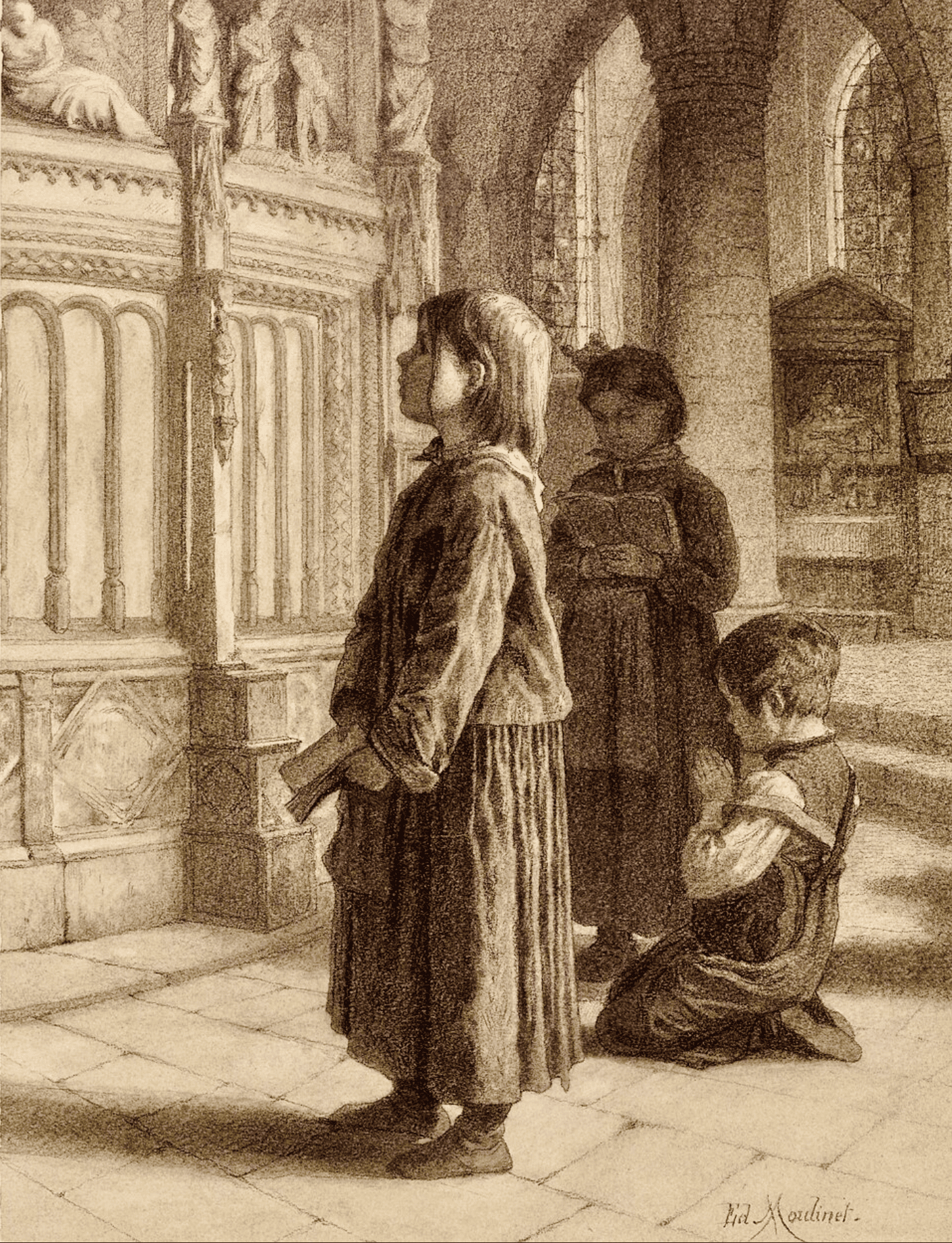
The featured image is “Children at Prayer,” by Antoine Édouard Joseph Moulinet (1833–1891), and is in the public domain, courtesy of Wikimedia Commons.