Do you go to prayer for what you get out of God or for what you want to give him, with and through Christ who died for us on the Cross?
 There is an unwritten law in every religious order or congregation that no one should interfere with the person in charge of the novices. When the Bishop made me the director of his Retreat and Conference Centre, the mother superior of the Dominican convent who owned the property gave me their Novice Mistress as my personal assistant and secretary. It was then that I made a “private vow”. I would do nothing to influence either her or her novices who looked after the domestic arrangements in Walsingham House. This I think was the reason why our relationship ran so smoothly, and my relationship with her novices never strayed beyond a certain superficial friendliness. That is until the revolution suddenly rocked the Dominican community at Chingford whose convent was next to the retreat centre. My first book on prayer had been published, the courses that I had introduced on prayer were now in full swing, and the Novice Mistress was away for eight months following the new Dominican renewal course in Rome, when it happened. I was beginning to wonder whether or not my courses on prayer, more particularly mystical prayer, were having any effect at all, when one morning I was besieged by seven novices and junior sisters. They all wanted to leave together to form a new congregation with my guidance and leadership. I found myself in an unenviable position that was not of my choosing. What I preached, it seemed, could not be lived in their congregation. Unaware of my “private vow” and the punctilious way that I had observed it, a new superior from South Africa totally blamed me for seducing them. I had done nothing but write a book and give talks on prayer to which the Novice Mistress freely chose to send them.
Eventually a compromise was reached. They would await the return of the Novice Mistress before leaving, in deference to her, and to avoid the centre being closed down for lack of their help, in deference to me. When she returned further compromises were made and we carried on as before, but in the next few years they all left one by one. In fact, in twelve years that I worked at the centre, not one of her novices finally remained. I do not know whether or not the Novice Mistress secretly blamed me, as our personal relationship never wavered, but she herself never showed any interest in my teaching on mystical theology, nor did she listen to any of my courses on the subject. It was only the year after she had attended the Dominican renewal course in Rome that I was incorporated into the team, to teach the mystical theology that was part of their heritage. When, with my help therefore, she was the main mover in the revolt against psychosociological renewal that was everywhere apparent in the late 1970s, the renewal that she asked me to help her bring about was back to the status quo rather than forwards to something new.
Leaving what had been my home and my family of the last twelve years, I was headhunted for another job that also enabled me to return to the road as a travelling speaker. On my travels individuals did respond to my teaching, but in the prevailing state of religious life that was daily deteriorating and diminishing, it meant that even those who wanted contemplative prayer, were so busy keeping the show on the road that there was no time to do that for which they yearned with all their hearts. Inevitably then many more joined the massive exodus that never seemed to stop on both sides of the Atlantic. Even before the Second Vatican Council was called some did realize that some form of new spiritual renewal was necessary, but they were the few and did not seem to know where it should come from. The biblical scholars, liturgists, and moral theologians who I had seen as my mentors, and whose works I still have to hand, and whose influence can be seen in all that I write, never developed spiritualities in which mystical prayer played any practical part. Some have tried and lamentably failed, because they too had all been affected by the spiritual dearth that had prevailed in the aftermath of the condemnation of Quietism. Compared to the rather dry intellectual scholasticism which first formed me, what came to be called the “New Biblical Theology”, even before the Council, was to me and many others new and exciting. It opened up the biblical theology to me that touched my heart as well as my mind, but the prevailing apathy to true mystical theology prevented its adherents developing a spirituality deep enough to lead people back to the great mystical tradition of our faith from its first foundation in the mystical body of Christ. It was here, in, with and through him that believers were drawn up and are still being drawn up into his mystical contemplation of the Father, to receive the fruits of this contemplation.
For instance, in the late 1950s the great man whom I have already referred to as my mentor, Louis Bouyer, was commissioned to produce a new book on spirituality by the French publishing house Editions du Cerf. It was to replace the old-fashioned spiritual manual written by Père Adolphe Tanquerey. Although Louis Bouyer’s work has many commendable qualities there is nothing in it that he has not said elsewhere in his writings and nothing to show he has any sympathy for, or knowledge of, personal prayer beyond first beginnings and therefore to help serious searchers along the “mystic way”. When I first read his Introduction to the Spiritual Life I could have wept to find that a man whom I so admired and who had so influenced me with his exciting brand of biblical theology had been so exposed by being enticed to write on a subject upon which he had no practical experience, as anyone can see for themselves who has read his memoirs. Of course, it is full of good things; how could it not be, but on the subject of the “one thing necessary” it is sadly and lamentably deficient. On the surface Tanquerey’s master work on the spiritual life may seem a bit old-fashioned in its language and in its presentation to a modern reader, and it is after all a manual, but its content is extraordinarily accurate, orthodox and safe, most particularly on mystical theology.
A more serious attempt to write on prayer was made by, possibly the greatest theologian of the twentieth century Hans Ur Von Balthasar. However, although I would recommend his book to anyone for the brilliant and beautifully written summary of Catholic theology, its teaching on mystical prayer is non-existent. An uninformed reader might protest that he uses the word “contemplation” more than any other, but he does not use the word in the way that it has been used in the Catholic mystical tradition from the beginning. As a trained Jesuit he uses it to denote a certain form of meditation introduced by St Ignatius that I once found very helpful as a novice. This method of meditation or contemplation as he uniquely calls it, helps a person gather together and galvanise all the sensual faculties to help them enter into the different episodes in the life of Our Lord. As I was in the middle of this form of meditation when the call to true mystical contemplation led me on, I became a lost soul for almost two years, because nowhere in the teaching of the Spiritual Exercises could I find the help to journey on; that is until I found the teachings of St John of the Cross and St Teresa of Ávila. Their writings of course post-dated the writings of the Spiritual Exercises, so unfortunately St Ignatius could not have been influenced by the two great mystical doctors of the Church. Harness the practical teaching on how to meditate on the person of Christ for beginners, as taught by St Ignatius in his “Exercises”, with the teaching of the great Carmelite Mystics, and put it into modern accessible language and you would have a perfect blueprint for spiritual advancement and for the constitution on the spiritual life that we are still awaiting.
None of the great biblical theologians who were called as experts to participate in the Second Vatican Council had any but a superficial understanding of deep traditional Catholic mystical theology, and some had none at all. How therefore could they have complemented an excellent constitution on the liturgy with one on traditional Catholic Spirituality in which the mystical theology, once banished without trace, was reintroduced to enrich the Church. This is the only teaching that can support a person through the purification that must precede union with God. In short, true renewal could never prevail no matter how perfect a liturgy might be that may galvanise the faithful. As Lewis Carol pointed out in Alice in Wonderland, you cannot have a cat with a smile but no substance. The liturgy is the expression of the collective personal relationship of the profound and substantial encounter of the faithful with God. Without this deep personal relationship, the liturgy will soon degenerate into no more than the smile on the face of the Cheshire cat. Of course, the liturgy can inspire, but it is predominantly the expression of love, of the love that is primarily learnt in prayer. The greater the love, the more the liturgy is transformed with the light that only love can give. Cut off the source of this light and what was once pulsating with life can gradually become spiritually lifeless, even though onlookers may be impressed by its aesthetic beauty.
If you, or someone you love wishes to join a religious order, do not be deceived by externals, whether they be of liturgical grandeur or of liturgical simplicity; make sure that time for freely chosen personal prayer is sacrosanct. That there will be time in the day for what is usually called “meditation”, at least in the apostolic orders is to be expected, but something further is required. Something further must be built into the timetable if meditation is going to lead on, or more precisely, if the Holy Spirit is going to lead a person on and into mystical contemplation. Those young religious, who finally left the Dominican Convent at Chingford left because they came to search for and to love God, but the opportunity for the personal prayer that they needed had been denied them. Let me explain how this was provided for in the Franciscan order where I went to try my vocation. When Compline ended at about 7.30pm, everyone was free. You could go to the library, to your room, for a walk around the garden or spend the time for further prayer in the Church or elsewhere. The same was true for both novices and students. Because the very essence of love is that it is freely given, choosing to give one’s time to God, from a variety of other options, is worth far more than the regimented time for prayer that is part of the official daily time-table and therefore monitored.
It was during this time that a dramatic change took place in my own prayer life. It was because I had already been taught how to meditate at school and taught how to meditate by using the method encouraged by St Ignatius in his Exercises, that the sudden change seemed so dramatic. Using what he called “contemplation” I loved going back two thousand years in my mind, with the help of my memory and imagination to visualize the great mysteries of Christ’s life and to participate in them, be inspired by them, and allow my natural human reactions to express themselves in heartfelt prayer. I used to look forward all day to this, the most exciting part of my day for which I would prepare by reading the scriptural passages that represented the mystery into which I was going to enter. Then one day when I was ready and prepared to go back into salvation history, I felt as flat as a pancake and so did all the inner faculties of my heart and mind that had made meditation so enthralling before. Nor did things return to what I had come to think was normal, no matter how I tried nor how long I waited. Only one thing remained and that was my desire for God but even this desire seemed to be going nowhere as dryness and aridity prevailed where sweetness and light had prevailed before and temptations and distractions drew the attention of my heart’s desire, that I wanted to focus on God, elsewhere.
This is the most important moment in the whole of the spiritual life. It is now that a person is presented with a question. Do you go to prayer for what you get out of God or for what you want to give him, with and through Christ who died for us on the Cross? For now you will be asked to carry the cross, and within prayer itself. Every Catholic will nod their head in agreement when asked if they realize that the spiritual life involves carrying the cross, but when they encounter the cross in prayer, the vast majority simply drift away from prayer, or seek to move on by embracing the counterfeit forms of mystical prayer to which I have already referred. Sadly, if they only knew it, they are saying no to participating in the very act with which Christ wrought our redemption. The reason for this is according to St John of the Cross ignorance of the mystical theology that still prevails even more in our day than in his day. Even such a great theologian as the Jesuit Hans Ur Von Balthasar lost his way at this point, but this is a matter to which I must return later.
___________
This essay is chapter fifty-five of The Primacy of Loving and is published here by gracious permission of the author.
The Imaginative Conservative applies the principle of appreciation to the discussion of culture and politics—we approach dialogue with magnanimity rather than with mere civility. Will you help us remain a refreshing oasis in the increasingly contentious arena of modern discourse? Please consider donating now.
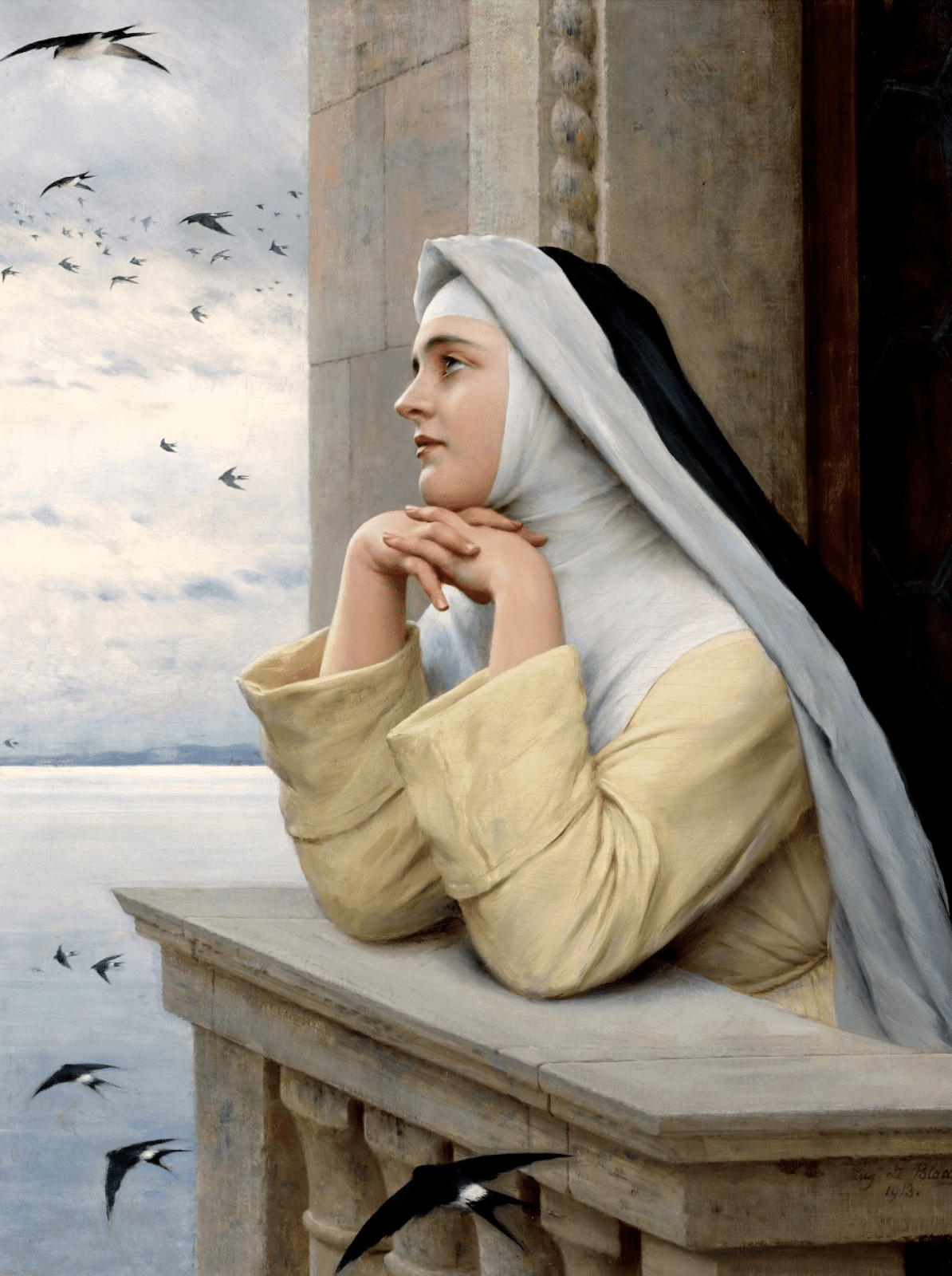
The featured image is “God’s Creatures” (1913), by Eugene de Blaas. This file is licensed under the Creative Commons Attribution 4.0 International license, courtesy of Wikimedia Commons.