INJECTING an element of farce into the nightmare scenario of the Iran conflict, it appears that the widely broadcast news of a meeting between the US and Iran was based on a false post on the Pakistani military WhatsApp groups.
The message stated: ‘Breaking: Attributable to Government Sources. Iranian Foreign Minister Abbas Araghchi is expected to arrive in Islamabad tonight with a small delegation, according to government sources. Following important discussions with the Pakistani mediation team, a second round of Islamabad peace talks between the United States and Iran is expected, government sources say. A logistics and security team is already present in Islamabad to facilitate the negotiation process.’
Reuters in Pakistan, Al Jazeera and other news services faithfully repeated the false claim as news, mostly using the exact text from the post, leading to a night of confusion with US special envoy Steve Witkoff and Jared Kushner on standby to head to Islamabad to meet with Araghchi.
In fact, the US negotiators never set off from Florida as Araghchi left Pakistan with his team before they had even boarded their aircraft. But then, as I pointed out here, there was never any chance of new negotiations and in any case Araghchi had no authority to agree a deal.
Trump is reported to have cancelled his negotiators’ trip, saying: ‘I see no point of sending them on an 18-hour flight in the current situation [of the negotiations]. It’s too long. We can do it just as well by telephone. The Iranians can call us if they want. We are not going to travel just to sit there.’
The President took to Truth Social to repeat his message, adding that there was ‘tremendous infighting and confusion’ within Iran’s leadership and that ‘nobody knows who is in charge, including them’.
Responding to this observation, Iran’s President Masoud Pezeshkian told Pakistan’s PM Shehbaz Sharif during a phone call that ‘Iran will not enter into forced negotiations under pressure, threats, and blockade’.
In the conversation cited by the IRGC’s Fars News, Pezeshkian went on to say: ‘Our clear recommendation to the United States is that to create a platform for resolving issues and to build trust, it should first remove operational obstacles, including the blockade.’
With that, we get the likes of Reuters headlining its report with ‘US-Iran peace hopes fade as Trump scraps talks’, telling us that ‘hopes of a diplomatic breakthrough in the US-Israeli war with Iran receded as a new week began’.
This in many ways typifies the amateurishness and superficiality of media reporting on this issue. Trump didn’t ‘scrap’ the talks – there were never any planned. As for ‘hopes of a diplomatic breakthrough’, with no talks in prospect, there was no expectation of a breakthrough.
Even the Sunday Times is telling us: ‘Trump cancels Pakistan peace talks as Iranians walk away.’
We are being sold a narrative that simply doesn’t exist.
To add to the confusion, we have a report from Politico which has Trump saying that Iran had presented him with ‘a paper that should’ve been better’, adding that within ten minutes of his cancelling his negotiators’ trip, Tehran had sent ‘a new paper that was much better’.
When asked what the new proposal contained, Trump is reported to have said: ‘We talked about they will not have a nuclear weapon. Very simple. That whole deal is not complicated.’ But reporters turning to the White House for clarification as to whether Iran would agree not to have nuclear weapons were left with no reply.
It is not clear, therefore, what exactly is on the table – if anything. One experienced commentator thinks that Tehran is playing games.
It is practising, he says, ‘what I’d call mediation laundering and mirage-craft diplomacy: change the negotiators. Promise one thing behind closed doors and deny it publicly. Multiply brokers, from Islamabad to Moscow to Oman. Leak, deny, distract, repeat’.
The goal, he says, is simple: ‘Create so much diplomatic noise that clarity becomes almost impossible and avoid committing to one serious mediation track.’
In a reflection of the reality of the talks, he observes that ‘everyone is drowning in contradictory reports about Hormuz, nuclear talks, and a possible deal’. In moments like this, he says, ‘more news does not mean more clarity. It often means the opposite. Iran’s last real card is time’.
Another commentator reminds us that the negotiations are solely about Iran’s surrender, nothing more.
In line with the previous commentator, he says that what is being floated publicly is a ruse and a ploy to buy time, with chaos being part of the objectives. Tehran is suffering while the conflict among its remaining officials rages, and Trump wants an end that ensures an achievement he can celebrate or an open-ended conclusion that allows resuming the war in its second phase.
There are two languages in Iran, he says: one in the media that claims resilience and victory, directed at the duped masses, and a second in the backrooms of negotiation that proposes a settlement ensuring a functional role for the regime in the region, in exchange for privileges that Obama had previously agreed to but which Trump rejects.
Tehran has accepted concessions that do not amount to surrender, and it fears that if it does so, its regime will collapse in a later phase as a result of the siege or a military operation.
Yet Trump believes that without breaking Iran, he will lose the arm-wrestling match with China, which is watching events closely and warily and intervening indirectly. The series of war and conflict has not stopped, and we await the next episode.
This is a taste of the murky world into which we have been dragged, but whether or not negotiations are to continue, it looks as if it is the end of the line for Pakistan as a mediator. The US State Department forward team and security detail stationed in Islamabad for two weeks, we are told, has been flown out on a C-17. President Trump separately told the New York Times reporter covering the talks to ‘come home’. The US is clearing all its people from the region.
Away from the apparent sweet reason of the Iranian president, though, we have the Iranian embassy in South Africa declaring: ‘Iran has prepared for the “largest missile strike in history” against Israel and US bases in West Asia, to be launched immediately upon detecting any signs of an attack.’
It is not clear from this whether this is the general view of the regime or just a rogue element sounding off. To an extent, that might support Trump’s assertion that ‘nobody knows who is in charge, including them’, for which there is some further support from another, unexpected direction.
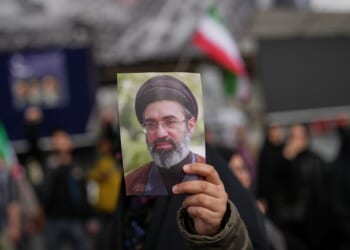
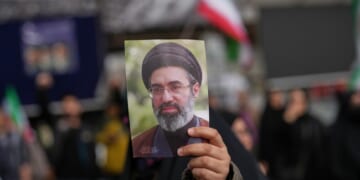
Unveiled in Tehran yesterday was a mural comprising a photo-montage of the regime leaders killed in the war. Among the photographs is one of the supposedly current Supreme Leader, Mojtaba Khamenei.
This could be a mistake but speculation is unavoidable, even in the absence of official confirmation of his death. The US president may have a point about the regime’s leadership crisis.
There is no suggestion, though, that the Iranian leadership are behind what appears to have been an attempted assassination of Donald Trump at the White House Correspondents’ Dinner. The list of potential suspects is far too long to pin the blame on them – they will have to take their place in the queue.
This article appeared in Turbulent Times on April 26, 2026, and is republished by kind permission.
Editor’s note: For a further discussion of legacy media’s Trump-focused coverage of Iran which puts the American President first and the war last see this article. Within this framework, Iran becomes a secondary actor in a soap opera whose villain is invariably the man with the red tie.