The warm joys of “The Odyssey” are not necessarily the “feel-good” kind. They’re sharp and unexpected, like splinters of hope. This is not just a tale of a lone hero who overcomes adversity and completes a journey, not just about survival and homecoming. It’s also about the pearls to be harvested from suffering.
 You remember Homer’s epic similes—those longish, detailed, and often surprising comparisons of rather dissimilar things: helmeted heads to poppy flowers (Iliad, Book VIII), thigh wounds to stylish harnesses (Book IV), warriors to woodcutters (Book XI), skin stripped by rocks from the hands of a half-drowned man to pebbles stuck in octopus tentacles (Odyssey Book V), a weeping queen to a mountain of melting snow (Book XIX). While the epic similes of The Iliad often startle the reader by comparing acts of war to images of peacetime, those of The Odyssey often reinforce the themes of journey, homecoming, and community. Especially notable are those passages where Homer compares one character’s experience to an experience that more obviously belongs to another. I’ll look at five of these (using Fagles’ translation, since that’s the one we use in my Great Works of Lit class).
1. In the first, Odysseus has been bobbing in the ocean since his raft was blown to smithereens three days earlier by Poseidon. Lifted by a wave, he catches glimpse of terra firma once again:
Joy… warm as the joy that children feel
When they see their father’s life dawn again,
One who’s lain on a sickbed racked with torment,
Wasting away, slowly, under some angry power’s onslaught—
Then what joy when the gods deliver him from his pains!
So warm, Odysseus’ joy when he saw that shore, those trees,
as he swam on, anxious to plant his feet on solid ground again. (5.436-442)
Odysseus seeing land is like a child seeing his father return from the threshold of death. Reading these lines, our thoughts drift from the coastline of Scheria to Telemachus, the son who was only an infant when Odysseus left for war. According to tradition, love for his son was the reason Odysseus feigned madness at the first mustering of the troops, and the reason he eventually had to give up the charade and go to war. Like the children of the epic simile, Telemachus, now twenty years old, doubts his father has escaped death. The simile places Odysseus in the position of Telemachus—despairing of his father’s life—and then in the position of Telemachus should Odysseus return—overjoyed that the man given up for dead has been restored and reunited with his family. For the moment, Odysseus sees the world through his son’s eyes —or at least, he greets the sight of land as he hopes his son will greet him.
2. Something similar happens when Odysseus leaves his year-long tryst with Circe to return to his shipmates, who have been waiting without expectation for their leader’s return:
But now, as calves in stalls when cows come home,
Droves of them herded back from field to farmyard
Once they’ve grazed their fill—as all their young calves
Come frisking out to meet them, bucking out of their pens,
Lowing nonstop, jostling, rushing round their mothers—
So my shipmates there at the sight of my return
came pressing round me now, streaming tears,
so deeply moved in their hearts they felt as if
they’d made it back to their own land, their city,
Ithaca’s rocky soil where they were bred and reared. (10.452-461)
There’s a double analogy here. Odysseus is to cows-coming-home as his men are to the calves that await their dams. And, to his shipmates, Odysseus is like Ithaca. Here, at least, Odysseus is both mother and home to his men. He is the wanderer and the returner, but he also shares in the maternal attributes of his wife Penelope, of his mother Anticleia, and of the nameless mothers of his men. He is Ithaca, “a rugged land but good for raising sons” (Odyssey 9.30), even if he can offer his men only a meagre substitute for the comforts of home. Odysseus himself tells King Alcinous of Scheria that he knows “no sweeter sight on earth / than a man’s own native country” (9.31-32). And so as Odysseus, compared to Ithaca, returns from Circe to his ships and to his voyage homeward, his men experience a double joy. And yet the hearts of the poem’s listeners doubly ache, for they know that this embracing of their captain and commander is all Odysseus’ men will ever know of homecoming—they will not reach Ithacan shores —and that Ithaca itself, that rocky soil Odysseus spends ten years trying to reach, is not itself without its king.
3. When Odysseus does return to Ithaca, without his men, his homecoming is not simple, immediate, and complete, but a series of revelations, recognitions, and restorations. The soldier’s footfall on native soil again is only a rudimentary kind of nostos. He will have to redefine his role among the civilians he left behind. His most intimate connections could not afford to pay him the compliment of being unable to live without him. Sure, Penelope has waited, and she weaves her wiles to keep the kingdom from forgetting Odysseus, but the stability she achieves is due to action, not stasis. Sure, Telemachus has grown up thinking of Odysseus, feeding on the memories of an older generation, daydreaming of his father’s return. But he has not been without a father-figure. One of the most pathos-driven moments of the poem occurs when Odysseus, back on Ithaca but disguised as a beggar, unready to trust anyone with knowledge of his true identity, suspects that visiting his old swineherd might be a good first step. The disguised hero discovers that his son thinks similarly. Returning from a coming-of-age journey to Pylos and Sparta, and narrowly escaping an ambush laid by his mother’s suitors, Telemachus delays his return to the palace in favor of a visit to the humble lodgings of Eumaeus:
As a father, brimming with love, welcomes home
his darling only son in a warm embrace—
what pain he’s born for him and him alone!—
home now, in the tenth year from far abroad,
so the loyal swineherd hugged the beaming prince.
He clung for dear life, covering him with kisses, yes,
like one escaped from death. (16. 19-25)
Odysseus, the father and the wanderer, seeing his grown son for the first time in twenty years, is relegated to the position of onlooker, constrained by disguise from any peculiar show of emotion. Before his eyes, the swineherd assumes the role of father reunited with son, and the son assumes the role of returning traveler. Eumaeus is to Telemachus as father is to son. But in simile and in the story, the long suffering belongs not to the youth who returns, but to the father who waits. Odysseus is still there, on the perimeter and at the center of the simile, as he observes two loved ones perform the roles he must consider more properly his own. Odysseus is the father, and he is the returner. Or, looked at from another angle, Telemachus is Odysseus in part, and Eumaeus is Odysseus in part. I imagine Odysseus feel relief to learn his son has experienced the care and affection of a noble servant, but not without the pangs that come with the realization that he has been replaced— however incompletely, however temporarily.
4. While Eumaeus has stepped up in Odysseus’s absence to serve as father to Telemachus, Penelope has tackled the responsibilities of being Ithaca’s ruler. It’s no small task to be mindful of the past while addressing the needs of the present. For Penelope, this means playing coy, weaving and unweaving. Keeping Odysseus’s throne warm and ready for him has required a lot of kinetic energy, and Odysseus seems to recognize this. He honors his wife through his own epic simile, spoken the night he and Penelope first meet. He’s still in disguise, and Penelope asks her wandering guest to tell his own story as a prequel to inquiries about her husband. No stranger to fabricating backstories, Odysseus nonetheless delays his account by praising her, comparing her to the good king whose just rule supports a flourishing country:
“Your fame, believe me, has reached the vaulting skies.
Fame like a flawless king’s who dreads the gods,
who governs a kingdom vast, proud and strong—
who upholds justice, true, and the black earth
bears wheat and barley, trees bow down with fruit
and the sheep drop lambs and never fail, and the sea
teems with fish—thanks to his decent, upright rule,
and under his sovereign sway the people flourish.” (19.119-135)
The listener might assume this is one of the many ways Odysseus would like us to see himself—as the stay-at-home king who rules wisely and well. There’s something of himself here, and something of Penelope, who has been a pillar of state in her husband’s absence. Odysseus’s highest praise for his wife is to compare her to an ideal king. She has done what Odysseus wishes he could have done.
5. Full recognition and restoration of the bond between Odysseus and Penelope doesn’t occur until the disguises are dropped, the suitors are killed, the great hall has been purged with sulfur, and the rooted bed, fashioned from the living trunk of an olive tree, has been validated as a true sign of their marriage. Odysseus calls the bed “our secret sign… our life story,” a work of art and a labor of love (19.227). On that cue Penelope, so circumspect, subject to years of impersonators offering lies about Odysseus in exchange for a warm bed and a meal, says she believes him. Their embrace is commemorated with another climactic simile of homecoming:
—he wept as he held the wife
he loved, the soul of loyalty, in his arms at last.
Joy, warm as the joy that shipwrecked sailors feel
when they catch sight of land—Poseidon has struck
their well-rigged ship on the open sea with gale winds
and crushing walls of waves, and only a few escape, swimming,
struggling out of the froth to reach the shore,
their bodies crushed with salt but buoyed up with joy
as they plant their feet on solid ground again,
spared a deadly fate. So joyous now to her
the sight of her husband, vivid in her gaze,
that her white arms, embracing his neck,
would never for a moment let him go… (23.260-272)
The passage begins with Odysseus’s emotional response—he’s the one weeping—but in the epic simile, the joy of the shipwrecked sailor escaping death belongs to Penelope. Odysseus’s journey and escape is hers, too.
The warm joys of The Odyssey are not necessarily the “feel-good” kind. They’re sharp and unexpected, like splinters of hope. This is not just a tale of a lone hero who overcomes adversity and completes a journey, not just about survival and homecoming. It’s also about the pearls to be harvested from suffering. These include an awareness of the suffering of others and a connection to others through participation in their suffering, through empathy, and through acknowledgment of likenesses. Pain can certainly be an isolating, individual experience, but in The Odyssey such pain and isolation is often followed by community and communion.
The shared and analogous experiences of the characters of The Odyssey are evident not only in the epic similes, but also in the characters’ own names and epithets. Calypso, who tries to hide Odysseus from the gods, is herself “hidden.” She reflects Odysseus’ hiddenness, too. The episode with the Cyclops Polyphemus, “many-voiced, much spoken of,” contains the clearest examples of Odysseus’ desire for fame, his tendency to jeopardize his homecoming for the sake of his reputation. Nausicaa, “ship burner,” is a helper-maiden whose crush on the hero can also be an obstacle to his homecoming. Telemachus is “he who battles afar”; he may be named for his father’s troubles (as Odysseus was for his grandfather’s), but the carrier of the name makes it his own, having his own battles to fight. Like Odysseus, Penelope is polytropos, much-wandering, of twists and turns; a weft embracing and bending the warp of circumstance to make a fine woven cloth, a life story worth telling and retelling.
As Tennyson’s Ulysses says, with a measure of truth and arrogance, “I am a part of all I have met.” The characters he meets, including those he struggles against and those for whom he struggles, have also shaped his character.
The story that memorializes Odysseus the warrior also memorializes Odysseus the poet. Encounters become episodes as suffering leads to storytelling. After the wild boar hunt that marked young Odysseus’s coming of age, the hero has both an indelible, identifying scar, and a story straight from Mount Parnassus (Book XIX). And later, after years of being heartsick on the open sea, driven off course time and time again, he has an eternal tale to share with others and to call his own—one of being crushed with salt, but buoyed up with joy. The epic similes that capture such poignant joys illuminate some of the ways Odysseus’s story extends to the human condition. Dull would he be of soul who would claim no one else shares in his wanderings.
__________
An earlier version of this essay appeared in Reflection and Choice, a publication of Houston Christian University.
The Imaginative Conservative applies the principle of appreciation to the discussion of culture and politics—we approach dialogue with magnanimity rather than with mere civility. Will you help us remain a refreshing oasis in the increasingly contentious arena of modern discourse? Please consider donating now.
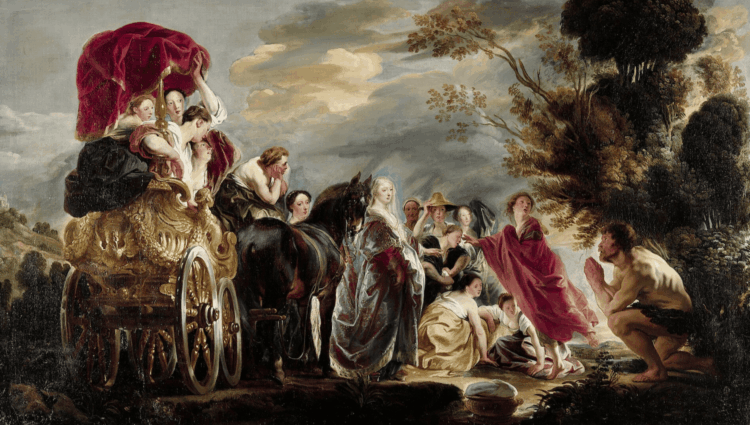
The featured image is “The Meeting of Odysseus and Nausicaa” (1630s), by Jacob Jordaens, and is in the public domain, courtesy of Wikimedia Commons.