Eric Voegelin stressed that progress falsely demands the sacrifice both of man and God. With history and progress as false gods, the man who would attempt to derail or thwart history is the sinner and may thus, justifiably, be removed, even if by bloody force.
 In my previous essay, I considered the ways in which Eric Voegelin (1901-1985) has shaped my own intellectual thought over the past 37 years. I argued, justly or not, that I had a hard time fully embracing him in my personal pantheon of heroes—such as I have done with J.R.R. Tolkien, C.S. Lewis, Christopher Dawson, or Russell Kirk—because of what seems to be questions about his character. In particular, I thought Voegelin was cynical to accept conservative money, funding, and fulsome praise—especially when such funding was rare and precious—and yet mock conservatives such as Russell Kirk behind closed doors for being “idiots.”
Despite my own (very possibly) uncharitable reservations about the man and his character, I can say one thing with absolute certainty: He was a genius, original, and utterly fascinating.
Take, for example, two of the most famous passages from his 1952 University of Chicago Walgreen Lectures:
The death of the spirit is the price of progress. Nietzsche revealed this mystery of the Western apocalypse when he announced that God was dead and he had been murdered. This Gnostic murder is constantly committed by the men who sacrifice God to civilization. The more fervently all human energies are thrown into the great enterprise of salvation through world-immanent action, the farther the human being who engages in this enterprise move away from the life of the spirit. And since the life of the spirit is the source of order in man and society, the very success of a Gnostic civilization is the cause of its decline.
Further:
A civilization can, indeed, advance and decline at the same time–but not forever. There is a limit toward which this ambiguous process moves; the limit is reached when an activist sect which represents the Gnostic truth organizes civilization in an empire under its rule. Totalitarianism, defined as the existential rule of Gnostic activists, is the end form of progressive civilization.[*]
These two passages are absolutely loaded with meaning, thought, intensity, and significant.
In the first paragraph, Voegelin simply eviscerates the idea of progress and progressivism as anything positive for human societies and stability. Citing Friedrich Nietzsche (1844-1900), who lamented that the twentieth century would be a war of the spirits—Voegelin stresses that progress falsely demands the sacrifice both of man and God. Employing the term for the ancient Christian heresy, Voegelin labels this diabolic trade “gnosticism.” The Gnostic, of course, of the ancient world believed that man could be saved not only through specialized knowledge, but also through his archane rituals and works. Believing civilization higher than faith (and perhaps antithetical to it), the Gnostic desires man to build and build, regardless of the moral cost. Instead, he must always progress, push all things toward the future.
Indeed, this push toward the future is so important that it becomes, in and of itself, a false god. As such, with history and progress as false gods, the man who would attempt to derail or thwart history is the sinner and may thus, justifiably, be removed, even if by bloody force. Creating more and more Towers of Babel, the Gnostic constantly moves life away from the spirit and toward the material. He finds solace in technology and innovation rather than in tradition and norms. Man becomes, essentially enamoured with himself and his creativity. He becomes a progressive and sapient ape—delighted with his ingenuity. Consequently, he turns from God. Man becomes man in his own image rather than in God’s image. Indeed, man becomes his own god.
In so doing, though, progressive society progressively moves away from that which makes it humane and good and true and beautiful and ordered and wholesome. The more it “progresses” the more it regresses. Man, especially, rather than being made in the image of God, becomes the plaything of power and might. Immorality, debauchery, and violence become the new norms—so much so that men forget there ever was such a thing as morality.
Again, as Voegelin concludes, any success of progressivism must be the ultimate doom of a humane society.
In the second paragraph, equally impressive and original, society can rise and fall at the same time. This, of course, is a troubling but very real paradox. At the moment we might be able to miniaturize our computers and phones and cure our cancers, we can also gene splice and make a monster, genetically, of the human thing. Take our current day and consider how many adults in this country have piercings and tattoos, sometimes covering major parts of the human body. With genetics, if we can splice in scales or feathers, who actually believes that we won’t? Far from being in God’s image, we will remake ourselves as savages, increasingly animalistic. Simply because we can do something does not mean, in the least, that we should do something. Take a very current example—simply because a business can make a profit does not mean that they should make a profit. Profit might very well be rooted in nature, but the image of man made in the Image of God is sacred, above nature.
Given Voegelin’s argument in this second paragraph, one is also reminded of the genius of Livy. By the time Rome had become an empire, she had so wallowed in her immorality, that she could not longer physically, spiritually, or mentally recognize what was once sure and true and stable. Such ideas had departed the realm of reality.
For Voegelin, the Gnostics hone themselves, narrowing and narrowing, until puritanically pure, they impose their “system” upon the structure of the world. This, of course, is the essence of totalitarianism and the dystopian becomes the rule. Man becomes the plaything of man, the strongest being the one who determines justice.
Again, it must be noted, all progressivism is irrevocably and inevitably totalitarian.
In the third and final essay, I’ll consider several other profundities from Voegelin.
__________
The Imaginative Conservative applies the principle of appreciation to the discussion of culture and politics—we approach dialogue with magnanimity rather than with mere civility. Will you help us remain a refreshing oasis in the increasingly contentious arena of modern discourse? Please consider donating now.
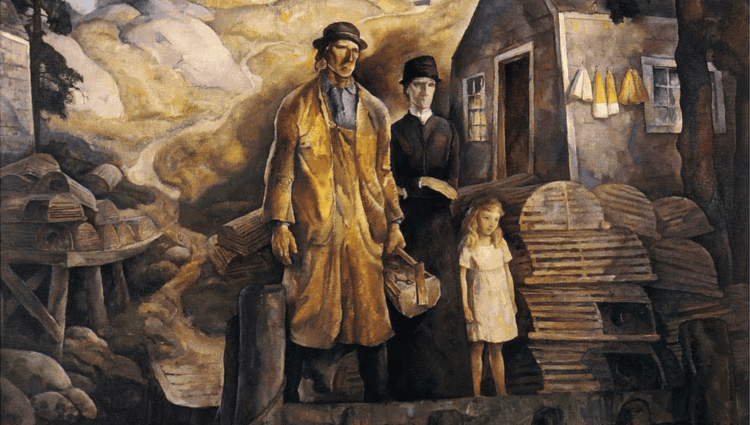
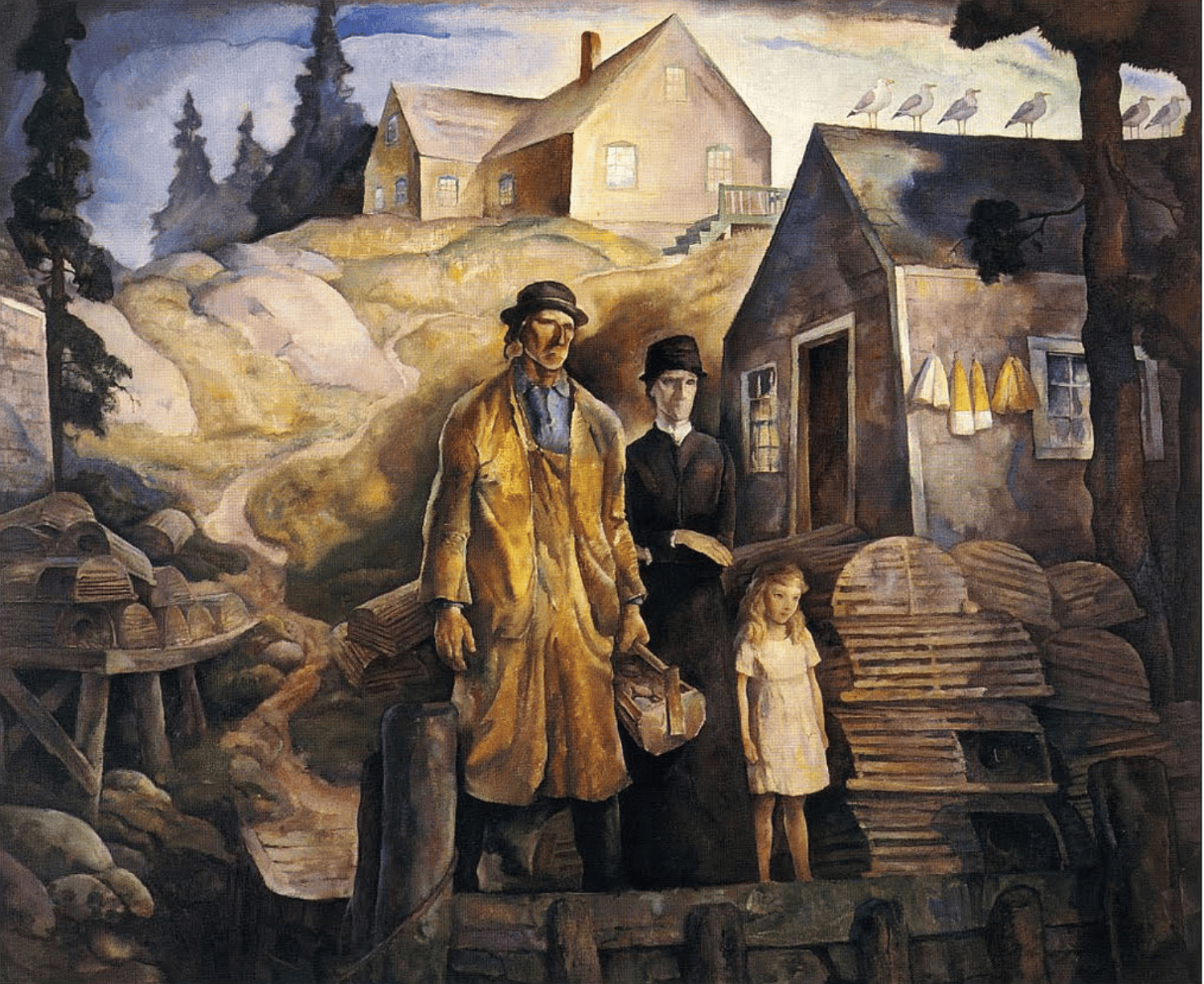
The featured image is “Fisherman’s family” (1933), by N.C. Wyeth, and is in the public domain, courtesy of Wikimedia Commons.
[*] Both quotations from Eric Voegelin, The New Science of Politics, 131-32.