The very essence of the teaching of Jesus Christ is that God is love, and his love was so embodied in his own mystical body on the first Pentecost that it could draw up into itself all who are open to receive it. You do not find any trace of this profound mystical teaching in the philosophical mysticism of the Pseudo-Dionysius, precisely because it totally depends not on revelation but on reason alone.
 Those who failed to see the essence of authentic Catholic mystical theology in subsequent centuries, and persisted in their allegiance to the Areopagite, like Eckhart and his disciples for instance, stepped outside the authentic Catholic tradition. Eckhart was originally condemned by the Church in the person of Pope John XXII. Nor is it true, as his modern disciples claim, that contemporary theologians have seen the light and totally exonerated him from the Church’s false accusations. His abstruse form of mental contemplation and his teaching of how to obtain it sadly leads to, amongst many other errors, some sort of pantheism in which the individual identity of the mystic is merged into his maker. However, orthodox Catholic mystical theology teaches otherwise. Love differentiates.
This means that the love that is the only way to true union, even in purely human love, does not mean that a person loses their individual identity but rather finds it ever more fully. For the love that unites them ever more deeply to each other simultaneously enables them to become more themselves than they ever were before, as they mature into their true selves from what sin and selfishness made of them before. What is true of human loving is even truer of divine loving for the ecstatic bliss of endlessly going beyond oneself to all eternity means that we never stop growing physically, psychologically and spiritually in the journey in with and through Christ our Lord as we gradually attain our ultimate destiny. Ignorant of the nature of their final destiny, pseudo-mystics still follow their pseudo saint, and are still drawn, not to the mystical theology of love, but to the mystical theology in which the mind searches in vain for what only love can attain. It is a mysticism that is particularly attractive to intellectuals, who tend to live in the mind and have already found a sort of psychological satisfaction in intellectual pursuits, that can all too easily be wrongly identified with the mystical contemplation that is a pure gift of God.
It was almost a thousand years before anyone even questioned the identity of Dionysius, and then for four hundred years more, many eminent scholars still defended him, and for that matter still defend him, as Hans Ur Von Balthasar, SJ has done for instance. Let me use the example of Balthasar, for what happened to him has happened to so many others, particularly intellectuals, but also to many educated and intelligent Catholic laity too. When after the initial emotional experience of practising meditation, or what his mentor St Ignatius calls “contemplation,” he found himself in an intellectual and emotional limbo land, at least in his prayer life, he was at a loss to know what to do in order to go forward in his personal search for union with God.
His prevailing experience seemed to coincide with that of the Neoplatonic mystics who concluded that you cannot possibly attain union with God through human reasoning, through the emotions or through the feelings because God is infinitely above them all. He had tried through the sort of contemplation taught by his mentor St Ignatius, but in the end it had failed to lead him to God, but only into a spiritual limbo land. That is why he turned to the Neoplatonists who taught that the only way to achieve what you desired was to strip your consciousness of the content of all these inner faculties and remain in a state of utter emptiness or “naughtism”. Here you had to wait for some sort of “intellectual intuition” to lead you into an ecstasy in which you encountered God. It is interesting to note that in order to help him to do this Plotinus, the greatest of all Neoplatonists set out for the East to learn from Indian mystics how to facilitate and support this “intellectual intuition”, as his spiritual descendants still do today in the many worldwide members of various types of mantra movements. For many years confreres of Balthasar have, like Plotinus, been looking to the East to help them in the spiritual wasteland that St John of the Cross calls the dark Night, or even before they get that far in their spiritual search. They call their counterfeit mysticism “Ignatian Yoga” and like children with a new toy they are trying to share it with anyone who will listen to them, and sadly there are all too many who will.
Accepting their philosophical proposition, that you cannot come to union with God through human intellect and human emotion, Balthasar was delighted to align himself with the “Catholic” Neoplatonist – the Areopagite. If he, and those who followed his example, had been educated by the Fathers of the Church, the Desert Fathers and the Catholic mystical tradition they would have followed the example of the great Christian mystics from the beginning. They would have turned to the simple “prayers of the heart” or the “prayers of naked faith” as they are called at the beginning, to help keep their deepest heart’s desire fixed upon God. In short, they are God-centred prayers. They are therefore in direct contradistinction to mantras, which keep a person’s attention fixed on self, and on seeking self-satisfaction through seeking out inner psychological palliatives. Those who choose to use the prayers of the heart, will have to pass through dryness and aridity, endlessly plagued by a thousand and one distractions, as I have described. But if they persevere, not just in months, but in years showing their love for God in this way they will pass through the purification in which, not just their desire for God is purified, but their minds and hearts too, their memories and their imaginations with their emotions and their inner feelings.
Those who have no understanding of the full Catholic tradition that comes to us from Christ, through the Fathers of the Church, and the great mystical writers cannot see the fullness of our Catholic faith. Nor can they therefore see its implication for the spiritual life. The meditation on Christ that suddenly comes to a stop in first fervour does so, because the union with him for which they yearn cannot be furthered. It cannot be furthered never mind attained, until the mind and heart, the feelings and emotions, are purified. The memory and the imagination are so infected with the sin and selfishness that is the salary of original sin, that they cannot be united with the perfect human being Jesus Christ until a sufficient likeness is created through purification. If a plug is old and encrusted with rust it cannot be inserted into the socket until that rust is removed by purification, nor therefore can it become the means through which electricity passes to give the necessary power to all who need it. At the end of purification then believers are, not only able to come closer to Christ than before, but they are able to do what all lovers desire, namely to enter into the one whom they love, and then to receive for themselves and for others the spiritual power, which is love, that is needed.
As we enter into Christ we enter into the hypostatic union, in which the divine and the human are one in a single person, the single person of Jesus Christ. This union is not just spiritual then, as the Gnostics would have us believe, but physical too, body into body, soul into soul, flesh into flesh, blood into blood. In this way through the hypostatic union our humanity enters into Christ’s divinized humanity through which we are united with God. The scriptures are quite clear about this profound and intimate union even if our imaginations cannot conceive it. This union then takes us up not just into Christ life but into his action – into his love of the Father. Now Paradise has been regained. We are not just back in the Paradise from which we were ejected, but back into union with God, but now far more profoundly and far more completely. We can, not just walk and talk with God in the garden as Adam did, but enter into God, because now we have been united with the New Adam, who does not just walk and talk with his Father but enters into him and remains in him to eternity. This is how we come to know and experience “eternal life” beginning in this life, as St John insists, but also coming to know it in the next life where God has prepared for us our final destiny.
This is the way of, and the teaching of the Fathers of the Church and the great Christian mystics, as summed up in the works of St John of the Cross and St Teresa of Ávila. Eventually then in what St Teresa of Ávila calls the Spiritual Betrothals those inner faculties of the heart and mind come back to life and are able to meditate as they could meditate before in first fervour before the commencement of purification in the “Dark Night of the Soul”. Only this time their meditation of God’s love, as embodied in Jesus Christ, both before and after the resurrection is far more real, far more vital, and more enthralling than before. They, not only enable them to relate to him, more powerfully and more lovingly than ever before, but to be united with him in his loving contemplation of the Father. This sudden new development is at first intermittent, as the phrase “Spiritual Betrothals” implies. However, when this purification is completed and what St Teresa calls the “Mystical Marriage” takes place then a new spiritual, personal, and physical relationship with Christ becomes permanent, both inside and outside of prayer, as can be seen in the lives of the great saints. And so does the union with God in, with and through him, that the rationalism of the Neoplatonic Mystics had insisted was impossible. It is possible precisely because of the Incarnation, and what Christ came to achieved through the Incarnation, for those who are prepared to take up their daily Cross with him, inside prayer itself rather than seeking the self-satisfying palliatives that will never lead a person to God but only into a spiritual cul-de-sac. Now it will, I hope, be appreciated why I have found it necessary to criticise Ignatian Spirituality, and the Jesuits and their allies who actively promote it. They have, not only knowingly insulated themselves from the fulness of Catholic Spirituality, but continue to do so, and so continue to lead so many of their ardent followers astray, and into a predominantly superficial anthropocentric spirituality that was unknown to the God-centred spirituality that Christ bequeathed to our first ancestors.
Dionysius was finally exposed by Hugo Koch and Joseph Stiglmayr, SJ at the end of the nineteenth century. These two scholars worked independently, and in 1895 came to the same conclusion. They discovered that whole extracts from his works had been lifted from the last of the great Neoplatonic writers, Proclus, his teacher. Further to this they found an astonishing agreement in the sequence of thought, examples and expressions that had also been taken from Proclus. So henceforth, he genuinely earned the title of the Pseudo-Areopagite. But it took well into the twentieth century before the fraud was generally accepted, although many still look to him with reverence and revere his teaching. Many still continue to allow this teaching to distort the true meaning of authentic Christian prayer, leading myriad well-meaning Christians into various forms of bogus mystical practices that will lead them nowhere.
There have been and there still are many would-be mystics both inside and outside of the Church, who look to the philosophical mystical treatise of the Pseudo-Dionysius as their Bible. These include modern followers of some of the Rhineland mystics, and even of Molinos and some who belong to the various branches of the mantra movements. At the end of the nineteenth century and the beginning of the twentieth century what had come to be called “Mysticism” became fashionable again, thanks to books like The Varieties of Religious Experience by Harvard Professor William James, brother of the novelist Henry James. When Counterfeit mystical experiences from the East or the West became hardly distinguishable, problems arose when they led to the idea of a new religion based on a common mystical experience. It was then that the Pseudo-Dionysius came back into favour. This was because they rightly saw that his way to mystical experience did not depend on any theological teaching, so dogma could be dispensable. Everyone would be united in a new religion based on a common mystical experience which many believed could be attained by man-made techniques.
Sad to say, in this country a famous Catholic academic, to whom so many look for authoritative guidance, uses the Pseudo-Dionysius as his basis for explaining the teaching of St John of the Cross and St Teresa of Ávila, both in his books, lectures, and retreats that he leads to Carmelite Spain. I have personally read some of his books and listened to him lecture, preceded by him praying in the lotus position at the headquarters of the World Community for Christian Meditation in London. The very position that he takes up for prayer seems to visibly embody his all-embracing acceptance of the new man-made mysticism that can unite both East and West in a religion in which dogma takes second place to pseudo mystical experiences. Like other speakers who I have listened to at the World Community for Christian Meditation, they cherry-pick from the teaching of authentic Catholic mystics like John Cassian and the author of The Cloud of Unknowing, whose teaching they wrongly believe endorses their own erroneous mysticism. It is easy to see how they feel that their mysticism is all but identical with the teachings of Indian and other Eastern Mystics. The reason why this new mysticism has such widespread support is because the methods and the techniques that they offer are so easy to adopt and promise all but instant mysticism, bypassing meditation where the love of Christ is learned as well as the purification in prayer that leads to contemplation.
The World Community for Christian Meditation was founded by Father John Main. His method of “meditation” which he had learnt as a layman in the Far East before he became a monk at Ealing Abbey London, can be summed up simply. In his own words the essence of his teaching is this: “When we begin to meditate we must say the mantra for the whole twenty or thirty minutes of our ‘meditation’… I repeat this to re-emphasise what is essential and perhaps the only advice worth giving about meditation which is simply: to say your mantra” (Word into Silence, page 56). His successors, follow exactly the same approach that has clearly be repudiated by the Vatican.
The Vatican document, Jesus Christ the Bearer of the Water of Life (3rd Feb 2003), insists that, “Meditation techniques now used are not prayer, even if they lead to a more pleasant state of mind or bodily comfort… their meditations are self-centred, directed towards attaining feelings of inner relaxation, peace and mindfulness, and are totally opposite to authentic Christian prayer. It insists that ‘Christian prayer’ is not an exercise in self- contemplation, stillness and self-emptying, but a dialogue of love, one which implies an attitude of conversion, a flight from ‘self’ to the ‘You’ of God” (see also Catechism of the Catholic Church, 2705–2719).
I will end by emphasizing yet again and for the last time that the very essence of the teaching of Jesus Christ is that God is love, and his love was so embodied in his own mystical body on the first Pentecost that it could draw up into itself all who are open to receive it. Here, with the help and strength of this divine love, their human love could be united in Christ’s mystical body with his mystical action – his loving contemplation of the Father, so that, as he conceived from all eternity, we could find our final destination in him and in the love that unites him to his Son.
You do not find any trace of this profound mystical teaching in the philosophical mysticism of the Pseudo-Dionysius, precisely because it totally depends not on revelation but on reason alone. It is simply impossible to generate love for Someone who is utterly unknowable. If some of his terminology and imagery has been used by later Christian mystics it does not mean that his philosophic mysticism is in harmony with all the great Christian mystics because it patently is not. As I have developed the teaching of the genuine Christian mystics in this book, from St Bernard of Clairvaux to St Teresa of Ávila and St John of the Cross, you will have seen that they were all engaged in doing the same thing. They are all teaching how our love can be so detached from all other loves that would prevent it rising to God, while being purified and refined in such a way that it can ultimately be the means of uniting us with Christ in with and through whom we can be united to God here and now and to all eternity.
___________
This essay is chapter sixty-two of The Primacy of Loving and is published here by gracious permission of the author.
The Imaginative Conservative applies the principle of appreciation to the discussion of culture and politics—we approach dialogue with magnanimity rather than with mere civility. Will you help us remain a refreshing oasis in the increasingly contentious arena of modern discourse? Please consider donating now.
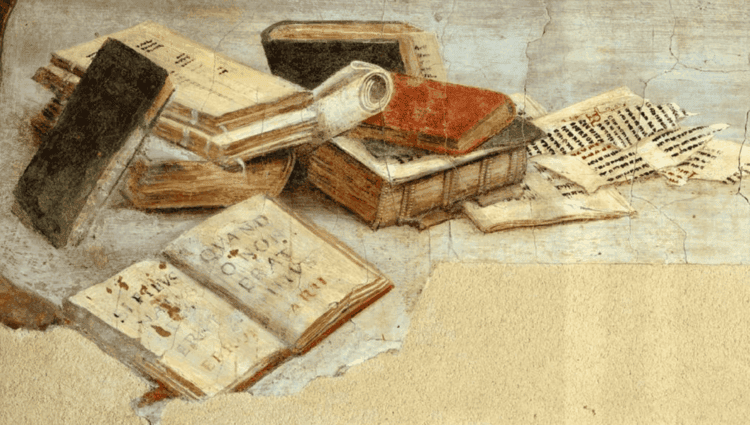
The featured image is “Triumph of St Thomas Aquinas over the Heretics,” (detail, between 1489 and 1491), by Filippino Lippi, and is in the public domain, courtesy of Wikimedia Commons.