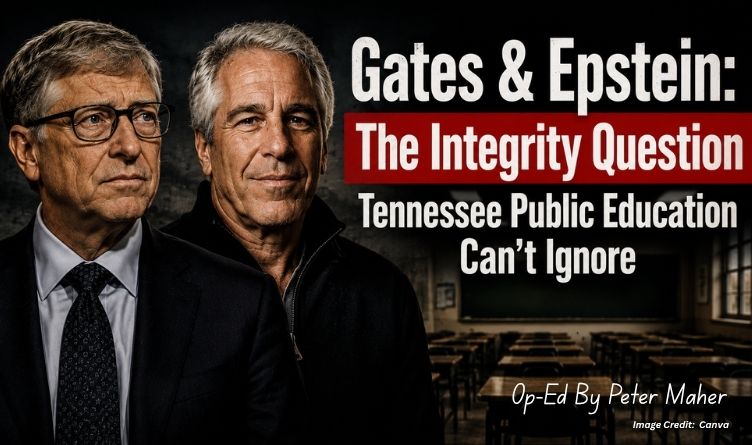
Image Credit: Canva
Note from The Tennessee Conservative: Editorial statements in this column are the sole opinion of the author; they do not necessarily reflect the opinions of the staff of this publication.
Submitted by Peter Maher –
Tennessee’s public schools and education policy have been shaped for years by a blend of elected decisions, federal incentives, and something far less accountable: large‑scale private philanthropy. Few philanthropic brands carry more weight in education than the Bill & Melinda Gates Foundation, and Memphis has been one of its most prominent touchpoints. The Foundation’s own grant records show massive K‑12 commitments to Shelby County’s school system, including an $84.5 million grant to Shelby County Schools in Memphis, alongside additional, later K‑12 support. Local reporting from the earlier “education reform” era described Gates’ personal engagement in Tennessee education policy and tied Memphis‑focused investments to statewide teacher‑evaluation systems, standards changes, and reform momentum.
That history should force a basic civic question: if public education is the largest public institution most Tennessee families interact with, why do so many of the most influential agendas arrive through private channels that voters cannot meaningfully audit at the ballot box? The Gates Foundation does publish a database of committed grants, but it is confusing and requires Tennesseans to actively search for information rather than receiving it transparently and locally. In Memphis, this funding web has always been uniquely confusing. It has included direct district grants to legacy Memphis City Schools and our current Shelby County Schools, early‑learning and advocacy support to Memphis‑based organizations, and later operating grants that influenced education‑focused institutions long after the initial reform era ended.
Lets start with the obvious: when Bill Gates can fund a school district at a scale measured in tens of millions of dollars, it can also fund the ecosystem around that district—research, advocacy, training programs, messaging, convenings, and even the information environment that shapes public understanding. Memphis experienced intensive Gates‑supported intervention during a period when Tennessee leaders promoted “bold reforms” and data‑driven teacher evaluation, framing the moment as a political pivot point for the state. But hindsight matters. Years later, national reporting and academic evaluations have shown that many top‑down reform efforts failed to deliver the promised academic transformation, despite enormous spending and sustained disruption. When a taxpayers bear the costs of experimentation and governance complexity, it deserves more than rhetoric about “innovation.” It deserves voluntary disclosure, evaluation, and accountability.
Widen the lens beyond public K‑12 operations to the institutions that shape educator pipelines and policy narratives. In 2015, our University of Memphis publicly announced that its long-troubled College of Education teacher‑preparation program would be transformed through a Bill Gates‑funded consortium, describing a multi‑year, multi‑site effort intended to standardize and reshape how teachers are trained. Separately, in 2015, our state’s postsecondary governance system, the Tennessee Board of Regents, announced a $2 million Gates grant aimed at improving graduation rates, particularly for low‑income and first‑generation students. These goals may sound laudable. But worthy objectives do not substitute for a transparent and accountable process—especially when private funding influences priorities, metrics, and the language public officials later repeat as if it were uniquely theirs.
Then Tennesseans have the policy‑advocacy layer. Gates Foundation grant records show substantial operating support for the Tennessee State Collaborative on Reforming Education (SCORE), an influential tax-exempt organization (founded by former Senator Bill First) that regularly convenes lawmakers, agency officials, and education leaders. That influence is not inherently improper, whether any of them possess measurable experience in Memphis’ public K-12 classrooms or not. What becomes concerning is when Tennessee parents cannot easily see who underwrites the convenings, the staff capacity, the research agenda, and the policy messaging—particularly when those messages flow directly into legislation, district priorities, and state accountability frameworks with little public scrutiny.
The information environment matters as well. Chalkbeat, an education news organization with a Tennessee footprint, publicly lists the Bill & Melinda Gates Foundation among its significant donors while asserting editorial independence. Transparency is better than silence. Still, it raises a hard question: in a media landscape where education journalism is chronically under‑resourced, how does our community ensure that philanthropic support does not quietly shape which stories receive sustained attention and which are deemed too technical, too uncomfortable, or simply too costly to pursue?
This is where broader concerns about Bill Gates’ judgment, lack of experience, and accountability intersect with Tennessee’s education story—not because they prove wrongdoing in education policy, but because they illuminate the risks of elite networks operating with limited transparency. Bill Gates is recognized by some for his technical expertise, global health work, and decades of philanthropic engagement. At the same time, his acknowledged relationship with Jeffrey Epstein demonstrates how even well‑intentioned folks can drift into ethically compromised spaces when accountability is informal and concentrated. The lesson for Tennessee is not gossip; it is governance. When powerful individuals and institutions coordinate through private meetings, private funding, and private influence, Tennesseans are often the last to know and the least equipped to respond.
Real transparency in Tennessee public education requires several concrete steps. First, every district, university program, and education nonprofit that receives major private funding should maintain a plain‑language disclosure page detailing grant amounts, purposes, timelines, and reporting obligations—kept current and searchable. Second, statewide advocacy organizations that convene lawmakers should voluntarily publish sponsor lists and amounts for major events, research products, communications campaigns, and lobbying activity reports. Third, any education newsrooms should continue and expand donor transparency and consider clearer context disclosures when covering policy areas heavily shaped by major funders, because the appearance of influence can be as corrosive as influence itself.
Another troubling example is The Education Trust (EdTrust), a national education advocacy nonprofit with a Tennessee affiliate. EdTrust has been a long‑time recipient of major Gates Foundation funding and operates with a national policy focus. Gates’ “Edtrust Tennessee” employs a government-relations and advocacy staff. Yet, Tennesseans have to guess what EdTrust’s lobbying activity reports actually look like. According to its most recent IRS filings, EdTrust’s president and CEO received compensation approaching $500,000—an unusually high figure for a tax‑exempt advocacy organization that claims to represent local equity interests. Yet EdTrust’s publicly available leadership biographies emphasize federal policy, national advocacy, and think‑tank experience, while documenting no direct professional experience working within Memphis‑area public K‑12 school systems such as current Shelby County Schools or legacy Memphis City Schools. This disconnect—between national philanthropic funding, executive‑level compensation, and the absence of demonstrated, place‑based experience—raises legitimate questions about how much influence well‑funded national nonprofits should wield over local or state education policy conversations.
Finally, and most importantly for Memphis, communities must demand that “reform eras” be evaluated with the same seriousness with which they were launched. If teacher‑effectiveness investments, accountability systems, and governance changes were sold as transformative, then their outcomes must be publicly assessed, locally grounded, and easy for citizens to understand—not buried in technical reports or national narratives. Memphis has lived through a failed generation of big‑idea education governance. The responsible path forward is not to ban philanthropy, but to require sunlight strong enough for parents, educators, and voters to see the full context of influence—money, messaging, metrics, and meetings—before the next cycle of creepy experiments begins.