During his heyday, George W. Chadwick was the most respected American “serious” composer. His music conveys a feeling of old-time America in a way that most listeners can relate to and enjoy. If we are looking for a “usable past” in American music, there is no better place to start than G.W.C.
 How do we define America’s contributions to the fine arts, historically speaking? Was American artistic creativity born with the modernism of the 20th century (the “American century”), as some critics suggest? Or is there a vital and worthy artistic tradition from earlier times?
In literature and painting, there can be no doubt that the latter is true. We can talk about the Hudson River School of painting and the great American authors of the 19th century (Poe, Hawthorne, Melville, Twain, etc.)—venerable artistic traditions that still speak to us today. The situation of music is a bit different. The United States took a while to find its feet in the world of “serious” (or “classical”) music, longer certainly than in painting or literature. We can pinpoint the emergence of an American tradition in classical orchestral and chamber music exactly to the period following the Civil War.
True, there was plenty of musical activity before this: the New England hymnodists of the colonial era, the music of the Moravian community in Pennsylvania, and maverick and inventive composers here and there (Fry, Bristow, Gottschalk). And America has always produced music that is hard to classify as either classical or popular—Stephen Foster songs, Sousa marches, Joplin rags, the great Broadway musicals. These repertoires also deserve a place of honor in the broader category of “American music.”
Bearing all this in mind, it’s clear that the first well-rounded body of fine-art music in America was produced by the Boston Classicists, aka the Second New England School, whose careers flourished from the 1870s through World War I. As their name implies their home base was Boston, then seen as the center of culture in the United States. The group is usually considered to have included John Knowles Paine, George W. Chadwick, Arthur Foote, Amy Beach, Edward MacDowell, Horatio Parker, and sometimes a few others.
Throughout the 19th century there was a strong drive for America to prove itself equal to the Old World in the arts as in other areas of life. In music, the question of what “American music” should sound like, and whether the young nation had ready-made traditions on which to draw, became widely discussed. When the Bohemian composer Antonín Dvořák visited the U.S. in the 1890s, he suggested that America did indeed have native materials that could form the basis of new classical compositions, namely Native American melodies and black spirituals. He encouraged U.S. composers to use these resources to inform their symphonies, chamber music, and operas.
At the same time, the new American composers looked to the established European—in particular German Classical and Romantic—models to form the backbone of their music. In 19th-century musical taste, Beethoven was king, and composers like Schubert, Mendelssohn, Schumann, Wagner, and Brahams were the acolytes. To audiences everywhere, these were the models of what good music sounded like. Classical music in the U.S. was, in fact, largely built up by German immigrants, channeling their energies into singing societies and orchestral clubs. Many young American composers went to Germany to study composition. They came back armed with solid musical craft and seeking to build musical life in this country. And they succeeded: American conservatories and orchestras sprang up in the decades after the Civil War, and music-making in general flourished.
The fine quality of New England School music helped bolster Americans’ cultural confidence at a critical moment. At the beginning of 19th century, Europeans typically regarded America as a cultural backwater, a land interested only in the “Almighty Dollar,” industry, and practical matters. Americans wanted to prove that they had the sensitivity and genius to produce great art. Chadwick and his peers made this dream a reality.
As thanks for their achievements, the New England composers were shunted aside with the rise of the modern school in the 20th century. In the light of composers like Charles Ives and the young Aaron Copland, the music of the Bostonians seemed old-fashioned, genteel, Victorian—irrelevant to the age of jets and skyscrapers. This sad tendency to throw aside the accomplishments of the past (and, I would add, saw off the branch one is sitting on) has been corrected in more recent decades. Since the 1980s the music of the Second New England School has been revived in concerts and recordings. Old prejudices die hard, however, and one still sees the New Englanders marginalized, their music portrayed as derivative or merely of historical interest.
I am here to argue that one the New Englanders in particular, George W. Chadwick, produced a body of work fully realized and compellingly attractive. I have found great pleasure in the music of Chadwick, as well as that of Arthur Foote. But Foote’s specialty was intimate chamber music, whereas Chadwick favored broad and colorful orchestral canvases. Anyone who enjoys Romanticism—and that takes in a lot of classical music fans—will find in Chadwick a full-fledged American Romantic. It is Chadwick, and not Ives or Copland, who made the first signal contribution to U.S. concert music.
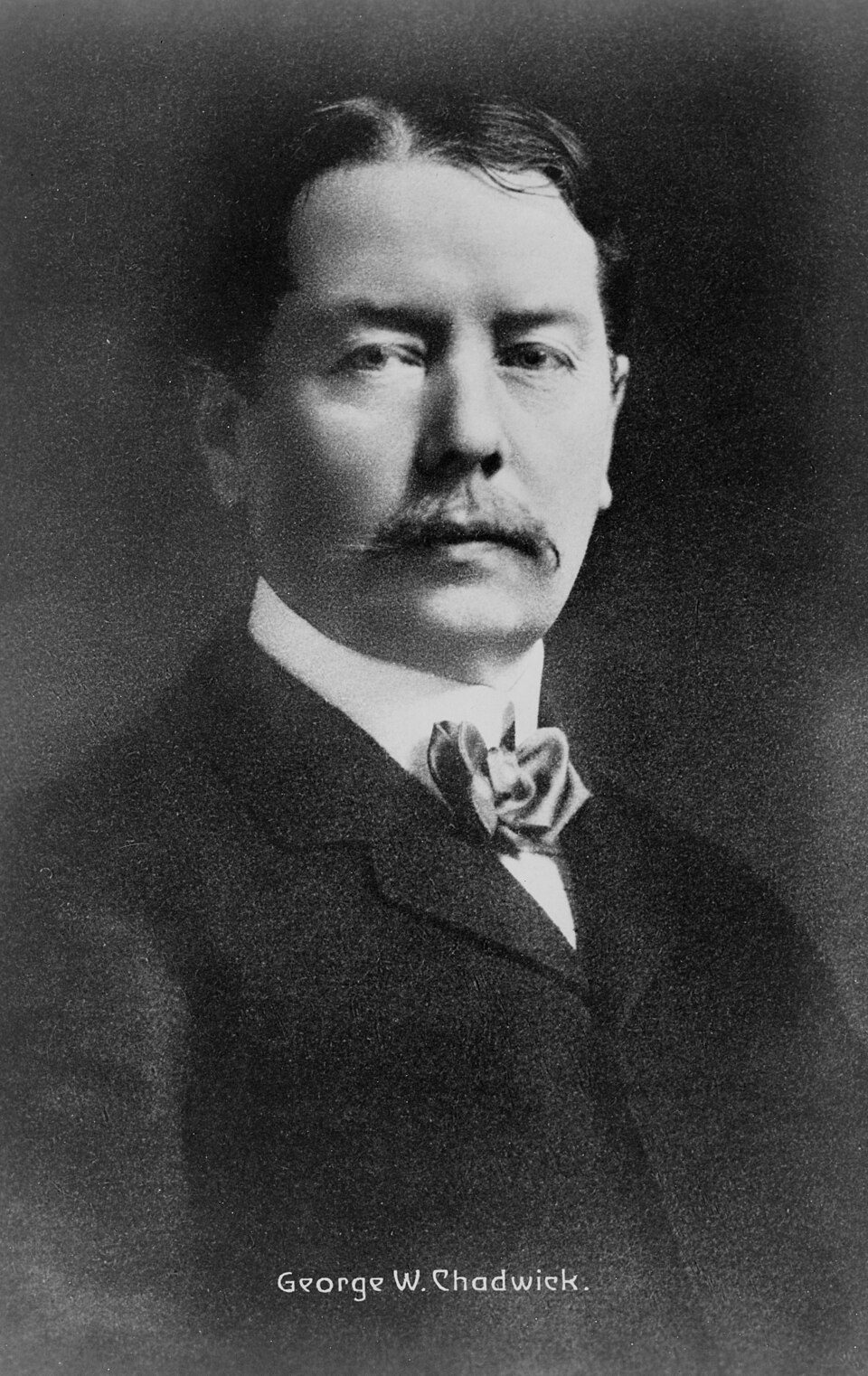
George W. Chadwick
First, a little about his life. George Whitefield Chadwick was born on November 13, 1854 in Lowell, Massachusetts into an old New England family that traced its roots back to the 17th century. He was named in honor of George Whitefield [pronounced “Whitfield”], the 18th-century evangelical preacher. Chadwick participated in community musical activities growing up but, upon reaching adulthood, was obliged to work in his father’s insurance business. Chadwick did not like the work, but traveling for business allowed him to attend concerts and theatrical performances and further kindled his interest in music. Chadwick’s decision to pursue music as a career was not well received by his father—a familiar theme in the history of composers—but the young man plowed ahead, enrolling in the New England Conservatory (founded as recently as 1867) and later going abroad to Germany to study with some of the most sought-after teachers.
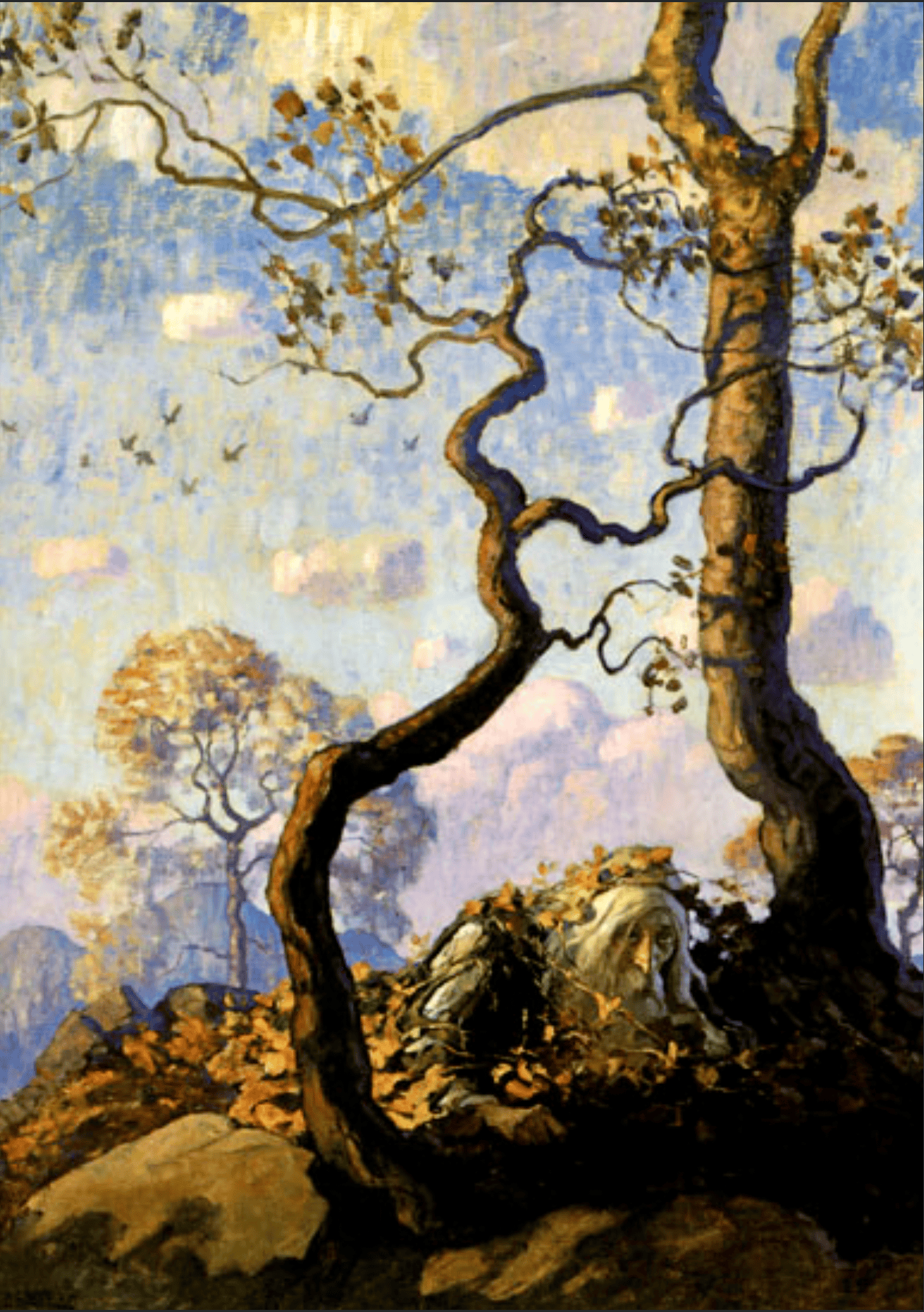
Chadwick became a gifted organist as well as a choral conductor, and began to write his first compositions as a student in Leipzig, the city of J. S. Bach. One of these was the orchestral Rip van Winkle Overture, inspired by the Washington Irving tale. It was Chadwick’s breakthrough work, establishing his name both in Germany and back home in the States. Chadwick was not the first American composer to write music on an American theme—New York-born George Frederick Bristow had written his Arcadian Symphony (also known as “The Pioneer”) in 1872—but never had it been done with this level of competence and skill. John Knowles Paine, the senior member of the New England group, had written accomplished symphonies and tone poems in the 1870s, but he did not choose American subjects.
The orchestra, with its variety of color and texture, would be Chadwick’s favorite medium, although he would also write string quartets, a piano quintet, and many choral anthems and hymns. Many of his orchestral works would be given their premiere by the Boston Symphony Orchestra, which had been founded in 1881. In time Chadwick was called upon to lead his old school, the New England Conservatory; he served as director of the institution for over 25 years starting in 1897, bringing the school up to speed with Europe’s best.
During his heyday Chadwick was the most respected American “serious” composer, his only possible rivals being Edward MacDowell and Charles Martin Loeffler (both friends of his). But by the time of his passing in 1931, Chadwick had grown out of sympathy with the directions music was taking in the 20th century. He felt like an old relic, a victim of changes in musical fashion. From today’s vantage point, when the aesthetic battles of the 20th century are themselves relics of the past (and thankfully so), we can appreciate Chadwick’s art anew. He is not merely of historical interest, but a marvelous and genuinely American composer.
What are the qualities of Chadwick’s music that make him an American composer of stature and appeal? I would sum it up as a combination of European craftsmanship with American attitude. Chadwick wrote three fine symphonies that demonstrate his fluency with form and thematic development as established by the German masters. But the feeling and spirit of the music are Chadwick’s own, and distinctly American. We hear a syncopated snap in the rhythms, pentatonic melodies (using the five-note scale common to both Scots-Irish and Native American music), and a devil-may-care independence that cannot be tied to any other place than the United States. Chadwick’s music is fresh and exhilarating, with impetuous dash and dashing wit which surely reflect the New Englander who wrote it. He had a gift for melody—strong themes that are memorable and ripe for development. His instrumentation, brass-heavy at times, can resemble a band as much as an orchestra, reminding us that he was good friends with the “March King,” John Philip Sousa.
The Symphonic Sketches, perhaps Chadwick’s best-known piece, brings us further away from orthodox German Romanticism. Chadwick writes four movements, four sound impressions of American life: “Jubilee,” “Noel,” “Hobgoblin,” and “A Vagrom Ballad.” “Noel” is a lovely Nativity scene composed in honor of Chadwick’s son Noel, who was born around Christmastime, while the vaudevillian “Vagrom” depicts the escapades of a group of vagrants near the railroad tracks.
We hear another side of Chadwick in his orchestral tone poems based on Greek mythology: Aphrodite, Melpomene (the muse of tragedy), Thalia (the muse of comedy), and Euterpe (the muse of… music). Here the composer’s work reflects the strong taste for Greek classicism in turn-of-the-century Boston, the “Athens of America.” Chadwick’s later descriptive music is “modern sounding” than his earlier work, suggesting Richard Strauss and even anticipating film scores. One critic has characterized the Symphonic Sketches to be “as American as Mark Twain” and a source of inspiration to later U.S. composers like Gershwin and Bernstein.
This is a point worth emphasizing, because there is a received wisdom, endlessly repeated, that the music of the New England School “sounds European” and “doesn’t sound American.” But there are problems with this claim. In the first place, it is simple fact that Western art music is a product of Western Europe. In the second place, no one ever defines in concrete terms what it might mean for music to “sound American.” Simply quoting “Yankee Doodle” every few bars would not make for a coherent composition. A composer needs a structural base for his music, and in the context of Chadwick’s day this was modeled by the Austro-German tradition.
Now, all composers working within this tradition will express it with their own “accent,” conditioned by their cultural environment. And that is true of the Second New England composers. Chadwick’s music does not sound exactly like Brahms or Wagner: there is a kind of rhythmic energy and humor we don’t always get from those composers, along with melodic patterns that they did not use. Not recognizing the Americanness in this music is, I would submit, a result of not bothering to listen to the music closely enough.
There is another obstacle to our appreciation of Chadwick and his peers, and that is the cult of originality, a legacy of Romanticism. The idea of being “derivative” has become a stigma, but the fact is that every form of art is derivative of something else. The question is whether the artist makes something personal and enduring from his influences. We must get beyond the need to see artists as isolated individuals; it is far more interesting, to me, to see them as members of a school with a shared style and aesthetic.
Chadwick lived through a time of great cultural change in America and the world. The phonograph began to transform listening habits, making recorded music as common an experience as, if not more so than, live performance and home music-making. The growth of “popular” music—genres like ragtime and jazz—would give the public a formidable alternative to “classical” music, putting the latter in danger of irrelevance. The proliferation of all kinds of music, aided by technology and commerce, has proceeded in the nearly 100 years since Chadwick’s death, creating a general “white noise” into which great works of the past tend to get swallowed up.
We Americans are notorious for failing to respect, or even remember, our cultural past. In music, we seem to be stuck in a pattern of reviving past works to great fanfare, then letting them lapse back into obscurity. This might be one of the reasons why American classical music leads a ghostlike existence, unknown to most of the population and even to most classical fans.
Why not pick up some of these abandoned pieces of our heritage—like the music of Chadwick? It is happy music, filled with an optimism that is distinctively American. And as is not always the case with that much vaunted experimentalist Charles Ives, it is always attractive to the ear, the work of a man who did not worship roughness or experiment for its own sake. To be brutally frank, I have sampled things by Ives with titles like “Thanksgiving” or “Fourth of July” expecting to hear music that will elate me or make me proud to be an American or a human being, and instead been confronted by something akin to driving a tractor through the mud. With Chadwick, this never happens. (I don’t like pitting artists against each other as a rule, but I feel in this case that the comparison is instructive. If you are an Ives fan, please don’t take it personally.)
One more tangent before I conclude this sketch. In recent years the music of William Grant Still and Florence Price, Chadwick’s pupils, has been brought back. This is all to the good, as worthy music from the past deserves to be heard again. But I fear that too often we are retrieving the right music for the wrong reasons—because of the race or sex of the composer instead of because of the high quality of the work. Meanwhile, Chadwick languishes, and our picture of music history becomes skewed. If audiences could hear the music of Chadwick as well as the music of Price, Still, etc., their understanding and enjoyment would be further enriched.
So this is my plea: a little less Ives, and much more Chadwick. More Price, more Still… and more Chadwick. Because his music conveys a feeling of old-time America in a way that most listeners can relate to and enjoy, and its emotional range is comparable to music of better-known composers whose works are heard constantly. If we are looking for a “usable past” in American music, there is no better place to start than G.W.C.
___________
The Imaginative Conservative applies the principle of appreciation to the discussion of culture and politics—we approach dialogue with magnanimity rather than with mere civility. Will you help us remain a refreshing oasis in the increasingly contentious arena of modern discourse? Please consider donating now.
The featured image is “Rip Van Winkle Illustration” (1921), by N.C. Wyeth, and is in the public domain, courtesy of Wikimedia Commons. The image of George W. Chadwick is in the public domain, courtesy of Wikimedia Commons.