The Merry Fiddler
The Romantic tradition has taught us to value originality in the arts, exalting those artists who were pathbreakers and radical individualists. But the fact is that all artists learn by building on the past and imitating those who came before. History offers notable examples of artists known for imitating other artists. A good example is the Dutch Golden Age painter Gerrit van Honthorst, whose name is inextricably linked with that of his older Italian contemporary, Michelangelo da Caravaggio (himself something of a radical individual). Honthorst’s embrace of a Caravaggesque style in his paintings was obvious to his peers and remains so today. Yet Honthorst also escaped his ties to Caravaggio, emerging as an artistic personality in his own right.
In fact, in a country and an era that produced painters as plentifully as it produced tulips, Honthorst stands out—for his glowing color, his realistic modeling of human figures and human interaction, and especially his highly expressive use of light and dark. If Vermeer is known as the “painter of light,” Honthorst could well be dubbed the “painter of night.” His pictures glow as if from within.
Yet you won’t find much press on Honthorst, certainly compared to stars like Rembrandt and Vermeer. That is very much to our loss.
The Denial of Saint Peter
Gerard (or informally Gerrit) van Honthorst was born in Utrecht, the predominantly Catholic city in the center of the Netherlands, in 1590 or 1592 and died there in 1656. Art was in his family: his father was a tapestry designer and president of a guild of artists, the Guild of St. Luke, which Gerrit would later lead. Honthorst went to Rome to study painting, there being exposed to the Italian Baroque in all its splendor, including most especially Caravaggio. Caravaggio’s realism, chiaroscuro (dramatic light and dark effects), and dynamic compositions made a strong impression on Honthorst, even though he never met the Italian artist. In fact, Honthorst’s very first known artwork is a copy of a piece by Caravaggio, Martyrdom of St. Peter.
The Dentist
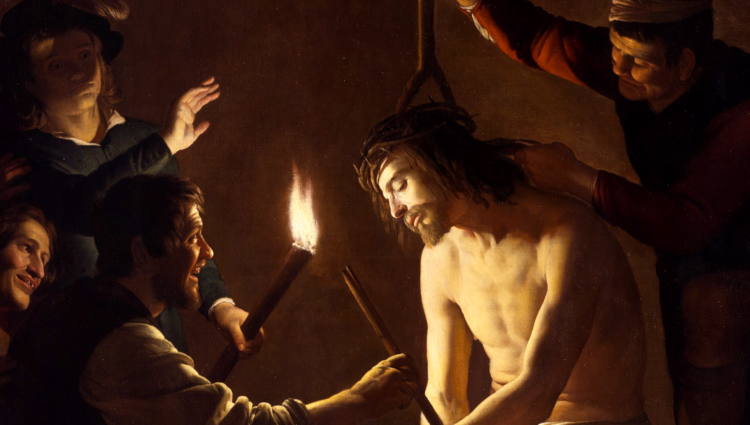
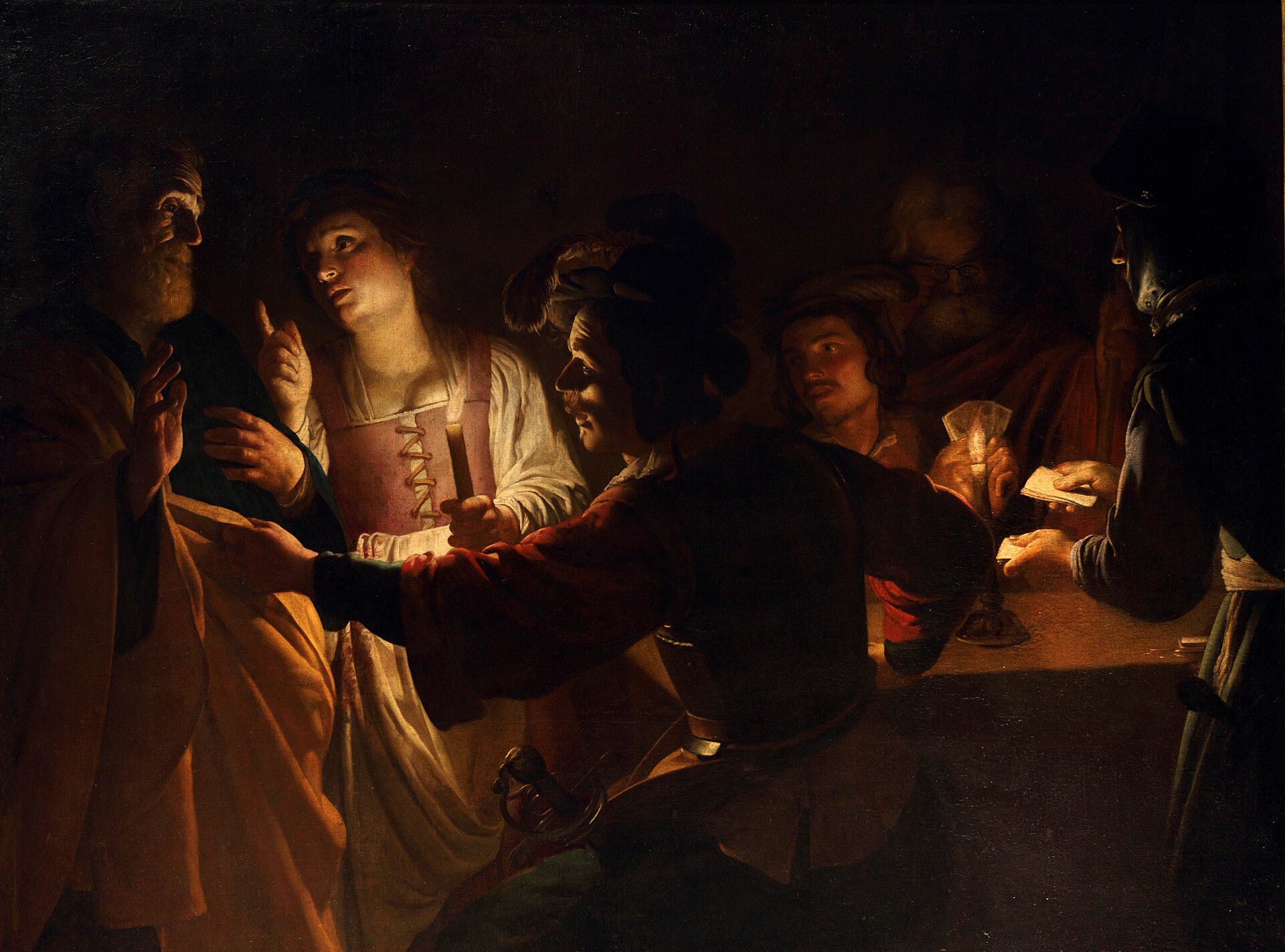
The young Dutchman’s career as one of the “Utrecht Caravaggisti” (which also included Hendrick Terbrughen and Dirck van Baburen) was launched. While still in Italy he produced an extraordinary Passion series. Peter’s denial, Christ’s trial before the High Priest, his mocking, crowning with thorns, etc. are depicted as taking place at night, the lighting by torch and candle adding to the menacing character of scenes taking place at evil’s darkest hour. There are no other Passion paintings quite like these, and it’s remarkable what a secure sense of self the young Honthorst had. As in all his religious scenes, it is the human treatment of the sacred subject matter that draws us in and moves us. Yet there is no coarseness, no exaggerated gestures as we sometimes find in Honthorst’s idol from Italy. By avoiding the snarling caricature, Honthorst imbues his Passion scenes with greater subtlety.

The Childhood of Christ
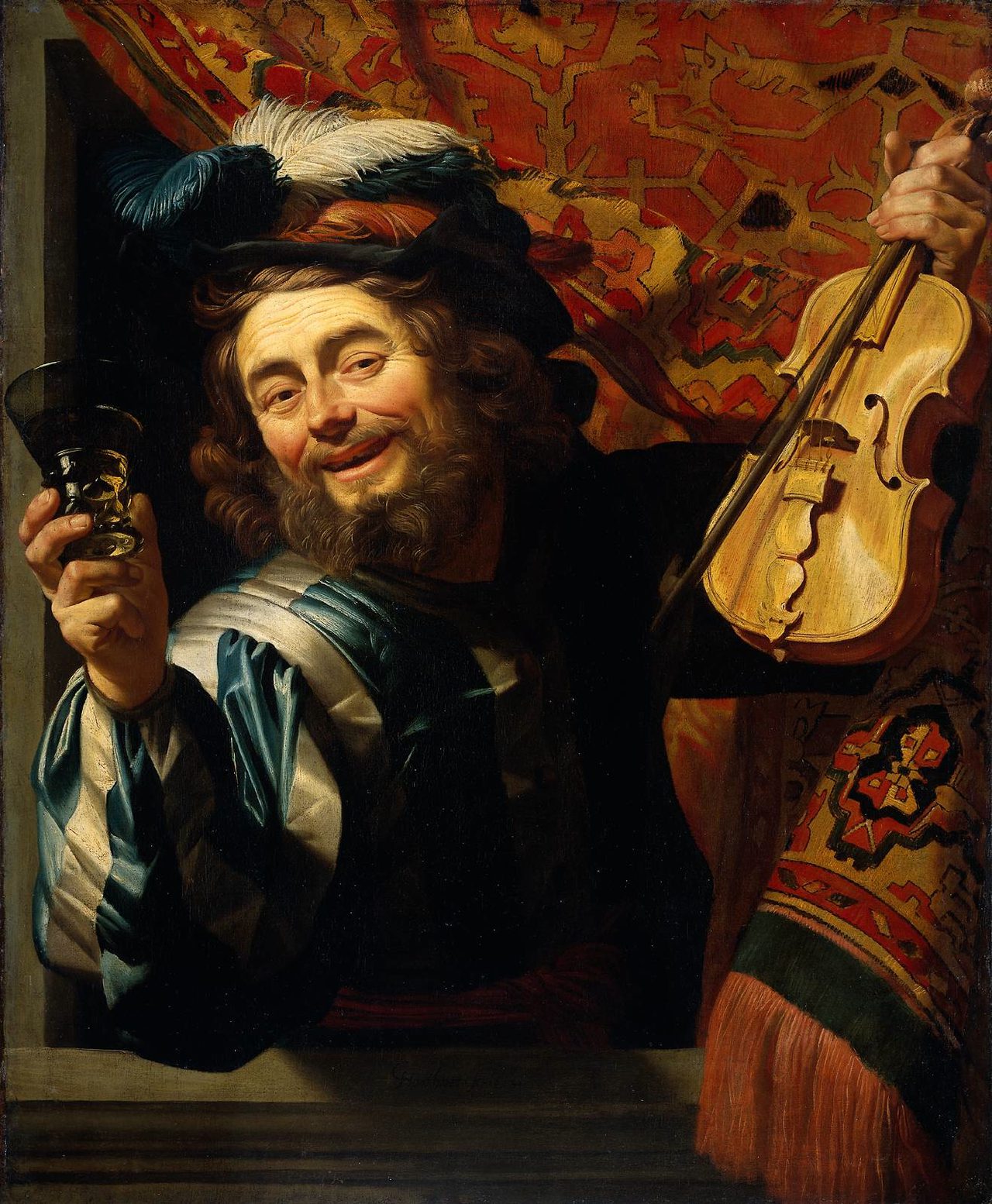
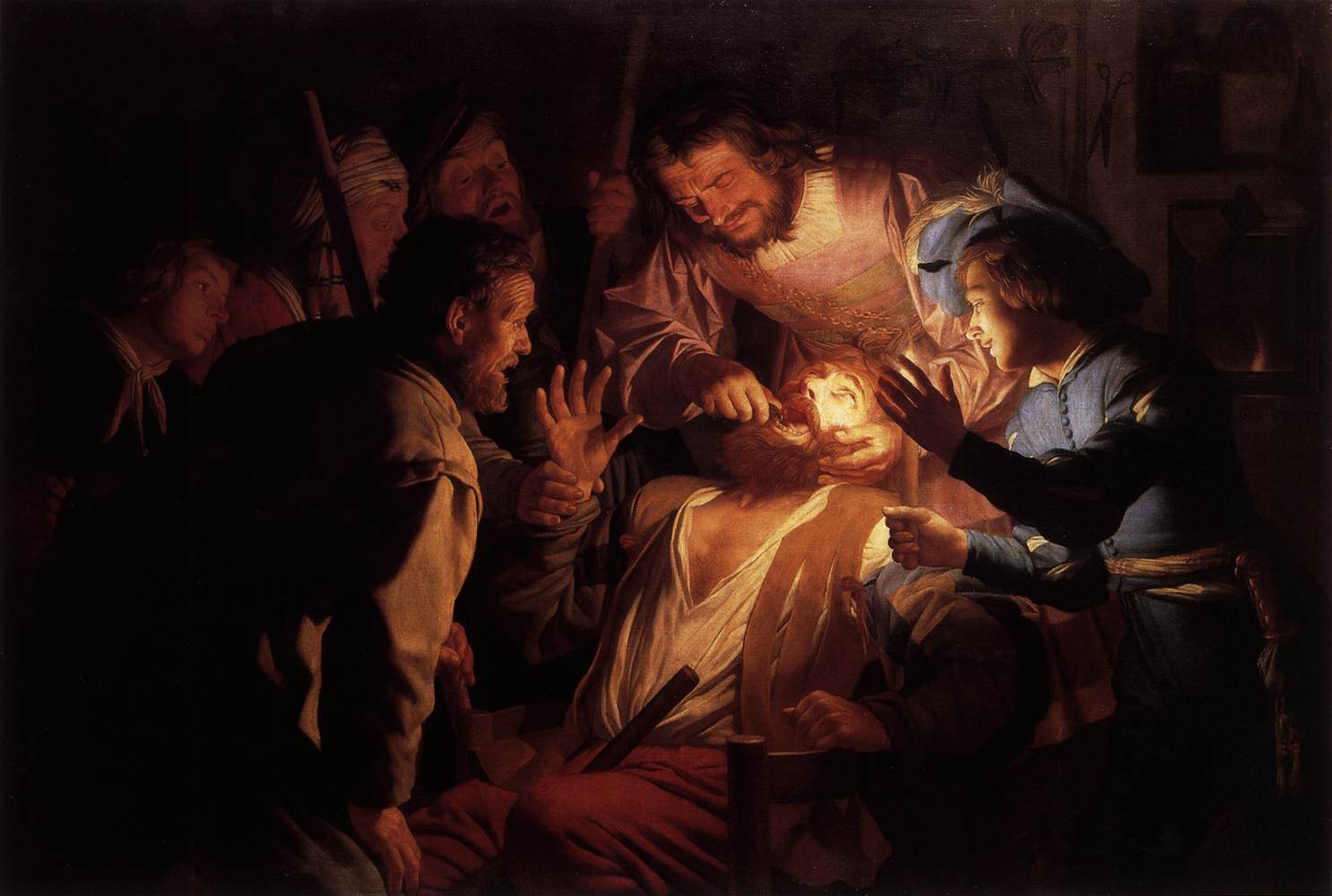
Working both for churches and private homes, Honthorst could bounce from sacred to secular subjects with aplomb and with hardly a change in style. The Dentist uses the same chiaroscuro effects as the Passion pictures to depict the suspense of a patient about to undergo the rigors of 17th-century dentistry. No side of life seemed insignificant to this artist. Soldiers, violinists, card players, drinkers, kings and queens, shepherdesses, innkeepers all people his canvases. All sorts of persons and all pursuits from the saintly to the seedy were fair game. And while a Jan Steen-like grotesquerie about human nature was well within his range, it is never done with malice: Honthorst’s people are portrayed with a basic sympathy and humanity. And they look like unique individuals, not cookie-cutter prototypes of perfection. Witness the grizzled, hardworking St. Joseph in The Childhood of Christ, or the jolly, hedonistic reveler in The Merry Fiddler. Honthorst had a talent for portraying real people in all their pains and pleasures.
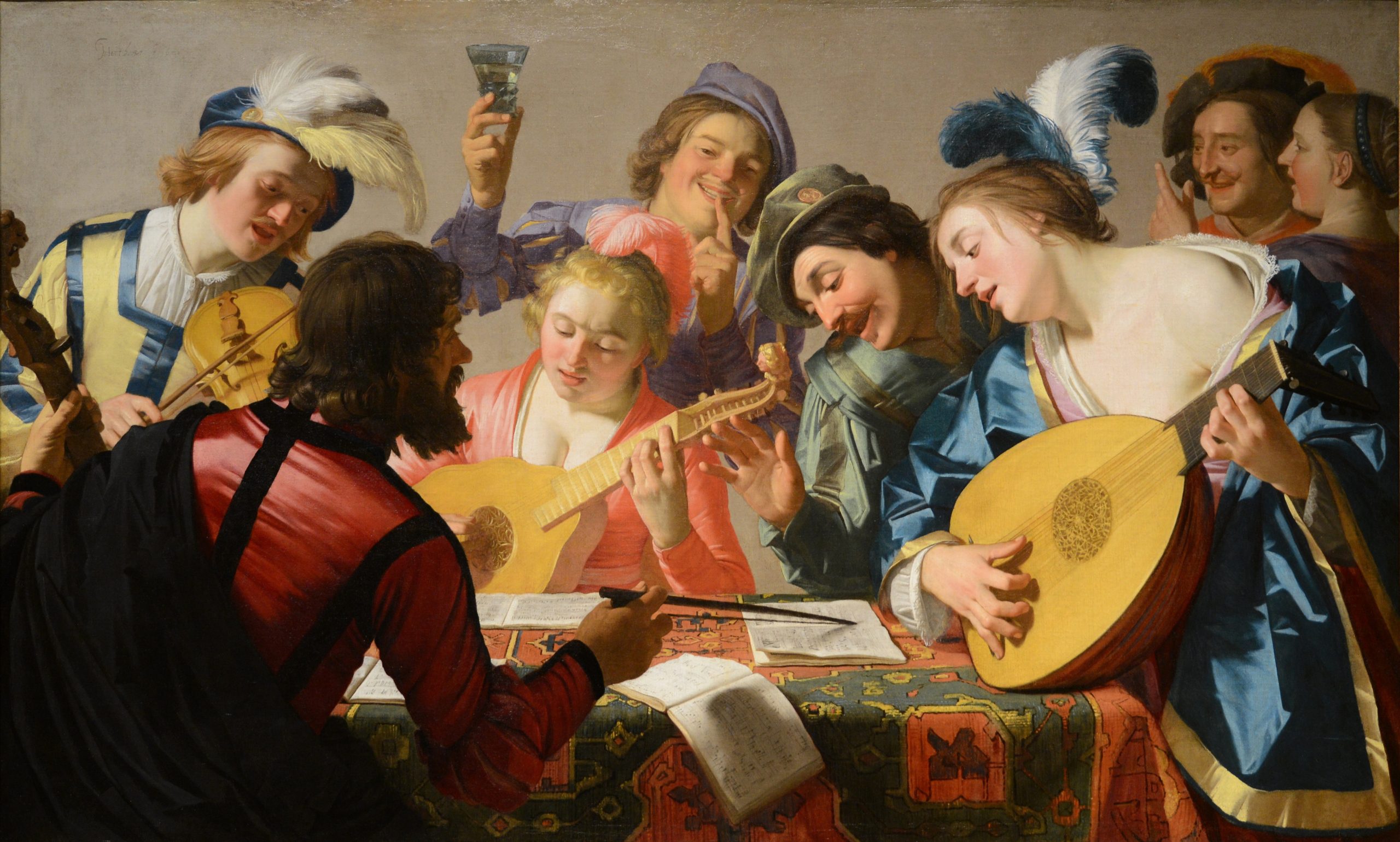
The Concert
Not all Honthorst’s paintings are nocturnal. The Concert, which I have enjoyed many times at the National Gallery in Washington, is in broad daylight and bright colors. The outward vesture alone—plumes, silks, and all—goes toward conveying the full splendor and flamboyance of the Baroque. Honthorst conveys a real sense of the concentration in making music as well as the joy and conviviality it brings. You can practically hear the sounds of this Baroque consort in full swing. The theme of musicians playing together was a common one, and Honthorst painted more than a few examples. Musical Group of a Balcony, painted for Honthorst’s own home ceiling, shows its players from an extraordinary perspective, from below a balcony with a clear sky opening above. Not every artist could pull off such a spatial feat and make it as convincing as Honthorst does.
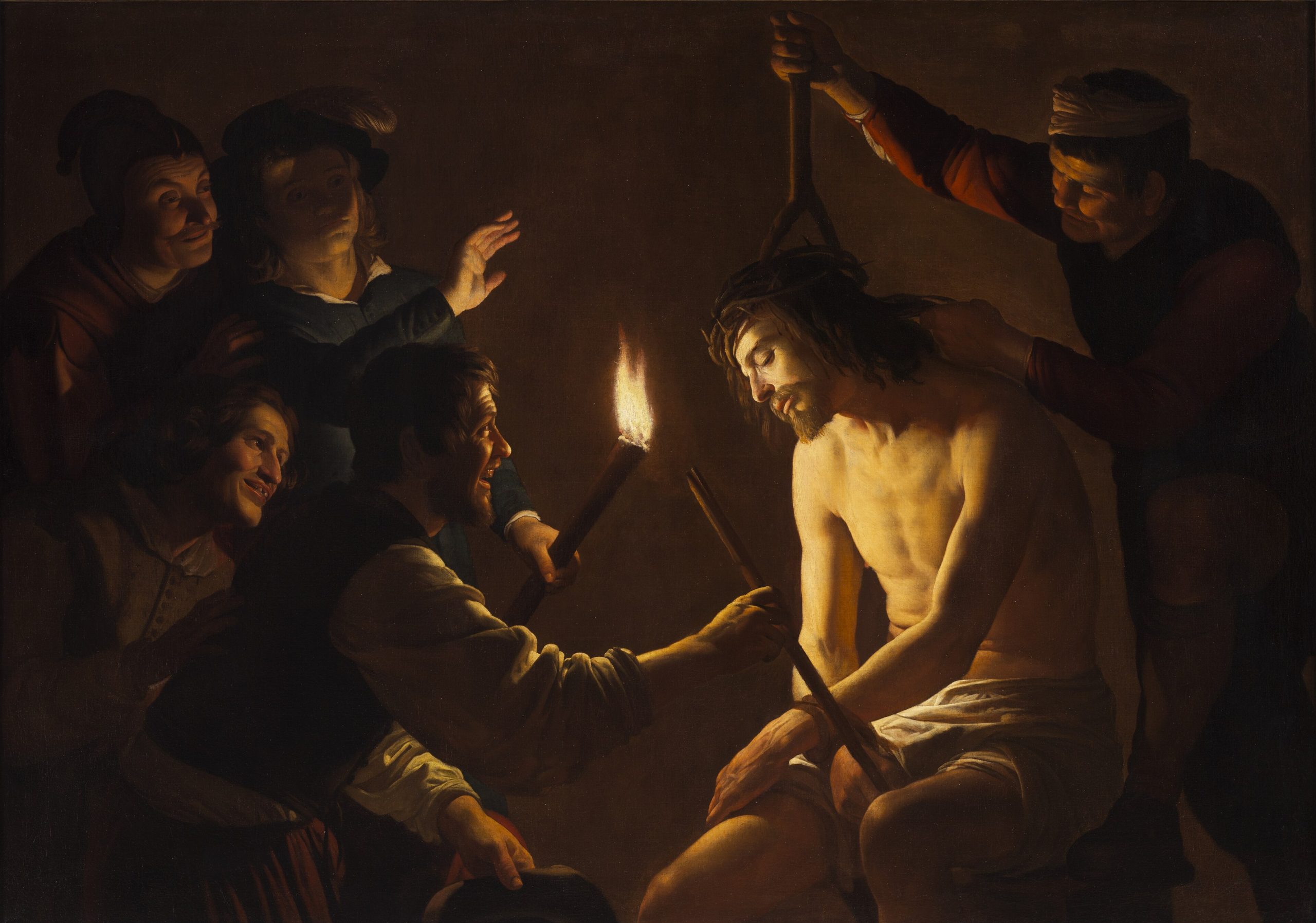
Mocking of Christ
Caravaggio was famous (even notorious) for rejecting an idealized and sanitized version of life as reflected in the Italian Renaissance, and ushering in the more dynamic and energetic art of the Baroque. But with Honthorst you really do get the best of both worlds: realism and idealism together. Honthorst’s people are more credible, both physically and emotionally, than those of many other artists of his day and before. There is a classical clarity to his scenes that tempers their strong sense of drama.
Chiaroscuro as a technique in European painting was, for all intents and purposes, first developed by Leonardo da Vinci in the late 1400s. Leonardo found a wondrous way of depicting subtle gradations of light and tone in oil paint, especially through the sfumato (from the Italian for “smoky”) technique in which outlines were blurred and contours gently molded. Chiaroscuro took a more extreme form with Caravaggio, under whom it acquired a new name, tenebrism (from the Latin for darkness) and was used theatrically to highlight scenes of drama and passion. Other Baroque painters who used chiaroscuro in a masterly manner were Velasquez, Rubens…and the Utrecht School, including Gerrit van Honthorst.

Christ before the High Priest
Honthorst may be compared to another “candlelight painter,” and one who was influenced by him, the Frenchman Georges de la Tour. But here again, Honthorst has the edge (at least to my eyes) for his modeling of the human face and figure and his convincing rendering of emotion. Never are Honthorst’s people the least bit wooden or doll-like.
The Italians never forgot Honthorst and his distinctive style, nicknaming him “Gherardo delle notti”—Gerard of the nights. Honthorst became a bridge between Italy and Holland, between southern and northern art. In the 1620s his talents won him the patronage of the Queen of Bohemia and of King Charles of England, who invited him to paint the British royal family; he was also in demand to immortalize Dutch royals at the Hague. But Honthorst’s court portraits are more formal and conventional and thus, to my taste, less interesting than the genre and sacred scenes. It is in the latter that his true greatness lies.
Someone, somewhere, at some point must have written a book called The Seventeenth: The Greatest of Centuries. If they didn’t, they should have. Savoring Dutch Golden Age painting drives home the energy and brilliance of this era, which inherited the best of both the Middle Ages and Renaissance (and of course classical antiquity). It was a richness that spilled out into all the arts and continues to be vital and “contemporary.” Key members of the Baroque club, Gerrit van Honthorst and his colleagues gave us masterpieces that illuminate the darkness.

Adoration of the Shepherds
__________
The Imaginative Conservative applies the principle of appreciation to the discussion of culture and politics—we approach dialogue with magnanimity rather than with mere civility. Will you help us remain a refreshing oasis in the increasingly contentious arena of modern discourse? Please consider donating now.
All images are in the public domain, courtesy of Wikimedia Commons.