
It seems that H.L. Mencken always ranged the borderlands of faith—wary, yet vigilant. Did he ever pass beyond?
 When I was a boy, white-haired Alistair Cooke used to host “Masterpiece Theatre” on PBS. As I write these lines, I hear echoes of the theme music that opened each episode: the Rondeau from Mouret’s “Symphonies and Fanfares for the King’s Supper.”
I loved the music. But for a long time, it represented a world far away from mine in rural New England. The images that flashed by on the screen—fine leather books, wine in crystal glasses, museum-quality furniture—they all seemed unapproachable.
Mr. Cooke helped with that. Welcoming, cultured, and avuncular, he helped me step through the door to that world. I began to learn about great books and great writers.
He wrote a coffee-table book too, Alistair Cooke’s America, which in its day did good service in helping many readers find an often undiscovered country: the country they lived in, but knew too little of.
* * *
Fast-forward to the recent past.
One Saturday, a local library sale yielded a 60-year-old paperback called “The Vintage Mencken.” Curious, I picked it up. On the front cover, I saw the words “gathered by Alistair Cooke.”
That caught my eye. Here was an old friend. Flipping the book over and scanning the back cover, I read: “This collection is meant to revive the oldsters, and acquaint the youngsters, with the glory that was Mencken.”
From Cooke’s introductory essay, it was clear he thought Mencken was an undiscovered country too. He cast phrases that set me thinking, phrases like “the master craftsman of daily journalism in the twentieth century,” “a humorist with one deadly sensible eye on the human animal,” “a superb craftsman,” and the clincher: “the style of H.L. Mencken… a style flexible, fancy-free, ribald, and always beautifully lucid.”
I learned too of how a stroke laid Mencken low in 1948, and how he lived on for eight more years, physically helpless, yet marshalling humor and fortitude that Alistair Cooke admired. Mencken had given his blessing to Cooke’s collection of his writings, and I found that moving. One great writer, repaying a debt to another. “The Vintage Mencken” appeared in 1955. Mencken died one year later.
* * *
The truth is, I’d crossed paths with Mencken before, but parted company.
“What about Mencken?” an editor friend asked several years ago. “Any interest in writing a book about him?”
“I don’t know,” I said doubtfully, “he could be awfully caustic and cutting.” I thought a moment more, then added: “And he was needlessly unkind to G. K. Chesterton.” For me, that was a serious transgression. (Not to mention Mencken’s membership in a writer’s circle called “The Smart Set.”) We let the subject drop.
But now, several years later, and with Alistair Cooke as a guide, I’ve been rethinking all that.
Maybe it’s time for a second look.
* * *
Why so? Part of the answer lies with one essay in the collection. Mencken called this piece “Holy Writ,” and that caught my eye too. Written in 1923, it’s a reflection on the King James Bible. I’d heard Mencken could be unsparing when he wrote about matters of religion. Would he be so here?
There were one or two caustic flashes, but then, this essay seemed strangely subdued. It had lines that were different from anything I’d read by Mencken before. Many of the things he said struck a chord; indeed, they were welcome. Here’s one of them, in which he describes the adamantine beauty and power of the KJV:
To this day it has enchanted the English-speaking peoples so effectively that, in the main, they remain Christians, at least sentimentally. Paine has assaulted them, Darwin and Huxley have assaulted them, and a multitude of other merchants of facts have assaulted them, but they still remember the twenty-third Psalm when the doctor begins to shake his head, they are still moved beyond compare (though not, alas, to acts!) by the Sermon on the Mount, and they still turn once a year from their sordid and degrading labors to immerse themselves unashamed in the story of the manger.
It is not much, but it is something.
Just a few sentences later, Mencken says something that was, as Alistair Cooke had written, “beautifully lucid.” He begins with qualified admiration for the Catholic Church, but closed with words of unqualified praise. “The Latin Church,” he says, “has always kept clearly before it the fact that religion is not a syllogism, but a poem.”
I thought about that for a long time. I think about it still.
Which led to these thoughts.
Maybe Mencken’s caustic prose, along with his stirring passages, flowed from a longing for truth and beauty and ultimate answers. Maybe sometimes we rage against things that aren’t what they ought to be, things that are broken and ugly. Maybe Mencken’s fulminations pointed to “the God-shaped hole in our heart,” as someone once said, or is supposed to have said. Maybe an uneasy believer like him, or someone who wants to believe, can teach us something. I believe that’s true.
It seems Mencken always ranged the borderlands of faith—wary, yet vigilant. Did he ever pass beyond? Only he, and God, knew for sure. But he cared deeply about that fateful journey. There is something poignant, and telling, in that.
__________
The Imaginative Conservative applies the principle of appreciation to the discussion of culture and politics—we approach dialogue with magnanimity rather than with mere civility. Will you help us remain a refreshing oasis in the increasingly contentious arena of modern discourse? Please consider donating now.
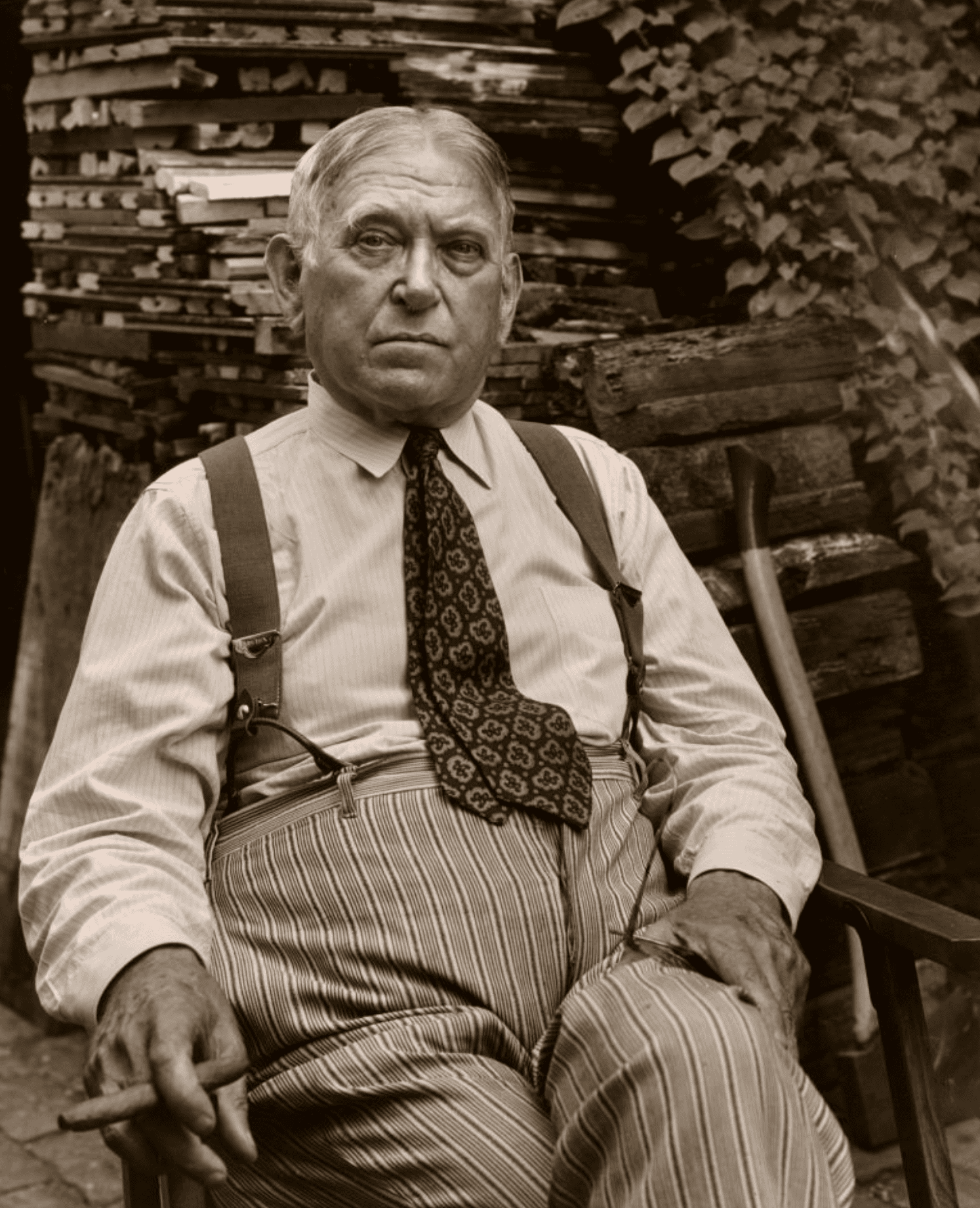
The featured image is a photograph, “H.L. Mencken on his 75th birthday,” taken in 1955 by A. Aubrey Bodine, and is in the public domain, courtesy of Wikimedia Commons.