 What do the films of Frank Capra (It’s a Wonderful Life, Mr. Smith Goes to Washington, You Can’t Take it With You, Lady for a Day, Lost Horizon, Mr. Deeds Goes to Town, Meet John Doe, etc.), the musicals of Rodgers and Hammerstein (The Sound of Music, The King and I, Oklahoma, Carousel, South Pacific, etc.), and Allen Levi’s novel Theo of Golden have in common? All portray and celebrate the power of faith, hope, and love in an age of cynicism, skepticism, and relativism. All hold up kindness and generosity as antidotes to selfishness and apathy. And all have been unfairly dismissed by critics who, consciously or unconsciously, have adopted what Paul Ricoeur called the hermeneutics of suspicion.
Despite the claims of jaded critics, none of these products of the human imagination present a utopian view of reality. All understand the world is a fallen, often dangerous place, rife with deceit, despair, and death. And yet, all refuse to give up on what Wordsworth called “the native, naked dignity of man.” What critics dismiss as melodramatic sentimentality, as looking at the world through rose-colored glasses, is actually an affirmation that the eyes of faith can see through mourning to the comfort that awaits, that the hands of hope can reach through time to embrace the telos (Greek for purposeful end), and that the heart of love (caritas in Latin; agape in Greek) can move out of itself toward the suffering person.
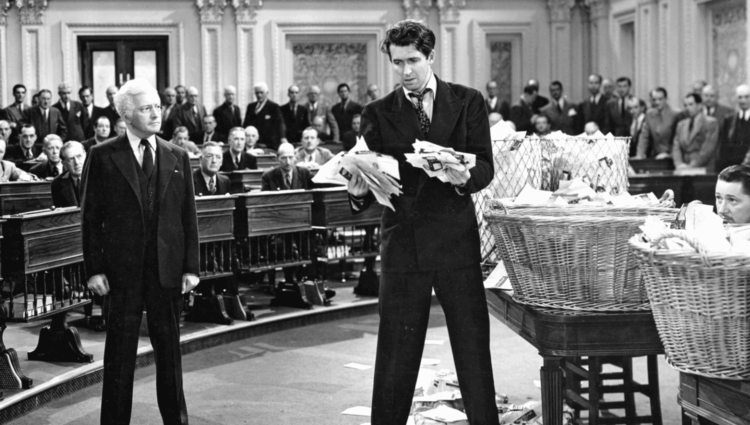
The core message of Capra’s films, Rodgers and Hammerstein’s musicals, and Levi’s novel, what makes them so beloved by so many Americans, is best summed up in a rousing speech from Mr. Smith Goes to Washington. The honest but naïve Jefferson Smith is chosen by the corrupt political party of his state to serve out the term of their flunky in the Senate who died suddenly. Jeff takes his cues from senior Senator Paine who knew his father and whom Jeff idolizes. When Jeff learns that Paine has compromised and is in the pocket of the ruthless businessman Taylor, he speaks up, only to be framed for the very crime he tried to expose. He flees to the Lincoln Memorial, prepared to give up the fight and return to his state. There he is met by his secretary, Clarissa Saunders, who, though she has not approved of Paine’s corruption, has succumbed to cynicism and apathy.
But Jeff has woken something decent and hopeful in her. She meets him at his moment of deepest despair and challenges him to renew his faith and hope in himself and the country he loves:
Your friend, Mr. Lincoln had his Taylors and Paines. So did every other man who ever tried to lift his thought up off the ground. Odds against them didn’t stop those men. They were fools that way. All the good that ever came into this world came from fools with faith like that. You know that, Jeff. You can’t quit now. Not you. They aren’t all Taylors and Paines in Washington. That kind just throw big shadows, that’s all. You didn’t just have faith in Paine or any other living man. You had faith in something bigger than that. You had plain, decent, everyday, common rightness, and this country could use some of that. Yeah, so could the whole cockeyed world, a lot of it.
Rarely has the true, optimistic but realistic, idealistic but conservative, quixotic but practical ethos of America been so clearly stated. There is evil in the world that is manipulated by self-aggrandizing individuals, but there is also a goodness and a rightness in people that can overcome the corruption. Good is stronger than evil, but it too often lacks focus, confidence, and vision. There is no Rousseauvian denial of original sin here. Sin is real and predatory, and no one is immune from its ravages. But there is a bigger picture, a larger hope that we have lost sight of. We need fools—dare I say holy fools—like Jefferson Smith to wake us up to what we know is true. The villains are so brash and bold that they cow us into believing that they are the majority, that their theories and methods are unassailable, that we cannot resist their will. They give us only two options: Join the team or be crushed. Jeff finds a third way.
Taylor is too far gone, too consumed by his greed and lust for power to be reached. Not so Paine. Paine was once a fighter for freedom; in fact, he fought a lost cause alongside Jeff’s father, an impractical crusade for justice that ended in the murder of his partner. Jeff believes that there is still some good in Paine, that underneath the layers of protection he has wrapped around himself, there is a beating heart that still knows right from wrong. When Jeff realizes that the daring, audacious filibuster he has mounted to reveal the truth has been lost, he turns to Paine and calls on what Mr. Lincoln once called the better angels of his nature.
“I guess this is just another lost cause,” says Jeff, his voice so hoarse he can barely be heard:
All you people don’t know about lost causes. Mr. Paine does. He said once they were the only causes worth fighting for. And he fought for them once, for the only reason any man ever fights for them. Because of just one plain, simple rule: ‘Love thy neighbor.’ And in this world today, full of hatred, a man who knows that one rule has a great trust. You knew that rule, Mr. Paine, and I loved you for it, just as my father did. And you know that you fight for the lost causes harder than for any others. Yes, you even die for them, like a man we both knew, Mr. Paine.
After making his plea, his cri de coeur, Jeff collapses. He has lost, incapacitated and rendered unconscious by the overwhelming force of the Taylor machine. But he has also won. Paine, his conscience pricked by Jeff’s words, first attempts suicide and then publicly confesses to his fraud. 1 John 4:4 assure us that he who is in us (the indwelling Holy Spirit) is greater than he who is in the world (Satan). Though Jeff himself is crushed, his appeal to the image of God (imago Dei) within Paine releases a truth—not Paine’s truth, but the Truth—that defeats Taylor. Good is deeper, stronger, more foundational. That is not bourgeois sentimentality, not “Capra-corn,” but an affirmation of the imago Dei. For, though we are fallen and depraved, we and our world were made good. Traces of that good remain, and Jeff calls them out of Paine.
George Bailey does the same for the community of Bedford Falls in It’s a Wonderful Life. The evil Mr. Potter is, like Taylor, beyond redemption. He has chosen to shape his actions and his character around cupidity and narcissism, and he can no longer be drawn out of his self-made prison. Not so the common people who are saved from ruin and despair by the Building and Loan George inherited, unwillingly, from his father. By helping them to purchase homes, George restores their dignity and gives them a future and a hope toward which they can strive.
At one point in the film, Potter nearly bribes George into abandoning the lower-middle-class homeowners to whom he has devoted his life and career—what Potter dismisses as the rabble. George thinks for a moment that Potter will be the vehicle for securing him the rich, adventurous life he has always dreamed of. And then he shakes Potter’s sweaty hand and stares into his cold, dead eyes, and he is struck by a revelation about Potter, himself, and his fellow citizens.
Just remember this, Mr. Potter, that this rabble you’re talking about, they do most of the working and paying and living and dying in this community. Well, is it too much to have them work and pay and live and die in a couple of decent rooms and a bath? Anyway, my father didn’t think so. People were human beings to him, but to you, a warped, frustrated old man, they’re cattle. Well, in my book, he died a much richer man than you’ll ever be.
The American dream is not about achieving success on the backs of one’s neighbors, nor is it turning a blind eye to the plight of one’s fellow man. It is not socialism, but it is also not survival of the fittest.
George makes the right choice, not just for himself, but for his community. He puts justice and humanity over his own advancement, for when he looks at others, he sees individuals made in the image of God, not antagonists to be defeated or suckers to be manipulated. He understands the worth of others, and that understanding enables him to see and accept his own essential worth. “Strange, isn’t it?” says the angel Clarence to George Bailey after showing him what the world would have been like had he never been born. “Each man’s life touches so many other lives. When he isn’t around, he leaves an awful hole.”
We are not autonomous individuals living in self-protective silos. We are interconnected, fellow creatures in a world rich with meaning and purpose that gets trampled and torn apart by those who cannot see the face of God in the face of others. George never does get to take vacations to Europe, nor does he build the skyscrapers he has built so often in his imagination. Instead, he builds real homes for real people; his “plain, decent, everyday, common rightness” transforms his world into a haven for humble dreamers who harbor the desire but lack the means to live with honesty, security, and self-respect.
The musicals of Rodgers and Hammerstein are populated by just such dreamers who struggle to balance their desires with the realities in which they live and move and have their being. All their shows reward the audience with a happy ending, but they are only partially, tentatively happy. South Pacific tackles racism and miscegenation; though the main couple end up together, the young American soldier who falls in love with the lovely Polynesian girl is killed in action. The King and I centers around a romance that can never be consummated, for the king is polygamous and never quite rises above his autocratic tendencies. Carousel contrasts a happily married couple with a troubled relationship between an innocent girl and an abusive, criminal husband. The deceased husband returns from the dead in hopes of some kind of atonement, only to strike his daughter. We weep at the end, assured that we shall never walk alone, but the darkness is close and palpable.
Even their lighter, more hopeful shows (Oklahoma, State Fair, Cinderella) include cynical characters who cause pain and distress to heroes and heroines we care about. But the cynics do not win. With the help of beautiful songs and life-affirming dances, the protagonists rise above the downward pull of ignorance, prejudice, and hatred. Their faith and hope protect them, while their love and generosity prove infectious. They transform themselves and their world, inviting the audience to participate in the magic. And it is magic, a powerfully human magic that pays homage to our potential for goodness, kindness, and courage.
Perhaps not surprisingly, their darkest musical is also their most joyously optimistic. Beloved by audiences, even as it was ridiculed by critics for being naive and mawkish, The Sound of Music has continued to inspire hope in the human spirit, in the possibility of freedom and redemption, and in the power of song to build bridges and draw the best out of people. It is easy to make fun of the eager young Rolf melodically promising his girl that he is seventeen going on eighteen, and that he will take care of her. It is equally easy to forget that that same boy joins the Nazis and blows the whistle on the girl and her family. He is not won over by love or trust or intimacy, but the vain, gold-digging baroness and the cautious, cynical agent are.
And that is the point, here and in all their musicals. The Taylors, Potters, and Rolfs of the world may be impervious to the kindness that holds out its hand, the charity that looks beyond flaws and checkered pasts, and the humility that makes itself vulnerable, but others, many others, will open their hearts and receive what is offered. Against the virulent, xenophobic nationalism of the Nazis, the musical does not hold up a borderless world of flat equality populated by displaced people for whom place, home, and country are irrelevant. To the contrary, in “Edelweiss,” it sings a hymn to the beauty of Austria: “Bless my homeland forever.”
The proper response to scheming, cynical people is not to become a misanthrope who dismisses all people as hustlers and hypocrites. To do so is to give them the victory, to swallow whole their cynicism as the necessary condition of man. Better to embrace the cockeyed optimism of the heroine of South Pacific and to be willing, along with the heroine of The King and I, to get to know the strange ways of the neighbors one has been given than to accept the seductive counsel of despair that says that everyone at all times is merely looking out for number one.
I had feared that our country could no longer produce, or even fathom, a hopeful and humanistic protagonist like the ones brought to life in Capra’s films and Rodgers and Hammerstein’s shows. That is, until my dean and good friend Dr. Jodey Hinze, to whom I dedicate this essay, gifted me a copy of Theo of Golden. In the eighty-six-year-old, Portuguese-American Theo, who buys portraits from a local coffeeshop so that he may bestow them freely on their human originals, I discovered a Capra/Rodgers and Hammerstein hero for the twenty-first century.
Here is a man who sees to the heart, whose eye, like the eye of the portrait painter, or the eye of God (theo in Greek means God), pierces through the often-rough exterior to the precious child of God beneath. Whether that person be a successful but unhappy woman who was pushed by her demanding father to have an abortion and pursue a career she dislikes, a socially marginalized janitor whose wife was killed and young daughter maimed by a freak car accident, a gruff, cynical Vietnam Vet with a love of books and a generous heart, a struggling but accomplished cellist, a homeless woman with mental health problems, or a street musician who gave up his teaching job to care for his dying sister, Theo finds in them a courage, a kindness, and a hope that they do not realize they possess.
He sees in them what Jesus sees in the Samaritan woman at the well (John 4): a person of value with deep, God-given desires who has gone astray and become trapped in a suffocating identity which they are powerless to shake off. By helping them to see in themselves what the portrait painter discerned in their faces, Theo frees them to change, not into radically different people, but into the people that God created them to be. His wise and charitable insight, by opening them to the possibility of redemption, acts as living water: that very living water which Jesus promises the outcast woman will be within her a fountain springing up to eternal life (4:14).
There is much tragedy, suffering, and despair in Theo of Golden, and the novel makes no attempt to paper over it. We are fallen people living in a fallen world, and we must all endure the consequences of our bad choices and misdirected desires. We are all in need of salvation, but we are also in need of a fresh perspective. I am not saying, as the Gnostics of old did, that the problem with man is not sin but ignorance; but I am saying that we need people like Theo, Maria Von Trapp, George Bailey, and Jefferson Smith to lift us out of the despair and darkness that choke and blind us so that we can see again the light and hope that we have lost or forgotten.
Mr. Smith inadvertently exposes the graft of Paine and Taylor when he tries to establish a boys’ camp to help American kids understand what America means and what it can be. As he mounts his filibuster, his noble lost cause, he calls on his fellow senators to lift themselves for a moment out of the compromise which they have accepted as “real” life and see their country afresh:
Just get up off the ground, that’s all I ask. Get up there with that lady that’s up on top of this Capitol dome, that lady that stands for liberty. Look at this country through her eyes if you really want to see something. And you won’t just see scenery; you’ll see the whole parade of what Man’s carved out for himself, after centuries of fighting. Fighting for something better than just jungle law, fighting so’s he can stand on his own two feet, free and decent, like he was created, no matter what his race, color, or creed. That’s what you’d see. There’s no place out there for graft, or greed, or lies, or compromise with human liberties. And if that’s what the grownups have done with this world that was given to them, then we’d better get those boys’ camps started fast and see what the kids can do. And it’s not too late, because this country is bigger than the Taylors, or you, or me, or anything else. Great principles don’t get lost once they come to light. They’re right here; you just have to see them again!
Allen Levi, like Capra and Rodger and Hammerstein before him, has gifted our country with a lens through which to see anew what is really real and truly true. May we all have eyes to see!
__________
The Imaginative Conservative applies the principle of appreciation to the discussion of culture and politics—we approach dialogue with magnanimity rather than with mere civility. Will you help us remain a refreshing oasis in the increasingly contentious arena of modern discourse? Please consider donating now.
The featured image is a promotional still from the 1939 film Mr. Smith Goes to Washington, published in National Board of Review Magazine (November 1939), and is in the public domain, courtesy of Wikimedia Commons.