There is something calming and focusing about praying at night. It is often a time to be alone with nothing to distract one from oneself and God, a time of waiting and longing for the Lord. We could all profit from such prayer.
 About half of our life takes place at night. Much of that, of course, is spent sleeping, though the ubiquity of electric lights often tempts us to extend our work and leisure into the hours of darkness. Perhaps you are a night owl and prefer to stay up to read or watch TV, or maybe you are an early riser and start your day before the sun shows its face. Either way, there is a good chance that, sooner or later, you will find yourself awake with the moon and the stars. You will be in good company; whether due to choice, insomnia, biphasic sleep, or many other factors, people have long found themselves with time on their hands after the sun has gone down.
One of the things that people often have done in this situation is pray. The Bible frequently mentions praying throughout the night. We see Paul and Silas singing hymns around midnight (Acts 16:25), the Psalmist rising in the middle of night to praise God (Pss 119:62, 63:7, etc.), the prophet Samuel “[crying] out to the Lord all night” (1 Sam 15:11), and even Jesus himself spending the whole night in prayer before choosing his twelve apostles (Luke 6:12). In our Dominican tradition, St. Dominic was famous among the brethren for his habit of spending the whole night keeping vigil in the chapel, often falling asleep before the altar if he slept at all. This practice of praying at night embedded itself deeply in the liturgy of Christian monasticism with the offices of Compline at nightfall, Vigils in the middle of the night, and Lauds as dawn broke, as described in the Rule of St. Benedict. In the modern Liturgy of the Hours, Night Prayer is still “the last prayer of the day, said before retiring, even if that is after midnight” (GILH 84), and the Office of Readings “should retain its character as a night office of praise” (SC 89c, in translation cited in GILH 58), even if it may now be said at any time of the day.
Following in this tradition, we would do well to heed the antiphon used for Psalm 134 at Compline after Evening Prayer I on Sundays and Solemnities: “In the silent hours of night, bless the Lord.” There is something calming and focusing about praying at night. It is often a time to be alone with nothing to distract one from oneself and God, a time of waiting and longing for the Lord. We could all profit from such prayer.
On a deeper level, though, the antiphon captures the whole of the Christian life, for our lives here are a journey through the darkness of faith and suffering. Every moment is part of these silent hours of this symbolic night, a time for praising the Lord by our words and lives as we await the dawn of the Sun of Justice, Christ the Lord. For we know that we are not made for the night; with St. Paul, we can say with confidence that we are “children of the light and children of the day” (1 Thess 5:5). It is even now the hour to wake from sleep, for “the night is far gone, the day is at hand” (Rom 13:11-12). With this reality firmly in view as we long for the light of our heavenly homeland, we lift our minds and hearts to God at all times, but perhaps especially when we find ourselves watching in the silent hours of the night.
✠
Republished with gracious permission from Dominicana (October 2026).
The Imaginative Conservative applies the principle of appreciation to the discussion of culture and politics—we approach dialogue with magnanimity rather than with mere civility. Will you help us remain a refreshing oasis in the increasingly contentious arena of modern discourse? Please consider donating now.
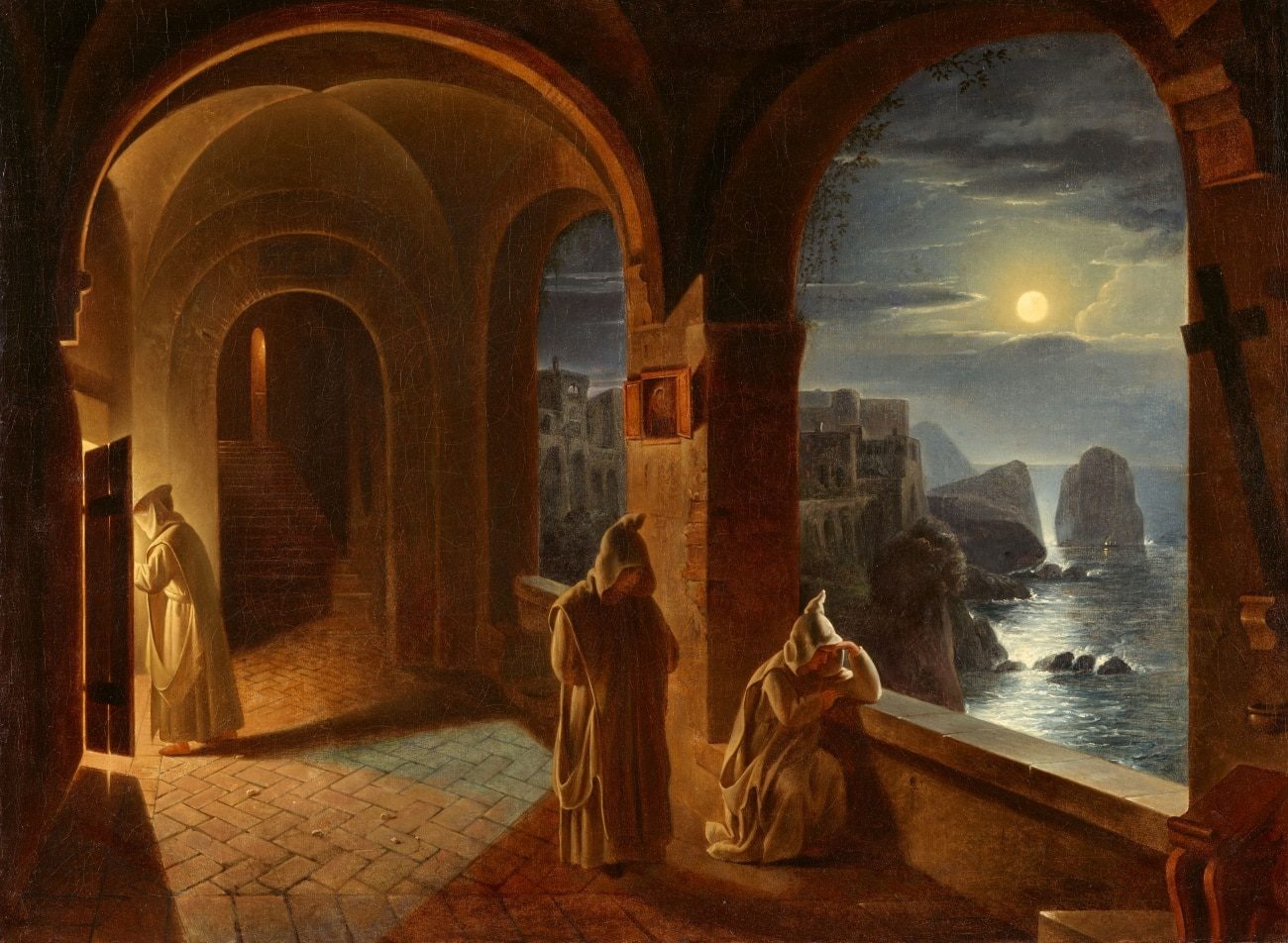
Image: Franz Ludwig Catel, Carthusian monks in Certosa di San Giacomo on Capri