I synthetize an Italian literary critic and historian of literature, of Catholic inspiration, Rocco Montano (+1999).
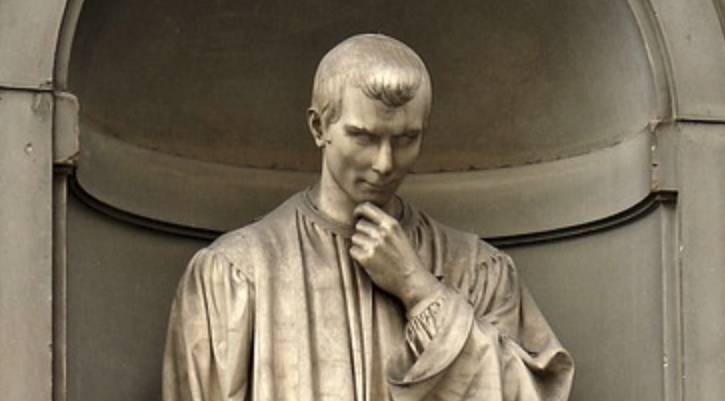
Machiavelli saw only the side of strength in the political world; he didn’t realize the truest foundation of the state, he ignored the popular soul, the enormous weight that are disclosed in every society by the judgment of the good, the moral traditions, religions, and the sense of justice. He believed to follow the “actual reality” of the policy and he missed the substance of it, namely, the fact that societies are based on certain currents of opinion, and on fundamental concepts of right and good, and that there are infinite threads that bind the governed to a ruler and that there is the weight of the past, and the hope of the future.
Machiavelli saw only the beginning of the conquest of power, the most deceitful; he gave a more one-sided, less realistic view of the game of politics. Italian critics – and, among them, Croce and Gramsci, along with all the post-WWII’s critics – did not notice these fundamental limits of Machiavelli’s thought. They continued to refer to him as the discoverer and the most authentic exponent of the political “science”, as of the master of realism, as the irrefutable assertor of autonomy of politics with respect to morals.
It has not been known or wanted seen that the prince can on behalf of him set aside each moral or religious scruple and believe that the politics is a jungle, an arena in which if Caesar does not kill Brutus, Brutus will kill Caesar.
In a real society, conversely, it is necessary to take into account of what makes any action acceptable to most; it is also necessary to evaluate whether the recourse to action is legitimate or justified. The right choices are the ones most likely to be accepted and followed. Moral judgments are antecedent. Men don’t just look after mere self-interest. Nor if the prince doesn’t touch their purse everything is OK. They revolt against injustice, immorality. They fight for freedom, for what they call homeland, religion. They sacrifice life for things that have more than material involvement. Society is not an association of interests, but a union of people who believe in certain principles and want to implement them.
Political writers of the 16th century are invariably divided into two ranks: the moralists and the realists, i.e. the Machiavellian. Certainly, the portrait that Tacitus gives of Tiberius reveals a master of cruelty, cunning, political prowess, deceit and respect to whom Caesar Borgia, which Machiavelli had presented as “imitable”, as a model of the prince, appears like a rough novice.
Counter-Reformation theorists (i.e., St. Roberto Bellarmino) saw, in the Annals, the whole gamut of cunning, iniquitous or not, practiced by Augustus and Tiberius. They knew that in many cases even cruelty, force, and deceit are necessary. But they were far from denying moral principles in politics.
Counter-Reformation’s scholars knew that the prince who violates beliefs, principles, feelings, popular conscience is not only blameworthy compared to the norm religious but demonstrates yet political ineptitude.
But one can find the true overcoming of Machiavelli only in Giambattista Vico. He understands what it is really the state; that is, it is not an association dictated by interest, or, much less, the arena of which Machiavelli speaks – including the cunning, the violent, the unscrupulous men.
Vico states plainly, irrefutably, that in life politics operate and temper, in a dualist manner, material needs and sense of right and religion which, albeit in various ways darkened, are found in every man.
There is neither the pure force, nor the agreement of the interests as one finds in Locke. Unavoidable and fundamental is expressed the sense of law. Above all the issues, there is Providence, the same that sustains the living organism against the dissolution forces, and ensuring the perennity of species.
There are of course always, together, coexistent, the useful and the right. Vico calls, “Epicureans” those who, like Machiavelli and such natural law scholars, such as Hobbes, Locke, Spinoza and, we might add, Marx.
They talk about politics as the result of agreements, clashes of forces, and interests.
It was believed that the line of thought that develops from Lutheranism and Hobbes, Locke, Spinoza, which places a total separation between the political sphere and the ethical-religious dimension, was the “modern” line, the only valid one.
It is preferred ignore that the basis of Luther’s thoughts, of Calvin and all Protestant thinkers (excluding the Anabaptists, against whom Luther unleashed the fiercest war and who totally denied state) is the principle that the rulers, however they are, they are “ministers of God”.
But the thing certainly more important is that, also, this political conception – that one developed after Protestantism and implying a total separation between the sphere of interests, of force, of politics, or of what Marx would call the “structure” and the “religious sphere” – goes against the reality of human nature, which is a unity of spirit and matter, and is very often very far from guaranteeing moral autonomy of the individual, respect for justice and protection of the common good.
The political majorities formed may have no respect for religion, or individual life. When you believe, as the communists do, that economic interests, and social plans are what matters, it occurs then fatally that other rights, of the person, or of the family, or moral life are ignored and trample yourself. The liberal state of Locke and the French Revolution has no strength against fascist or Nazi majorities or the Stalinists one; nor does it have any moral principles with which oppose the advance of aberrant ideologies. Vico foresaw accurately that the naturalistic state is the Enlightenment’s state, like the Machiavellian one, leads inevitably to denial of God, and draws everything in materialism, killing the true forces of society.
A review of this process of political thought – enlightening the gross deficiencies of Machiavellianism and of the enlightened, liberal, secular state, founded on pure relationships of interest, and on a mere regularization of factors, say, social, but that are, in truth, only economic factors, modes of production – should also involve discussing our positions.
There is no standard math to show where the reason lies. Even those who make the biggest historical deformation can claim to be objective. In the case present I think the facts are enough evident. I certainly didn’t mean to state a creed, nor was I bothered about the label of progressive or reactionary that they could apply to me. I think it already is much if in our studies we advance by a little knowledge of the facts without presuming to make us standard-bearers or reduce ourselves to party officials.
Thanks as usual for the hospitality!