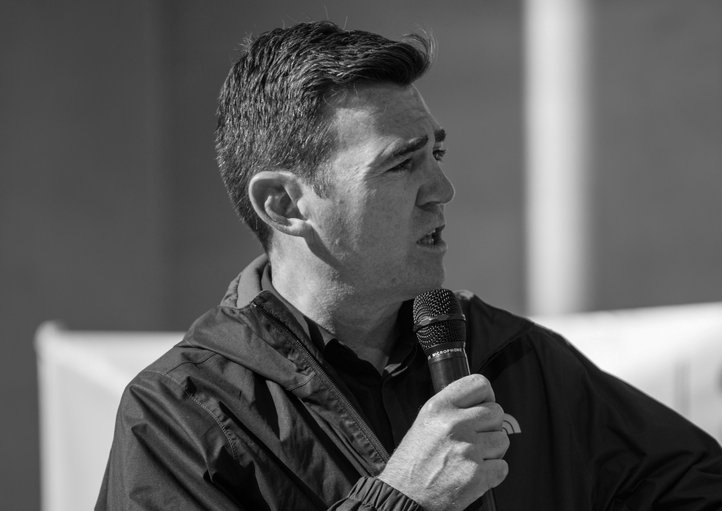
THERE is no question. The scale of Andy Burnham’s victory in Makerfield has come as a severe shock.
Pointing to Reform’s local election victories in Makerfield just a few weeks ago, pollster Luke Tryl said: ‘Even running it close would have been defying electoral gravity, if it’s a clear Burnham victory that’s something quite extraordinary.’
In the event Burnham increased Labour’s vote share in the constituency by 10 per cent, a feat that the BBC’s John Curtice says defied national and historic trends.
A suitably chastened Nigel Farage admitted that it was a vote share that nobody predicted – ironically, I thought, as he had presented his party as the ‘centre right’ replacement. That was his first mistake. If the centre right sell never worked for the Tories, why would it for Reform?
In case you haven’t caught up yet, these are the results:
Labour 54.8 per cent
Reforem 34.5 per cent
Restore 6.8 per cent
Conservatives 2.2 per cent
The only good news was the Green Party’s 300 odd votes.
If the right was ever delivered the message that they need to come together and act together, then this was it.
Burnham spoke one word of truth among his many lies during his ‘I’m one of lads’, black T-shirted, post-victory speeches. ‘Labour came together,’ he said repeatedly, ‘as it always does.’ By stressing this enduring feature of Labour’s ‘political culture’ he underlined exactly what ‘the right’ did not do in this campaign, nor ever does, because it is congenitally incapable of burying differences even if temporarily for the greater purpose.
It is true, however, that Restore’s vote share was not the only reason for Reform’s failure. The numbers show that. Reform, as with the Tories in previous years, failed to seize the moment. Instead of really going for Burnham’s and the left’s jugular over what they have brought this country to they were reduced to deflecting interest from the off-putting and distracting spectacle of Restore snapping at their heels, from Rupert Lowe’s relentless attacks upon them in which Labour must have revelled.
The turnout – 58.75 per cent – described as exceptionally high for a by-election, suggests both Reform and Restore still have a lot of room for engaging the interests of the non and never voters and getting them out.
Reform’s lacklustre candidate did not help. This wasn’t a local election. It was of national importance because it is very likely decide who is to become the next Prime Minister. Robert Kenyon proved incapable of skewering the man behind Burnham’s Mr Nice Guy, I’m one of the lads, image, exposed here by Harry Cole:
It is not as though Burnham’s shallowness and hypocrisy wasn’t all delivered on a plate for Reform UK by TCW. ‘How was a man neck-deep in Labour Together, the same shadow cabal who engineered Sir Keir Starmer’s victory, going to change anything for the better?’ he could have asked.
Kenyon, however much of a genuinely good bloke he is by comparison with Burnham, just didn’t have what it takes. Instead of weakly denying his own ‘sexism’, he could so easily have doubled down on Burnham’s. Why didn’t he vociferously attack the far more egregious form of sexism evident in failing to protect Greater Manchester’s girls from Muslim grooming and rape gangs, and delivering justice for them? This was a line of attack promised at the start of the campaign but not followed through.
Burnham, the man who came to power in Manchester just a couple of weeks before the terrorist bombing of the Ariana Grande concert in May 2017, did little to tackle the pervasive rape gangs infesting swathes of his fiefdom. This is also a man who was also never going to touch the governance of Manchester Arena bomber Salman Abedi’s resident Didsbury mosque. He is a man who rode other people’s waves as private equity and smart investment raised much of the city from its Coronation Street-style knees, as Danny Lockwood starkly set out here.
Instead ‘likeable’ Burnham appeared a strong candidate and Kenyon just seemed weak. Banking everything on fielding a local candidate as one who would connect with the electorate failed abysmally. Next to Burnham Kenyon looked like a boy. That he couldn’t shake off the taint of misogyny from liking some laddish tweets many years earlier (even when the day before the vote the kerb-crawling Hugh Grant came to the constituency to support Burnham) says it all. Also, of course, working in Burnham’s favour was the ubiquitous loathing of Keir Starmer and the belief he will be gone in weeks if Burnham is elected.
If the Makerfield vote is a microcosm of the larger picture, then our next choice is Labour or Labour.
No one should assume, given sticky Starmer’s tenacity, that Burnham is going to ride the wave right into Downing Street, and especially if Burnham promises an immediate general election, risking the loss of Labour’s majority and the livelihoods of Labour’s political career-only MPs who might struggle to make a living in the real world. Starmer has been busy amassing his war chest for the battle with Burnham while attention was focused on Makerfield. He has backers, reports the Times, the organ most friendly toward him. My money is on Starmer winning.
For the right, the question remains whether Farage’s Reform will prove powerful enough to defeat either man on the national stage. Remember a strong (albeit far from charismatic in the flesh) Matt Goodwin lost Gorton to the Greens. What yesterday’s vote should tell everyone on the right is that we are in massive trouble. There will be tough battles ahead to prevent the emerging Labour dictatorship.