If we wish to avoid the culture of death, we need to heed the words of the wisest. We need to use their wisdom to demolish those philosophies which are built on the shifting sands of falsehood. We need to invite Socrates, Plato and Aristotle into our classrooms and into our lives and our libraries.
 Imagine the scene. It’s the first day of classes at a college in New England. The year is 2025. It’s a philosophy course, and into the classroom walks the distinguished professor. His name is Peter Kreeft, and he has arrived to enlighten the drab and dreary minds and to enliven the world-weary hearts of his students. He does so by introducing them to his friend, Socrates.
Imagine that we are a fly on the wall as the distinguished professor begins to lecture. He shows how the ideas of Socrates, Plato, and Aristotle laid the philosophical foundations and built the philosophical framework of Western civilization. He shows how their ideas have stood the test of time and how they challenge and ultimately discredit the ideas of modern philosophers whose erroneous understanding of reality has undermined the foundations and weakened the framework of civilization.
Imagine that we could enter the distinguished professor’s classroom and take his course without ever signing up for classes. We can do so by reading the Socrates Meets series by Peter Kreeft, recently published in an eight-volume box set by Word on Fire.
In opening the pages of each of the eight volumes in the series, we are opening the door to Peter Kreeft’s classroom and entering into the brilliance of the mind of Socrates, the founding father of Western philosophy. In doing so, Dr. Kreeft takes us to an imaginary classroom in which Socrates is the professor and in which modern philosophers are his students.
There are eight students in Socrates’ class. They are Machiavelli, Descartes, Hume, Kant, Kierkegaard, Marx, Freud and Sartre. Each of them is around two thousand years younger than their distinguished professor, give or take a century or two, and each presumes that their understanding of reality is superior to his. One by one, Socrates enters into dialogue with each of them, highlighting their errors, exposing their contradictions and showing how their ideas represent a misreading of reality.
The Socrates Meets series exemplifies the need for the Great Conversation in which the great minds of the past are invited to question the presumptions and prejudices of the present. This is the reason that Chesterton described tradition as the proxy of the dead and the enfranchisement of the unborn, as something truly democratic because it invites all generations to contribute to the wellbeing and wisdom of humanity.
Another great contemporary writer who has championed the Great Conversation is Louis Markos, who has emulated Peter Kreeft in his tireless efforts to enlighten the present with the wisdom of the past. The titles of his works speak for themselves: From Achilles to Christ: Why Christians Should Read the Pagan Classics; From Plato to Christ: How Platonic Thought Shaped the Christian Faith; and, recently published by InterVarsity Press, From Aristotle to Christ: How Aristotelian Thought Clarified the Christian Faith.
Like Kreeft, Louis Markos has an uncanny ability to convey apparently complex and difficult abstract truths with a succinct and accessible brilliance. In this, he follows the example of C. S. Lewis, whom Kreeft and Markos both acknowledge as their mentor. Thus, for instance, each of the titles to the five sections of From Aristotle to Christ begins with the word “how”, indicating that wisdom is a practical path to authentic happiness whereas its absence leads to individual misery and societal collapse.
“Aristotle knew full well that choices have consequences,” Markos writes, “and that the habits we cultivate determine the types of people we become and the kinds of societies in which we live.” Each choice we make changes us, for better or worse, but it also changes our society, for better or worse. “Civilization, especially democratic civilization, is a tenuous thing,” Markos continues. “If we take the blessings bestowed on us by our democracy and use them to pull everyone else down to our level or to demand no accountability for our actions, then we shall be washed away like the foolish builder who built his house on sand.”
If we wish to avoid the culture of death, and the death of culture which it portends, we need to heed the words of the wisest. We need to use their wisdom to demolish those philosophies which are built on the shifting sands of falsehood. We need to invite Socrates, Plato and Aristotle into our classrooms and into our lives and our libraries. We need to learn the lessons they teach. We need to exercise our minds and exorcise the mindlessness. We need to inherit the wisdom of the ages bequeathed to us by the wisdom of the sages.
__________
The Imaginative Conservative applies the principle of appreciation to the discussion of culture and politics—we approach dialogue with magnanimity rather than with mere civility. Will you help us remain a refreshing oasis in the increasingly contentious arena of modern discourse? Please consider donating now.
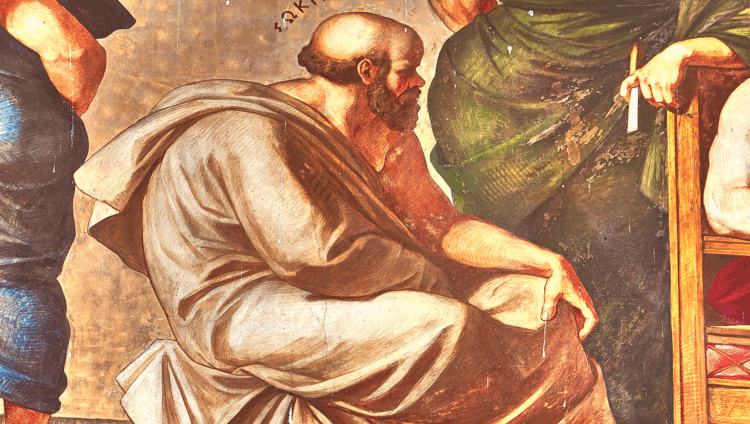
The featured image, uploaded by George E. Koronaios, is “Depiction of Socrates on the facade of the historic building of the University of Athens on September 25, 2021.” This file is licensed under the Creative Commons Attribution-Share Alike 4.0 International license, courtesy of Wikimedia Commons.