***Note from The Tennessee Conservative – this article posted here for informational purposes only.
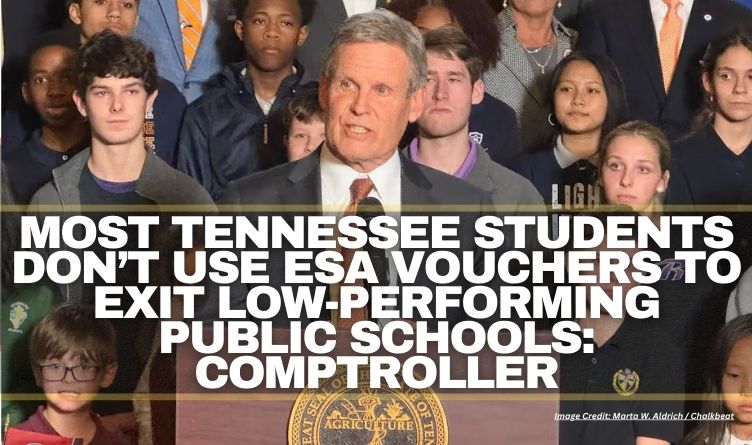
Image Credit: Marta W. Aldrich / Chalkbeat
This story was originally published by Chalkbeat. Sign up for their newsletters at ckbe.at/newsletters.
By Melissa Brown [Chalkbeat Tennessee] –
Most Tennessee public school students who use Education Savings Account vouchers aren’t leaving low-performing public schools, while ESA students overall are underperforming their public school peers in both academic achievement and growth.
Tennessee Comptroller Jason E. Mumpower’s office released these findings Monday in the first comprehensive review of the program.
The comptroller’s report also found that the Tennessee Department of Education has not yet established parameters for removing private schools with repeated low academic performance, nor could it provide documentation “used to measure schools’ performance or counsel schools that have multiple years of low academic performance.”

Republican lawmakers passed the Education Savings Account program in 2019, though legal challenges delayed implementation until 2022. The program was the precursor to the 2025 universal voucher program, which GOP lawmakers are already looking to expand this year after 20,000 students were enrolled last fall.
The ESA program could be limited to 12,500 enrollees under state law this school year, with a cap of 15,000 set to kick in next year. But the program has never been fully utilized, with just 3,693 students enrolled in the current school year.
The ESA program was designed to benefit public school students: First-time ESA applicants in 2022 had to be moving from a public school, entering kindergarten, or transferring into Tennessee from another state.
In 2022, 66% of ESA students came from a public school, and 33% were entering public school.
By the next school year, lawmakers had made a change to “grandfather” some students into the program who had attended public school at least one year since 2019, the year the law was passed. Those students accounted for 31% of ESA students. Overall, 15% of 2023 ESA students were entering kindergarten, 38% were coming from public schools, and 14% had reenrolled in the program.
In 2024, nearly half of all ESA students had reenrolled in the program, 28% came from public schools and 14% were entering kindergarten.
The program was a signature issue for Gov. Bill Lee, who has supported additional school choice policies as a way for parents to choose higher-achieving schools.
The comptroller’s report indicates this is not necessarily happening. The program was targeted at districts with a relatively high number of Priority schools, a federal designation for schools that underperform in certain categories. In practice, that meant the ESA program could only be implemented in Shelby, Davidson, and Hamilton counties, large districts that often have as many high-ranking, or reward, schools as priority schools.
“Most schools that students are leaving to participate in the ESA program are neither reward nor priority schools, which would indicate their performance is neither among the highest or lowest of public schools in the state,” the comptroller’s report states. “When considering schools that have received state and federal designations, more ESA students are leaving reward schools than priority schools.”
This varies significantly by county, though. In Davidson County, 80% of ESA students who previously attended public schools attended schools with A, B, or C letter grades, and 18% of students came from schools that received a D or F letter grade. In Memphis, 58% of students previously attended A, B or C-graded schools.

In Hamilton County, 50% of ESA students previously attended public schools with D or F grades.
The comptroller’s report also found the state education department did not do enough to advertise the ESA program to low-income students, a requirement in state law.
Overall, students receiving ESA money performed worse on the state’s standardized tests than students in public schools, although ESA students outperformed their peers in Memphis-Shelby County schools last year. The comptroller’s report also notes that scores from students receiving ESAs have increased over time.
Meanwhile, virtual schools participating in the ESA program for the first time last year performed worse than both private schools with ESA students and local public schools. Just 20% of ESA students enrolled in virtual schools were proficient in English language arts, and just 17% were proficient in math.
Parent satisfaction with the program remains above 95%, but the comptroller notes only 15% of participating families actually provided feedback on the program last year.
There could be major changes to ESAs this year. The comptroller report suggests lawmakers reconsider eligibility requirements and where the program is targeting, noting other districts like Knox County Schools could be drawn in.
Meanwhile, House Speaker Cameron Sexton wants to eliminate the income limit and enrollment cap altogether for the program and open it up to all students in the current three counties.
This current income cap is 200% or less of the federal income eligibility to receive free school lunch, which would be $83,590 this year for a family of four. Around 76% of families in ESA-eligible counties are already eligible for the program, according to an EdChoice analysis.
The ESA this year provides around $9,747 per student, which fell below the average tuition cost by about $3,000 for participating private schools, the majority of which were religiously affiliated.