The doctrine of new creation is a treasure of our faith, one of our strengths, which sets us apart from other worldviews and philosophies throughout history and throughout the globe. We must not lose it, for it is the source of our hope in a God who creates, restores, and redeems—an active God who is “working still.”
 Of all the elements that made Christianity unique in the ancient world, the doctrines of Creation and New Creation loom large. The idea of God as creator of all things was foundational to ancient Jewish and Christian belief, but it was by no means shared by all ancient worldviews. Other ancient cosmologies saw the world as the work of a demigod (subordinate deity), or as the rubble from a cosmic upheaval between the forces of good and evil. Some Greek philosophies devalued the visible universe as a sort of falling-away from the world of ideal forms. To many ancients, creation—assuming they even saw the world as the result of a conscious creative decision—was flawed from the start.
The biblical story will have none of this. It states that a beneficent God made the world—both “heaven and earth”—out of his goodness and generosity. The Bible makes it clear that God made both heaven and earth, and made them for each other, speaking them into being by his divine Word (logos in the Greek Septuagint and the New Testament). Humanity, man and woman, was made explicitly in God’s image and likeness and was given the commission to steward all the things that God had made. God made himself present and available to humankind in Eden, walking with them in the garden.
Something then happened to spoil the paradise of Eden: the tradition speaks of the fall of man and original sin, unleashing ripples of evil across creation and manmade atrocities across history. But God did not abandon humanity. He made provision for us in our fallenness. Even after Adam and Eve’s exclusion from Eden, the possibility for redemption was already on the horizon.
This redemption is often spoken of in scripture as a new creation, building upon and even surpassing the old. There is a prodigality to God’s actions. Christianity—echoing Hebrew hopes and expectations—posits that the end of our story will be not only identical with but actually better than the beginning. Like the creation, this idea of new creation is exceptional. Many of the old worldviews were inherently pessimistic, seeing history as cyclical and without direction. In these worldviews, things were pretty much as given. Platonic thinkers saw that the body is the center of evil passions, decay, and death. Therefore, “sōma sēma” (the body is a tomb), and our goal is to escape from it into a realm beyond. No inkling of a God that is transforming creation; no hope or promise of renewal of the current order from within. No hint of God actively engaging with his creation, remolding it or using it for new purposes. Certainly, no hope that God could appear in visible, bodily form among human beings to bring them redemption.
The biblical point of view could not be more different. There, the same God who made the world and called it good actively works to repair what is broken and restore what is lost.
New-creational language becomes increasingly frequent in the Old Testament. Writing during Israel’s tragic exile in Babylon, Isaiah prophesies an immense restoration, one that will not only include the liberation of the Israelites and their return home but will have cosmic implications: a “new heavens and a new earth” where “no more shall be heard […] the sound of weeping and the cry of distress.” Isaiah even uses the Hebrew word for “create,” bārā, directly echoing Genesis and making clear that this renewal is nothing less than an ontological fresh start. By means of this new creation, God affirms the goodness of what he has made and the continuing effectiveness and faithfulness of his covenant promise.
The New Testament writings of Peter and John the Divine pick up this theme, echoing it directly and applying it to the coming of the Messiah Jesus. God’s coming in the person of Jesus—the Incarnation—was the launch of the new creation: a truly new thing in the created order. Paul describes the risen Jesus as “the firstborn of the dead”—a kind of “down payment” on the new creation.
During his ministry on earth, Jesus’ healings and wondrous signs were witnesses to the new creation breaking into the old, undoing the effects of evil. On that Sunday morning in springtime when Jesus rose from the tomb, all the goodness and beauty of creation were affirmed. His appearances to the disciples made it clear that he had retaken possession of all his bodily faculties, and then some: creation had been raised to a higher power. Paul wrote of how this gift of renewal passes on to the believer in Jesus: “if anyone is in Christ, he is a new creation; the old has passed away, behold, the new has come” (2 Cor 5:17). And elsewhere he says that “the creation itself will be set free from its bondage to decay and obtain the glorious liberty of the children of God” (Rom 8:21). The sacraments of the church are signals of new creation, in which created things are used in a new way and imbued with a new and Jesus-centered significance. St. Irenaeus wrote of how redeemed humanity will far surpass Adam and Eve in holiness and maturity.
*
As we passed from the patristic to the medieval era, Christian eschatology lost something of its urgency. Perhaps on some level this was inevitable. The earliest Christians were animated by the conviction that Jesus was going to return soon to fully establish his kingdom. As generations and then centuries passed, and it became evident that God had a larger timescale in mind, the emphasis shifted. We settled comfortably into the church/state system, and the spiritual life became a matter of eventually leaving the world behind and “going to heaven.” The three-tiered afterlife, with its system of rewards and punishments, came to dominate Western Christian imagination, influenced by the visions of artists like Dante and Michelangelo. For many on a popular level, Christian faith was no longer about transformation but about doing the right things so as to “go to heaven” and avoid “going to hell.” In a word, we ended up with a kind of moralism: laudable as far as it goes, since it emphasizes right moral behavior, but still falling short of the fullness of the divine promise.
The root problem is that our Western view of faith has all too often been an individualized and over-spiritualized one, in which creation is downplayed and salvation is seen as simply a matter between God and the individual. Our teaching on the future life has tended to emphasize the beatific vision—seeing God face to face, a vision that is unquestionably part of the biblical promise. But scripture also makes it clear that we are to reign with Christ—a very active activity—and that God’s glory is to fill the entire cosmos. Much of our Western art and literature has emphasized life’s transience, but without the compensating promise of future restoration that the Bible also insists on. The doctrine of creational redemption—a notable theme in the New Testament writings and the early church fathers—has been widely forgotten.
And what do we find on the non-Christian side—the modern secular, scientific side? There we find that human life is the accidental product of random physical processes, devoid of transcendent significance. Accordingly, matter can be manipulated at will and to serve humanity’s whims and desires because, ultimately, everything will end in a cosmic burnout. No reverence here for God’s world, no redemptive hope for created things. Instead, everything is to be used as we see fit and then summarily disposed of because it finally means nothing.
Authentic Christian faith calls us to something far better. The doctrine of new creation is a treasure of our faith, one of our strengths, which sets us apart from other worldviews and philosophies throughout history and throughout the globe. We must not lose it, for it is the source of our hope in a God who creates, restores, and redeems—an active God who is “working still” (John 5:17).
New creation is expressed also in the activities in our lives by which we share in God’s creative life. Scientific and medical wonders, whereby matter is transformed for the good of humanity, are works of new creation. So are works of art in which humanity reflects divine beauty, and “good works” of every kind by which we help to overcome the power of evil and build up God’s kingdom. Perhaps now, as history winds down and the kingdom approaches, it is time to remember this precious theological hope and put it into action.
__________
The Imaginative Conservative applies the principle of appreciation to the discussion of culture and politics—we approach dialogue with magnanimity rather than with mere civility. Will you help us remain a refreshing oasis in the increasingly contentious arena of modern discourse? Please consider donating now.
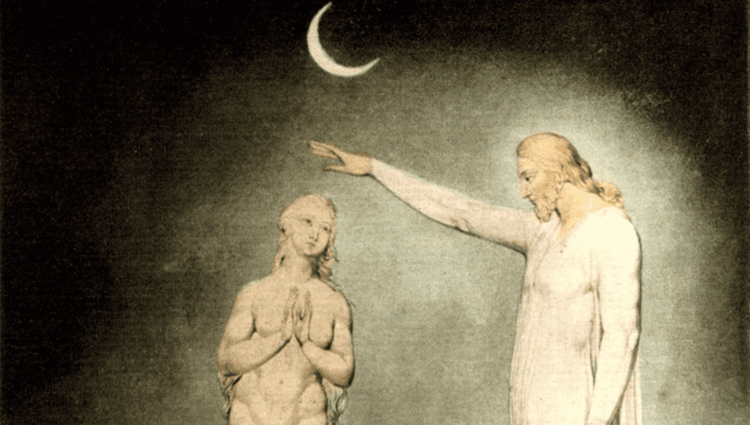
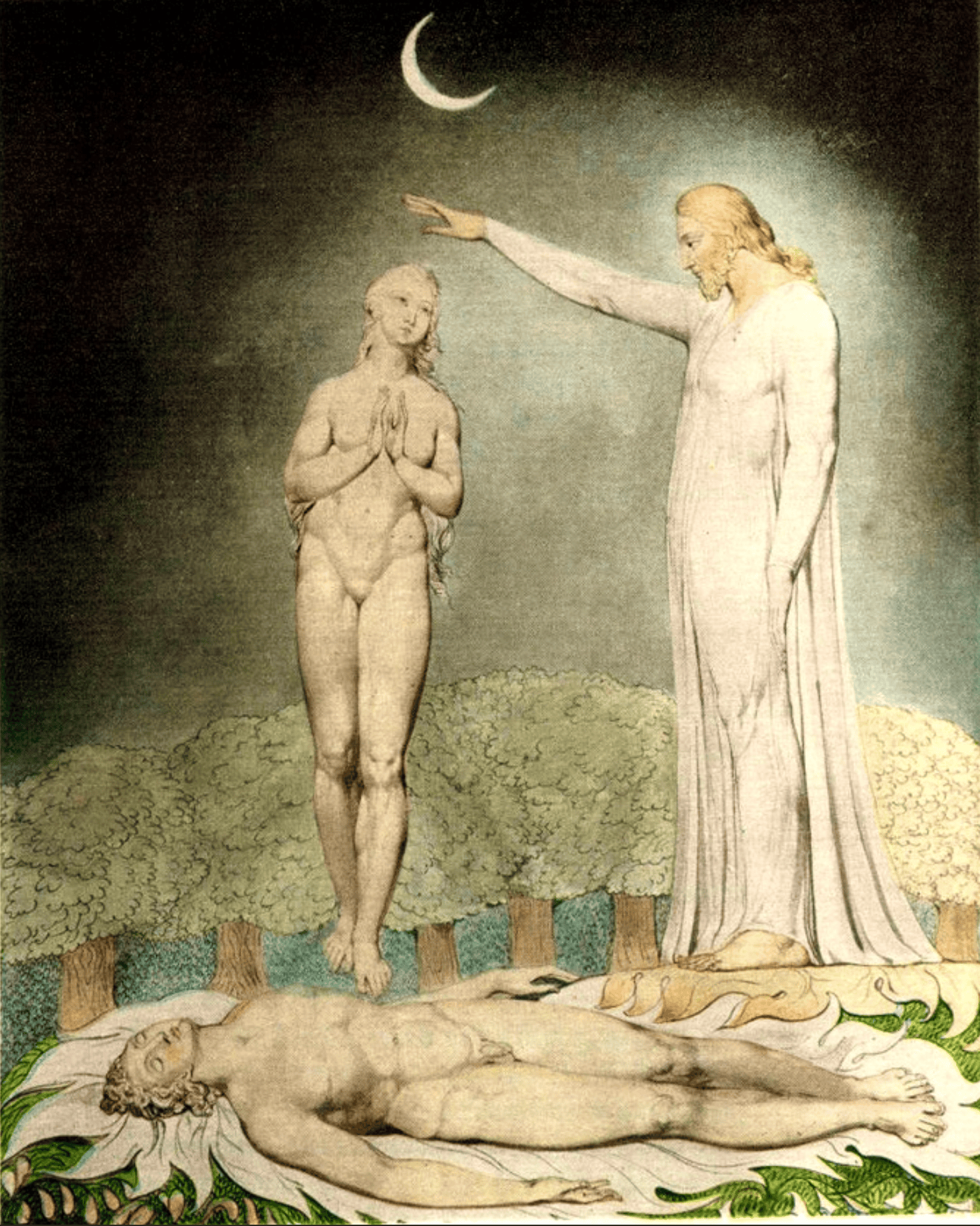
The featured image is “The Creation of Eve” (1808), by William Blake, from his watercolour illustrations to Paradise Lost, Book VII. This file is licensed under the Creative Commons Attribution-Share Alike 4.0 International license, courtesy of Wikimedia Commons.