At the very beginning of the Spiritual Exercises, St. Ignatius writes that they have been written to enable a person “to conquer oneself.” The way this is done is by embracing the stoicism kept at bay in the early Church but introduced into Christianity at the Renaissance.
 When most of our school friends were dreaming about becoming astronauts, high-flying multi-millionaires or rock-stars, my best friend, John Duffy, and I were dreaming about becoming Jesuits. By the time we were eighteen I had enjoyed nine Jesuit retreats, he seven. We loved their no-nonsense, down to earth, straight from the shoulder spirituality that took the stoical spirituality that was inculcated by the secular priests who taught us to a higher level. We were not just committed Catholics, but we wanted to dedicate our lives as active members of the Church Militant. If you want to sign up to fight for Christ then you want to join the spiritual equivalent of the Grenadier guards, the Commandos or the SAS. That is how we saw the Jesuits. While John’s brilliant mind meant that he was always top of the class, my dyslexia meant that I was at the bottom, so when he went to the Jesuit noviciate I went to the Franciscan noviciate, because my older brother who preceded me, had so dazzled his superiors with his academic credentials that they did not bother to ask for mine. When we compared notes at the end of our respective noviciates it turned out to be something of an eye opener for me. It was not so much that our experiences differed, but the Catholic stoicism that we were taught at school was far more intense and far more exacting in the spirituality inculcated in the Jesuit noviciate.
There are some strange anomalies about the Jesuits that took me some time to understand. Ask a dozen of them if their founder was a mystic and they will say yes. But ask them a week later if you should join their congregation because you want to become a mystic, and they will tell you to join some other order, for mystical theology is no part either of their training or their way of life. If I were to name twenty priests who impressed me most then the majority of them would be Jesuits. Priests like Fr Bernard Bassett, SJ who helped me at a key moment in my life, Fr Cliff ord Howell with whom I ran a Parish retreat, Fr James Walsh the editor of the spirituality magazine The Way who told me that it took twenty years before he was ordained a priest. Then there was Fr Lachy Hughes SJ, the canon lawyer with whom I worked for years helping to found a new Dominican congregation gain acceptance with Rome. He rang me to tell me that he had a conversion experience in Medjugorje when he saw the sun “dance in the sky”. He died a few weeks later. Then another great Jesuit was my good friend Kevin Donovan SJ, who used to give lectures on the liturgy for me at Walsingham House the Conference and Retreat centre that I ran in London. He seemed amused that he was an accepted expert on the liturgy, as Jesuits are not normally known for their liturgical fi nesse. He said, if you want to confuse a Jesuit put him in charge of the Easter Liturgy!
Kevin was simply the most pleasant, the most decent, the most affable, the friendliest and the most perfect human being I have ever met. I could go on and on naming more great Jesuits whom it has been my privilege to meet. It led me on to study the Ignatian Spirituality that had formed them in the hope that something of what formed them might help to form me too, but I was to be disappointed. I finally concluded that it was not the Ignatian Spirituality that made them great men, but that great men were attracted to the Jesuits, as John and I had been. Then you had to have something great about you to survive the punishing formation that many of my good friends had called a terrible treadmill. They were great, not because of the spirituality that formed them but in spite of it. They were great men in the making when they joined. When I did manage to read the Ignatian Exercises and the interpretations given by modern Jesuits, I was in for a shock.
The congregation was founded at the height of the Renaissance when the spiritual forces that thrived in the old pagan Empire once more reared their ugly heads and began to seep into the Catholic spirituality that had kept them at bay in the early Church. I am referring in particular to Stoicism, Manichaeism and Neoplatonism, all of which have deeply influenced the Spiritual Exercises. I was saved by my dyslexia, because if I had joined the Jesuits and survived I would have been destined to follow a spirituality developed at the height of the Renaissance which was devised for beginners, recently described as the place where pagan moralism meets Catholic fundamentalism, and where mysticism is replaced by emotionalism. However, with the Jesuits it was always a restrained emotionalism that is often more powerful than when it is overt. Although I always loved the spartan spirituality that inspired me in their retreats I was always a little ill at ease when the retreat master became emotional when speaking about devotions particularly those associated with Ignatian Spirituality.
If, as his followers maintain, St Ignatius was a mystic, then believe me, as a mystical theologian who has studied the subject for over sixty years, this is simply not true. Or to be more precise there is no evidence for this in the Spiritual Exercises that he composed. In fact, all the evidence shows that he was not, at least, when he composed them. It is a spirituality in which human endeavour is paramount, with no knowledge of, or teaching of the mystic way, where love is purified for the Union with God, which no amount of human endeavour can achieve. It is no good saying that there is always the grace of God, when in practice, human endeavour receives all the emphasis. And furthermore, the mystical purification of the heart in the dark night that enables a person to have ever-deeper access to the grace of God in the sacraments, plays no part in their spirituality. Once you have been inspired by the positive sort of “contemplation” that St Ignatius teaches, then it is off into the world to practise “contemplation in action”. This is long before you have been purified for this purpose in true mystical contemplation. Then, rather like all religious revivalists, when the fire begins to simmer down it is back to the Exercises to be reinvigorated once more by practising the art of conquering oneself and to be re-invigorated by the semi-self-generated love that flickers into flame in “active or acquired contemplation”.
At the very beginning of the Spiritual Exercises, St Ignatius writes that they have been written to enable a person “to conquer oneself”. The way this is done is by embracing the stoicism kept at bay in the early Church but introduced into Christianity at the Renaissance by such people as John Colet. As we have already seen, stoicism was put in pride of place in the English education system where it has survived to the present day, most particularly in the public schools. However, in the Spiritual Exercises stoical practices to make oneself holy are far more evident. Let me quote from the words of St Ignatius himself to make my point. If the first two ways of mortifying the body are not enough to frighten you then the third way certainly will. “The third way is to chastise the flesh by giving it sensible pain which is given by wearing haircloth and cords, or iron chains next to the flesh, by scourging or wounding oneself and by other kinds of austerity” (Fr David Fleming’s presentation of the Spiritual Exercises page 56). That is not to mention his strictures on fasting and deprivation of food and other means of mortifying the body that are more exacting than any others that I have ever come across. The Jesuit in the making has to carry beads with him to count how many times each day he has attempted to root out sin, primarily by his own endeavour, helped by twice daily examinations of conscience. Their efforts to uproot evil habits and implant good habits must be written down to ensure that he is always attentive to the task of making himself holy. There is therefore always much food for thought at the twice daily examinations of conscience, in which past failures have to be faced up to, and future successes planned.
That this stoical anthropocentric spirituality is still being used was confirmed by my best friend, John Duffy. He insisted that the way Ignatian Spirituality was taught and practised was exactly the same as it had been fifty years before, as detailed by Dennis Meadows in his Book Obedient Men and presumably, as it was taught and practised by Jesuits from the outset. If in the intervening years it has been changed by introducing modern socio-psychological techniques and depth psychology to enable man to do what is predominantly the work of the Holy Spirit in an authentic Christian spirituality, then it is cause for even greater concern. All would-be Catholic stoics should heed the words of Epictetus the founder of Stoicism. “Show me a stoic if you know one. You will show me thousands who speak like stoics, but let my old age gaze upon one, for so far I have never seen one.”
One thing should be clear to any objective student of Ignatian Spirituality, most particularly as exemplified in the Exercises, and that is that their Spirituality is aeons away from the God-given spirituality practised by the first Christians. Ironically this spirituality, that was the life blood of the early Christians, has been perhaps described better than anyone else by great Jesuit scholars such as Joseph Jungmann SJ, Jean Daniélou SJ, Henry de Lubac SJ, and Hans Ur Von Balthasar SJ, amongst many others who were inspired to return to the early Christian sources by St John Henry Newman. They all helped me and enabled this book to be written. They have enabled me to give the theological dimensions to the study of mystical theology that was in the past almost exclusively described in terms of the psychological experiences of those trying to follow the mystic way. However, because of their inbred antipathy for mystical theology, these great scholars, thanks to their Jesuit training, never understood or taught the theology that teaches how human love is purified by the Holy Spirit in the true God-given contemplation that prevailed in the early Church. When one of my favourite books was published, The Bible and the Liturgy, by Jean Daniélou SJ, it was described, as Louis Bouyer tells in his memoirs, as brilliant but lacking in depth. This review sums up all those great scholars, who taught me so much about early Christianity.
___________
This essay is chapter fifty-six of The Primacy of Loving and is published here by gracious permission of the author.
The Imaginative Conservative applies the principle of appreciation to the discussion of culture and politics—we approach dialogue with magnanimity rather than with mere civility. Will you help us remain a refreshing oasis in the increasingly contentious arena of modern discourse? Please consider donating now.
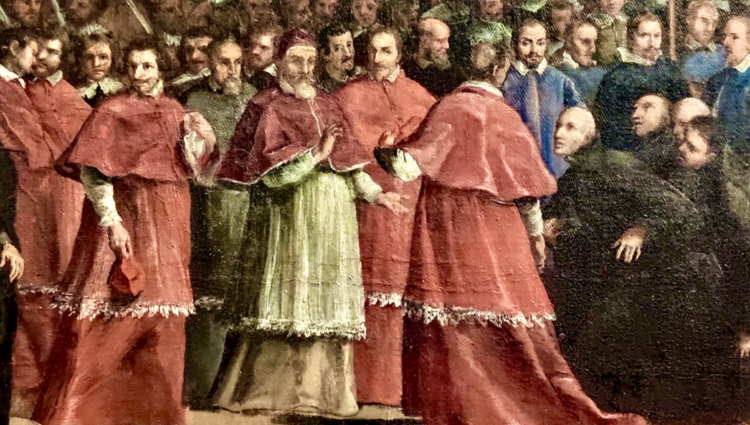
The featured image is “Detail of the main scene from Urban VIII Visiting Il Gesù during the Centenary Celebrations of the Jesuit Order (1641-1642), and is in the public domain, courtesy of Wikimedia Commons.